


Industries · Healthcare · Dermatology
Dermatology SEO and Website Design
I design websites and handle SEO and local search for independent dermatology practices. Each site is built to bring in new patients, and I keep it growing after launch.


How patients choose
Most dermatology patients decide on Google before they ever see your website.
Patients search on Google, look at the map, read a few reviews, and then open the websites of one or two practices. By the time a patient reaches your site, they already have an impression of your practice.
Your website has to confirm that impression quickly. Patients want to see a professional practice they can trust and a clear way to book. Credentials and a list of conditions help, but they rarely tip the scales when a patient is choosing a practice. The practices that keep attracting new patients are the ones whose website and whole online presence give people the confidence to book.


This is why I work on a practice’s Google listing and its reviews along with the website.
“What immediately stood out to us was the use of vibrant colors and the consistency of our branding throughout the site. More importantly, he did an excellent job capturing the vision of who we are, what we do, and what we specialize in at Skin Health Forever. The site clearly communicates our services and makes it easy for patients to understand who we are and how we can help them. For another practice owner considering working with Josh, I would absolutely recommend him.”
Denise Didley · Skin Health Forever
Who this is for
Medical and cosmetic dermatology are different businesses, and the site has to be built for the one you run.
Medical Dermatology
Patients often search with some urgency, about a mole, a rash or a skin cancer screening. They want to know the practice is skilled and can be trusted, and the condition pages do much of that work.
Cosmetic Dermatology
Patients compare practices and often pay out of pocket. The look of the website is part of how they judge the care, so the photography and the treatment pages carry a lot of weight.
Both Under One Roof
Many practices offer both, and the site has to serve each kind of patient. The homepage should lead each one quickly to the right side of the practice, medical or cosmetic.
What a dermatology practice needs to get right online.
- 01
A website that makes clear what you treat and how to book.
- 02
Pages for the conditions and treatments patients search for.
- 03
A strong place on the Google map, where patients choose.
Dermatology Website Design and Patient Trust
By the time patients reach your website, they have already seen your reviews and your location, and often a competitor or two. The website is where that impression holds together or falls apart.
Good dermatologist website design makes it obvious what you do, who you help, and what to do next. When those are clear, the site is easy to use and it feels trustworthy. When they aren’t, people hesitate, and a hesitant patient often leaves.
That starts with how the site is structured, and this is where website design for dermatology differs from a website for a typical small business. A dermatology practice serves patients with very different needs, from a skin check to a cosmetic treatment, and each of them should find the right page quickly. That takes the right pages in the right places, and copy that answers patients’ questions before they call.

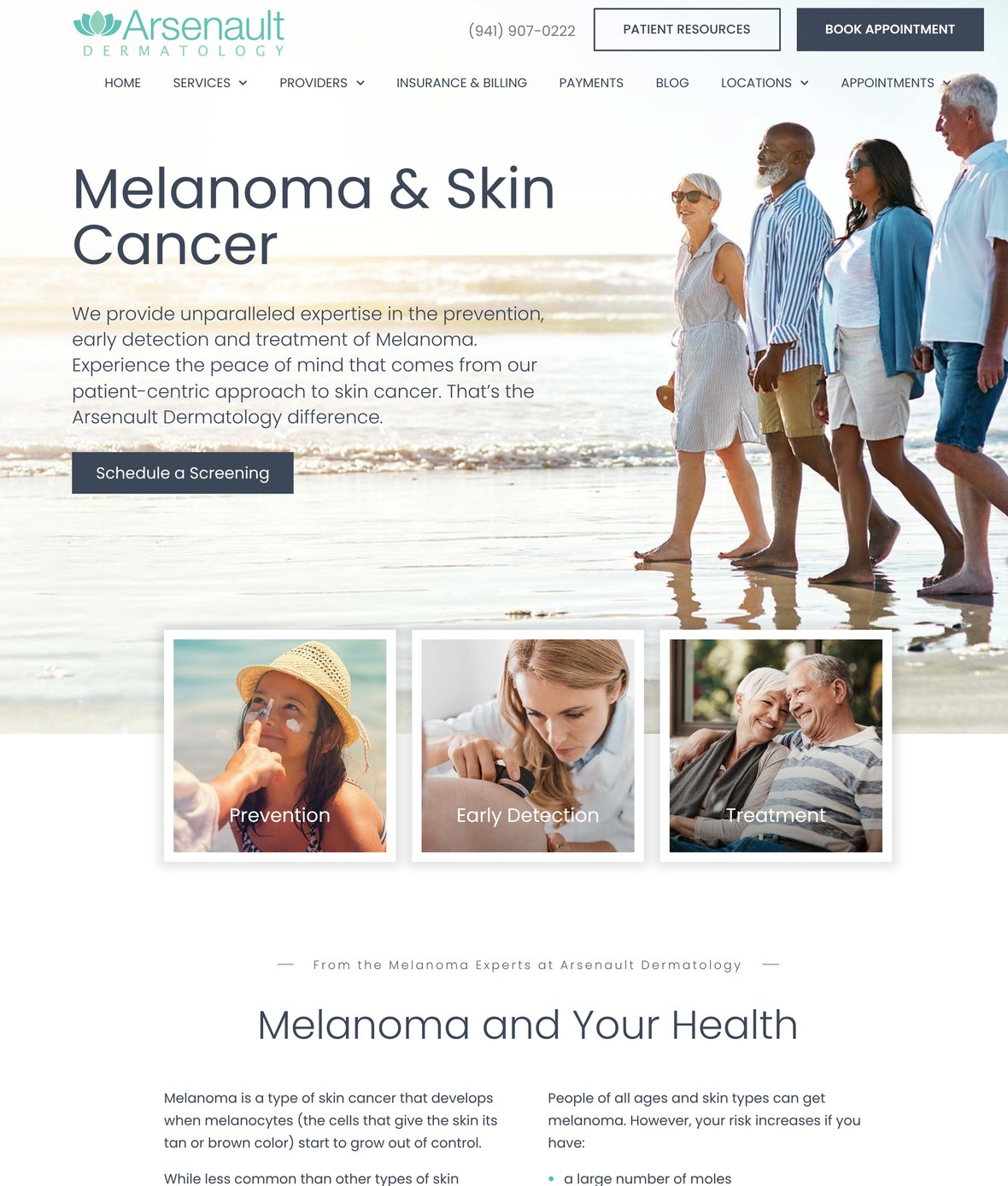
Arsenault Dermatology’s homepage and its melanoma and skin cancer page. See the case study →
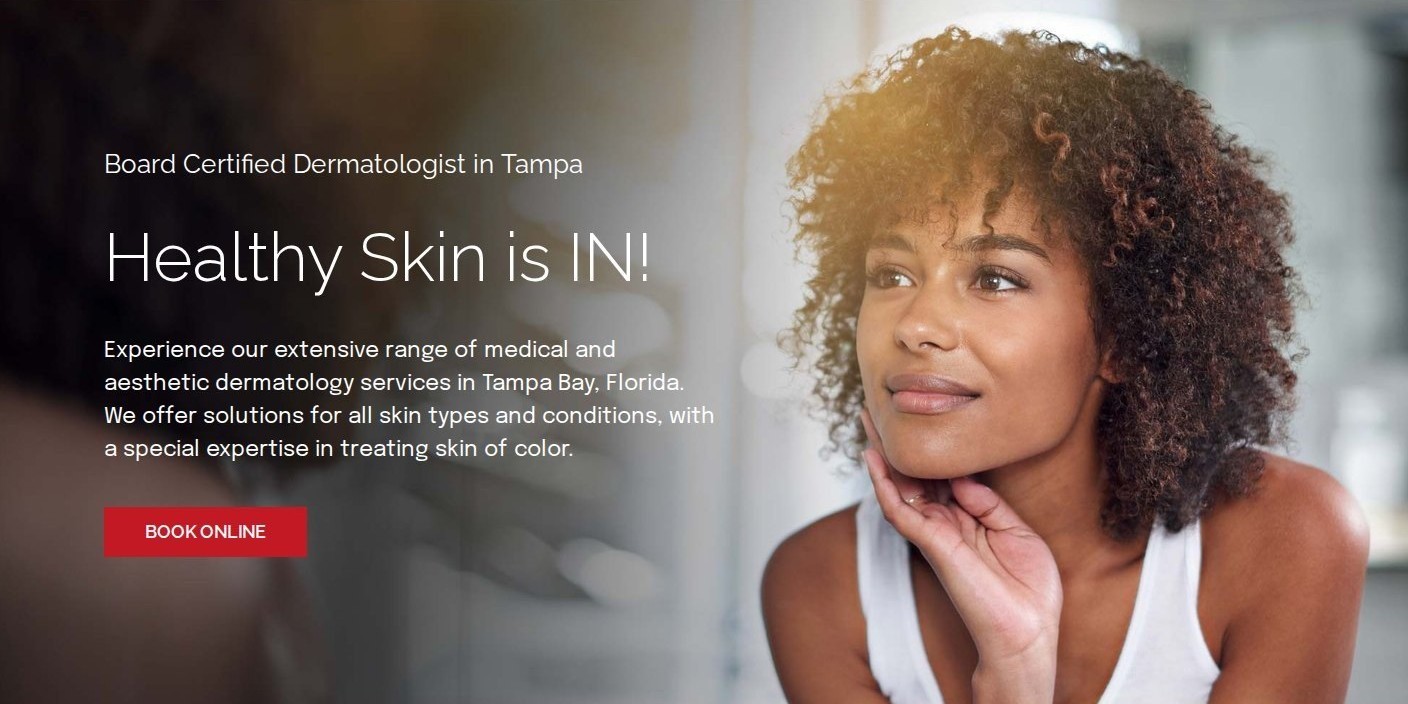
The design should feel like the practice. The look of the site, the photography and the words should give patients an accurate sense of the practice before they walk in, including what it values. Photography carries much of that. Patients want to see people who look like them, and a practice with a specialty, like care for skin of color, can show it before a patient reads a word.

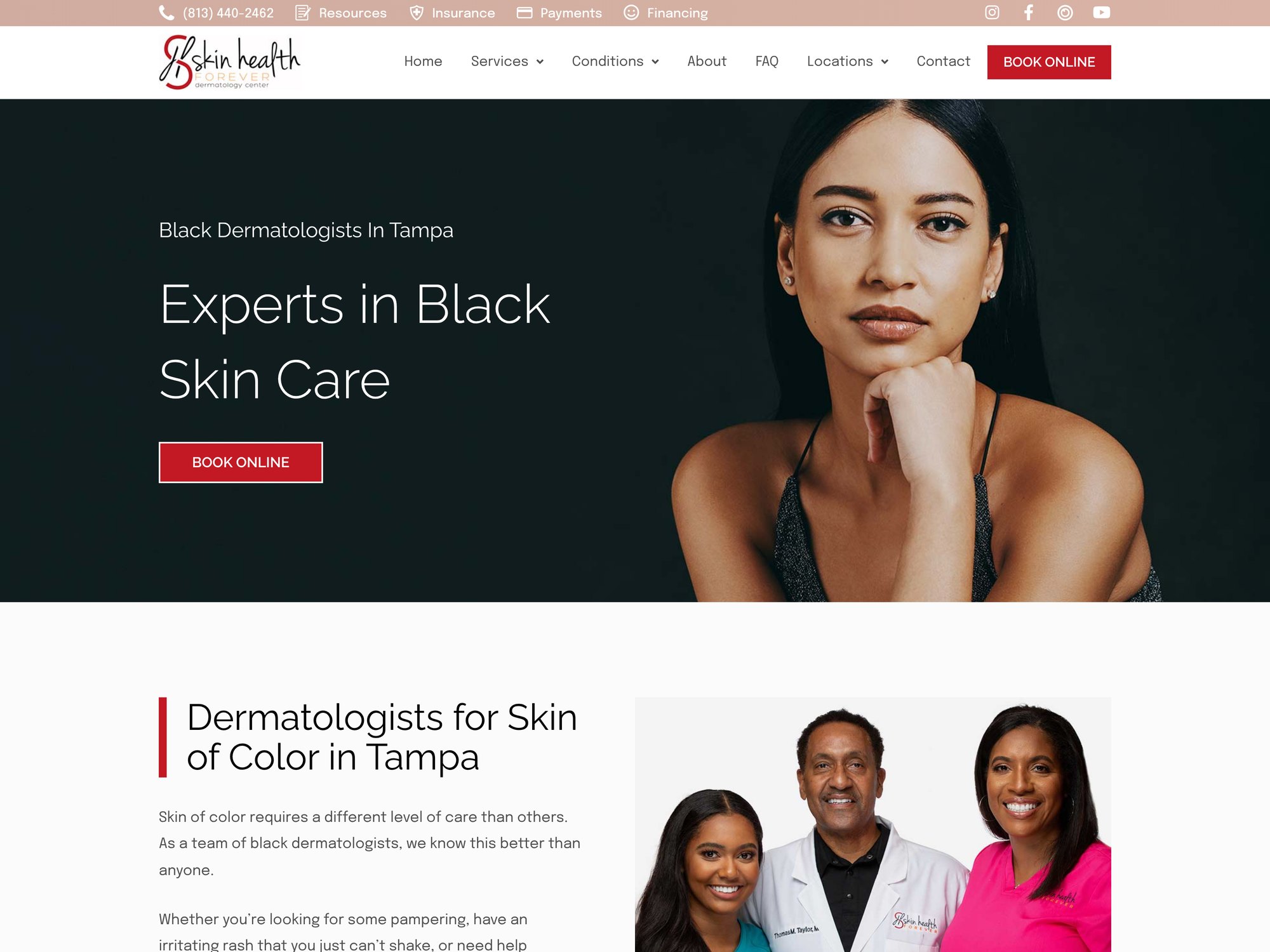
Skin Health Forever’s homepage and its skin of color page. See the case study →
Not every page is there to bring in new patients. Many support the patients a practice already has and the way it runs day to day. New patients fill in their forms online before the first visit. Wound care instructions answer the questions patients have after a procedure, and a provider can send a patient the right page by link. Pages like these save the front desk time and help patients feel looked after between visits. Some of them never show up in Google, and they are some of the most useful pages I build.
I plan the site and write its pages myself, so it is built around how your patients look for care and how your practice runs.
SEO for Dermatology Practices
Most dermatology patients start their search with something specific in mind. It might be a mole that has changed, a treatment they’re curious about, or a sense that they’ve spent too much time in the sun and should get a skin cancer screening. They look for answers first, and then for a practice.
Right now, patients in your area are searching for exactly what you offer. Dermatology SEO puts your practice in front of them while they search, before they know your name. That takes a page for each condition and treatment they search for, written to answer their questions, on a site Google can read clearly.
The method behind it is the same healthcare SEO work I do for every specialty, from how patients search to how the results get measured.
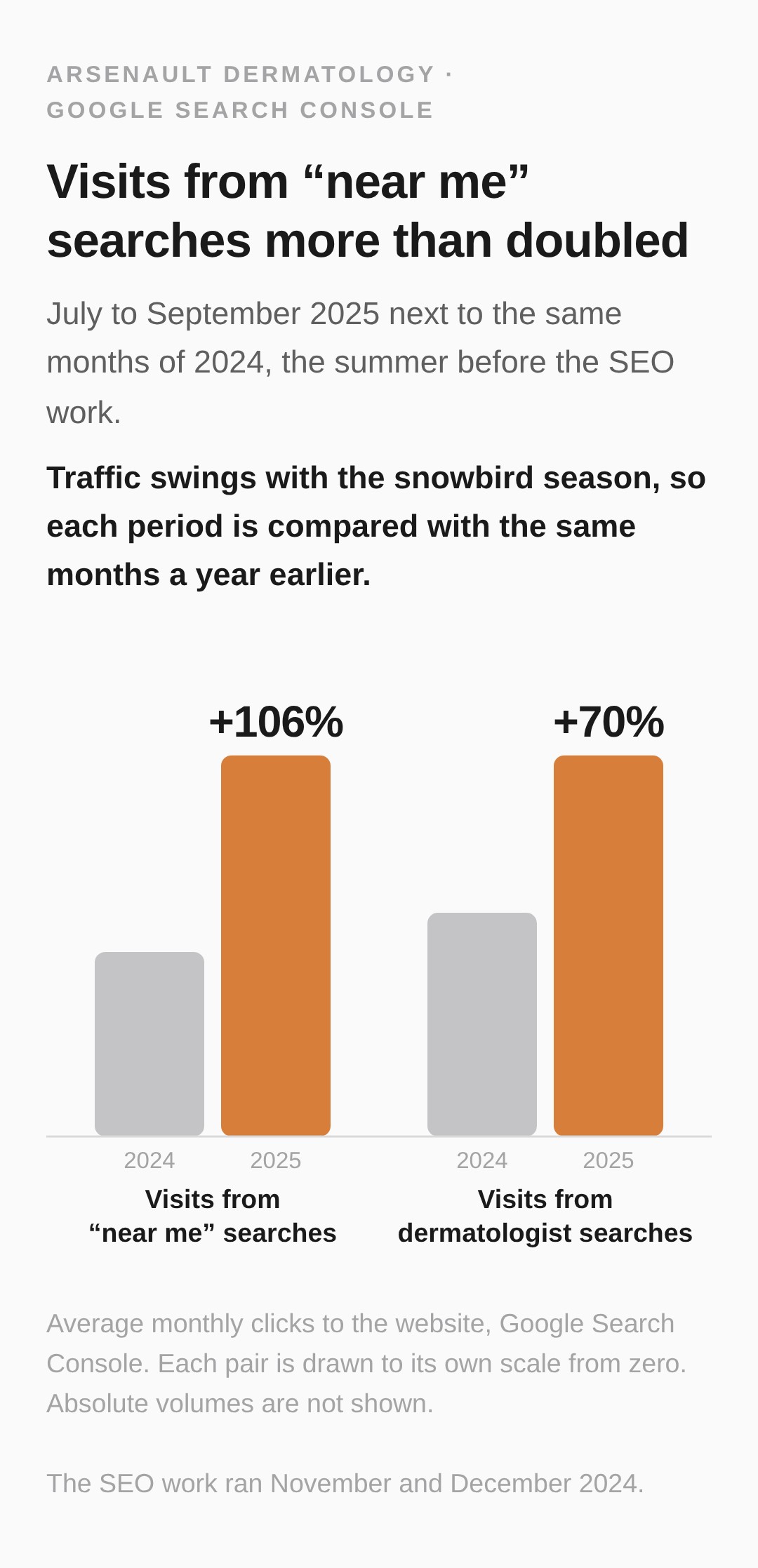
For Arsenault Dermatology, I did a concentrated round of SEO work in late 2024. The next summer, visits to the practice’s website from “near me” searches were up 106 percent, and visits from searches for a dermatologist were up 70 percent.

A practice with a specialty can rank first for searches that name it. Think of “black dermatologist tampa” or “pediatric dermatologist near me.” A well-built page around that specialty helps put the practice at the top. On the cosmetic side, every treatment deserves a thorough page of its own, from Botox and lip filler to microneedling and laser hair removal. Those pages bring in the patients who look up a treatment by name.
I research what patients in your area search for, then write and build the pages that bring them to you.
Local SEO for Dermatologists
For most dermatology practices, the Google map is the most important search result.
When someone searches “dermatologist near me,” or “Botox near me,” they’re usually ready to act. They’re looking at a short list of nearby options, comparing reviews, location, and first impressions before deciding who to contact. Local SEO is what gets your practice into that group and keeps it there.
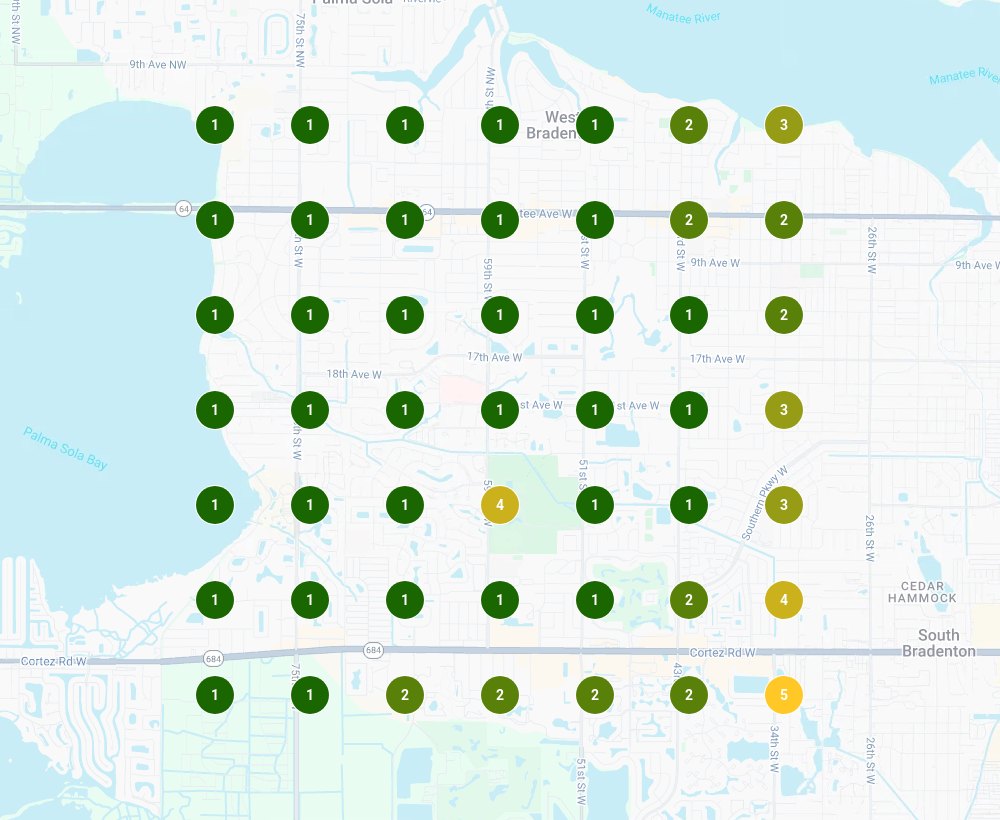

Arsenault Dermatology’s West Bradenton office on the Google map, for “skin cancer screening” and “pediatric dermatology.” See the case study →
It starts with your Google Business Profile: whether it’s complete, accurate, and set up the way Google expects. It extends to the listings for each of your providers, your pages on sites like Healthgrades and Facebook, and how your website reinforces all of it, so everything Google sees about your practice tells the same story.
Most dermatology practices have gaps in at least one of these. Closing them puts your practice in the small group patients actually consider when they’re ready to book.
A dermatology practice with several offices needs a Google Business Profile and a location page for each one, and a new office needs both as soon as it opens.
Every dermatologist in the practice can have a listing of their own, separate from each office’s, and those listings are often created without the practice’s involvement. Keeping them accurate is part of local SEO for medical practices.
I set up and look after all of it for you, from each office’s Google Business Profile to the listing for each of your providers, and I keep it accurate as the practice grows.
Structured Data for Dermatology Practices
Structured data is code that states the key facts on your website in a way that’s tailor-made for search engines and AI tools to understand. It spells out who your providers are, what you treat and where, so they get those facts right. It is written in a shared language called Schema.org, which Google and Microsoft both read, and AI tools can read too.
For a dermatology practice, structured data adds up to a map of the whole practice. A practice can have several offices, a medical side and a cosmetic side, and many dermatologists and physician assistants under one name. The map connects each provider to the offices where they see patients and the conditions and treatments they handle. People understand a map by looking at it. Search engines and AI tools read this one in code, and it is called a knowledge graph.


What a knowledge graph covers for a dermatology practice.
Most dermatology practices have only basic structured data on their websites, usually little more than the practice’s name, address and hours, or none at all. Most of their competitors are in the same place. That is the opportunity.
As AI systems get more capable, they will rely more and more on the code behind a website. A practice that has described itself well is ready for them.
Every website I build comes with a full knowledge graph, and I keep it current as the practice grows. If you already have a website, I have options for adding one. The schema and knowledge graphs page shows how a graph like this is built for a medical practice.
AI Visibility for Dermatology Practices
More patients now take their skin questions to AI tools like ChatGPT, Claude and Perplexity. They ask a full question, like “Should I get this mole checked?” or “Who is the best dermatologist near me?”, and get an answer that names a few practices. The practices named are the ones whose pages, profiles and structured data say clearly what they do.
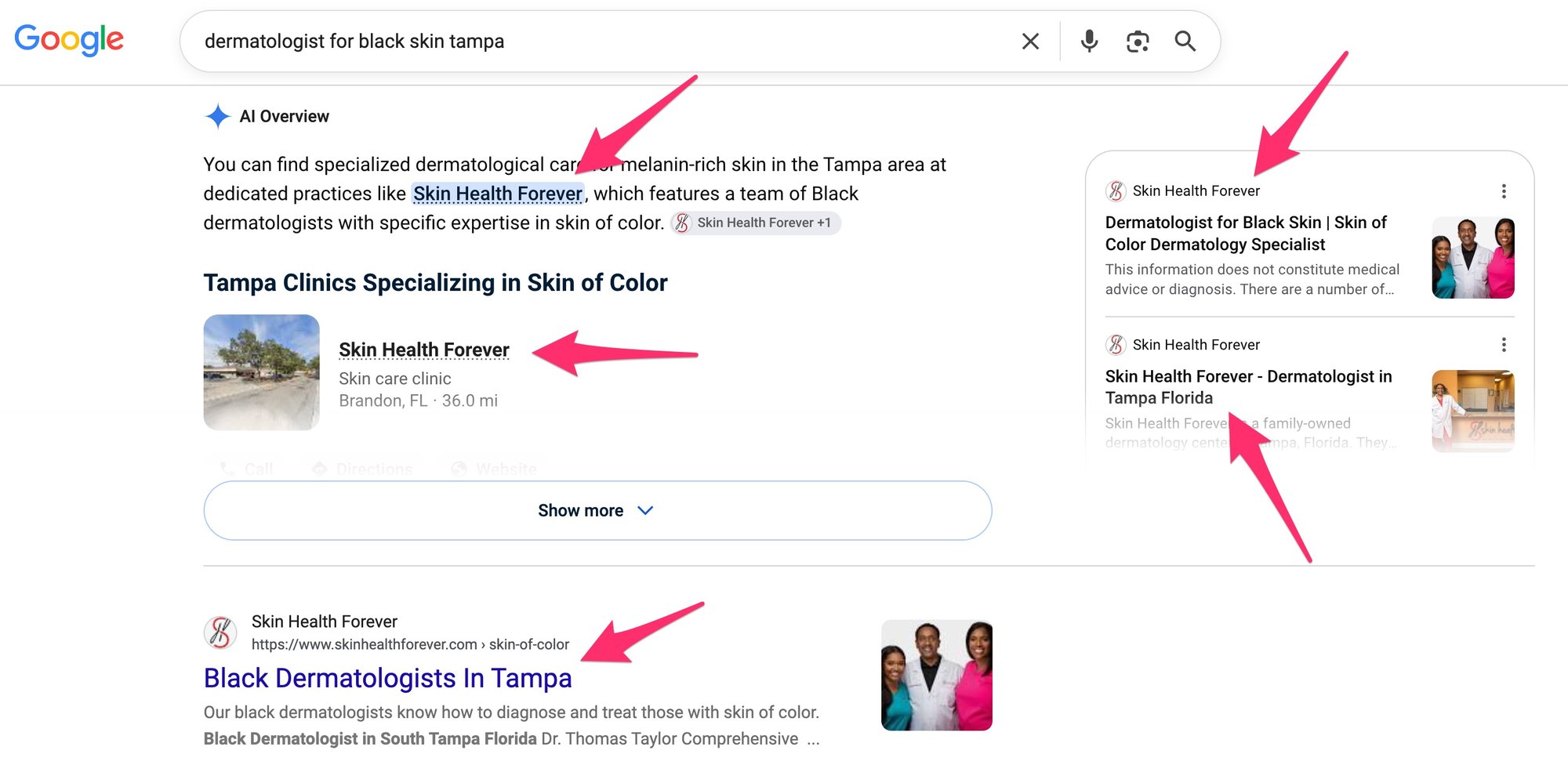
Skin Health Forever in Google’s results for “dermatologist for black skin tampa.” See the case study →
My dermatology clients already show up in AI answers. Search “black dermatologist tampa” and Google’s AI Overview names Skin Health Forever. AI assistants have sent Arsenault Aesthetics nearly nine hundred visits, from almost none in 2024 to dozens a month in 2026.
Starting early on AI search optimization is an advantage. AI search optimization means working on what these tools draw on: the practice’s pages, reviews, listings and knowledge graph. These tools favor practices that are well established online, and that takes more than just having the right pages. It takes time for reviews to add up, for other sites to mention the practice, and for search engines and AI tools to come to trust it. A practice that waits can build the same pages later, but it can’t make up that time. A practice that starts now will also be in a much better position as more patients move from Google to AI.
Searches with a town name or “near me” in them still mostly show the map, so the map is still where most patients choose a dermatologist.
I work on both for you as part of your SEO, and I regularly check how ChatGPT, Google’s AI and other tools answer when patients ask about a dermatologist near you. The AI search optimization page covers how, starting with an AI Visibility Audit.
One Person, Everything Connected
Dermatology practice marketing usually gets split among several vendors. One firm builds the website, another does the SEO, and someone else looks after your Google Business Profile. You end up explaining your practice to each of them separately. Because no one sees the whole picture, the details stop matching. A new physician assistant shows up on the website but not on the Google listing, or an office changes its hours on the website and Google still shows the old ones. Having one person handle all of it is a big advantage, because everything stays consistent. When a provider joins or an office opens, one person updates the website and the Google listings together.
For dermatology digital marketing, that one person is me. I design the site, write the pages, do the SEO and look after the Google Business Profiles, so every decision is made with the rest in mind.
It also gets better over time. I come to know your practice, your providers and how you like things done. You don’t have to explain the background again each time, because I already know it. A short note is enough, and the work gets done.
That is how I work with Arsenault Dermatology. Since 2020 I’ve been its go-to for all things web, from the website and SEO to the Google Business Profiles, and even its print ads. Its staff have sent me more than a thousand requests, and the person who reads each request is the person who makes the change.
Independent practices have a story to tell, and it’s a strength. You may be competing with corporate-owned groups that have marketing departments and large budgets. But you have your own advantage: your character and your place in the community. Patients want a relationship with a practice they trust. Nobody wants to feel like just a number. I help show patients who you really are.
Related
Web design and development
How a site gets structured before it gets designed.
Healthcare SEO
How patients search for care, and the work that answers it.
Arsenault Dermatology
1,000+ requests handled since 2020.
Skin Health Forever
70,000+ visits since launch.
See my work
Every case study, with the evidence.
“We could easily track progress, and edits and updates were handled promptly. That responsiveness has been just as valuable over the years as it was during the original project. For any business owner considering Josh, I would recommend him wholeheartedly. He combines a creative mind with an organized, efficient process and dependable ongoing support.”
Ash Ahmed, R.Ph., MBA · Founder and Owner, MedRock Pharmacy
Dermatology experience
I've worked with dermatology practices since 2020, across both the medical and cosmetic sides of the specialty.

Arsenault Dermatology
Web, SEO, local search, and print for one of the Gulf Coast’s best-regarded dermatology groups, built one piece at a time since 2020.

Arsenault Aesthetics
A new med spa led by Melissa Beachy, PA-C, with its website and search presence built from zero and carried through a rename.

Skin Health Forever
A Tampa dermatology practice whose specialty in skin of color is something you see before you read a word.

Medrock Pharmacy
A compounding pharmacy focused on dermatology, with a logo and a website built for prescribing doctors and their patients.
“It’s my true pleasure to share a few kind words for Josh Miller. He stepped in and helped resurrect a dying website that was rife with programming errors and contradictions trapped in the header and footer. Our load speeds were abysmal and I was honestly not sure whether the site could be saved. But saved it was!
Josh did a bang-up job working with us, correcting errors that could be corrected and providing terrific insight into what needed to be done. We ultimately moved the entire site to a new shell, getting away from the header and footer issues. Everything was seamless.
And, in addition to this technical expertise, Josh is a fantastic graphic designer as well. He recreated our homepage to something much more modern and appreciated. Thank you Josh for your terrific work. Looking forward to many more happy years working together.”
Michael Arsenault, MD, MBA · CEO, Arsenault Dermatology
A few common questions
What dermatology practices ask before we start.
The questions I hear most from practice owners and office managers. If yours isn’t here, ask it on the contact page.
What makes a good dermatology website?
A good dermatology website makes patients confident enough to book. That is what the best dermatology website design does. It needs clear, organized pages that answer the questions each kind of patient has, a look that matches the quality of the practice, reviews and credentials that are easy to find, and a short path to booking.
What are patients actually searching for when they're looking for a dermatologist?
Most dermatology searches fall into three categories:
- Condition-based:
- Patients searching for medical care often lead with the problem. “Eczema treatment,” “psoriasis specialist,” “skin cancer expert,” “dermatologist for acne.”
- Location-based:
- The highest-intent searches are location-driven. “Dermatologist near me,” “best dermatologist near me,” “dermatologist in [city].” These come from patients who are ready to book and looking for someone local.
- Combination:
- Many searches combine both. “Eczema specialist near me,” “psoriasis dermatologist near me,” “Botox near me,” “filler near me,” “laser skin treatment near me.” These are often the most valuable searches on the cosmetic side.
Showing up across all three categories requires different things from your website and your local presence. That’s why the strategy has to account for all of them.
What's the difference between SEO and local SEO for a dermatology practice?
Local SEO is one part of SEO. SEO is the whole job of helping your practice show up in search, and local SEO is the part that deals with nearby searches and the Google map.
The rest of SEO helps patients find you while they research conditions and treatments: “eczema treatment,” “skin cancer specialist,” “what does a dermatologist treat.” It works through the structure of your pages, the quality of your condition and treatment content, and the answers you give to the questions patients have before they book.
Local SEO helps you show up when patients are ready to choose. It decides whether your practice appears in the Google map when someone searches “dermatologist near me” or “Botox near me.” It adds a few things of its own: your Google Business Profile, your reviews, and how consistently your practice details appear across the web.
The two depend on each other. Google checks your Business Profile against your website, and your condition and treatment pages help you show up for searches near you. For most independent dermatology practices, the map is the best place to start, because patients choose a dermatologist within a reasonable drive. But it is one job, done on the same website, and I handle both together.
Do you work with cosmetic dermatology practices as well as medical?
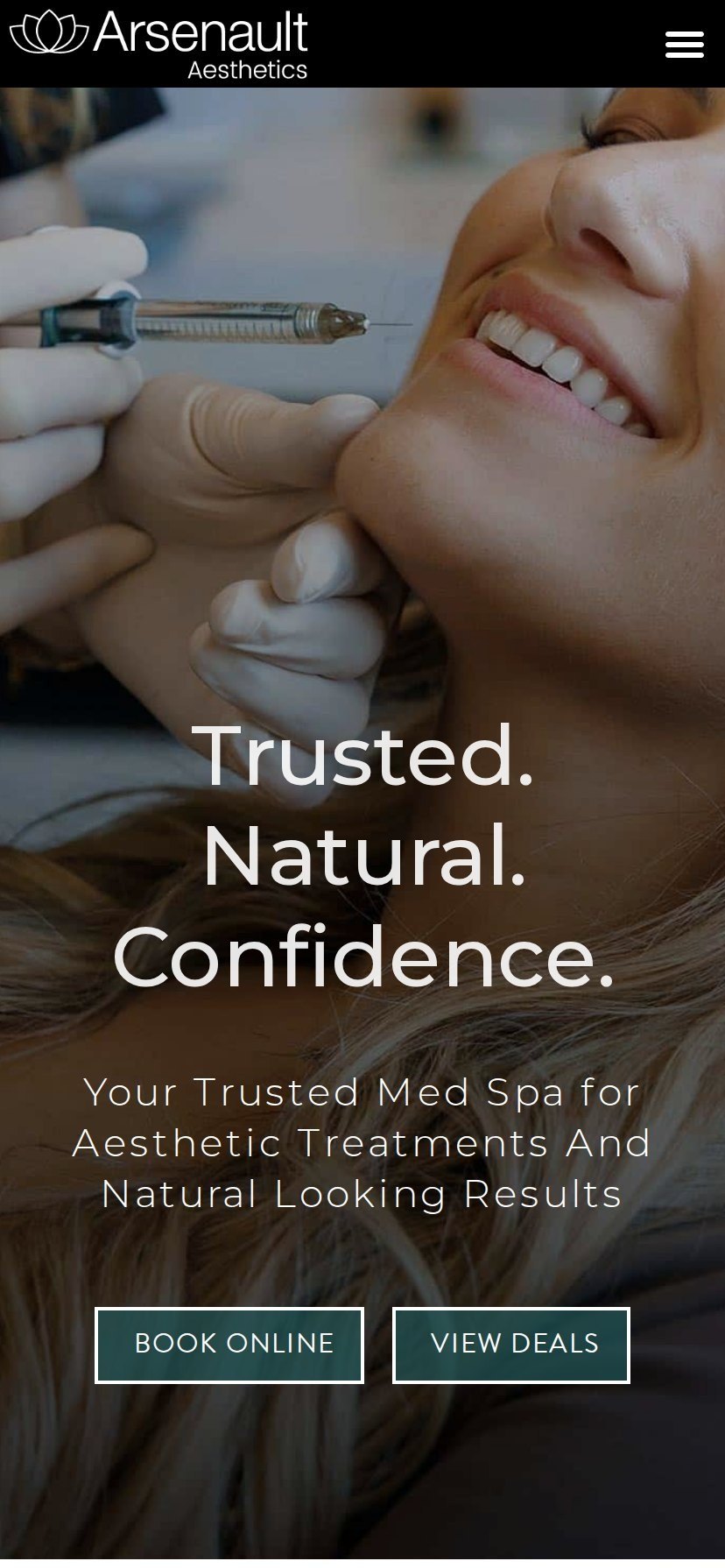
Yes. Arsenault Aesthetics is a med spa whose website and search presence I built from zero, and Skin Health Forever offers both medical and cosmetic care. The two sides need different things from a website, and I build each side for the patients it serves.
How long does dermatology SEO take to show results?
It depends on which type of results you’re looking for, and where you’re starting from.
Local SEO results tend to come faster. Once the foundation is in place, with a complete Google Business Profile, accurate listings on sites like Zocdoc, and proper structured data, most dermatology practices start seeing measurable movement in the map results within three to four months.
Organic search rankings take longer. For most dermatology SEO campaigns, meaningful movement on competitive terms takes six to twelve months. Less competitive terms and long-tail searches often move faster.
The starting point matters a lot. An established domain with existing traffic and a decent site structure moves faster than a brand-new site. A practice that’s never touched its local listings has more ground to make up than one that’s been actively maintained.
For Arsenault Dermatology, the SEO work of late 2024 showed clearly in the numbers by the following summer. The work compounds over time, and a practice that invests consistently in SEO keeps building on it.
What digital marketing channel works best for a dermatology practice?
For most independent dermatology practices, local search and organic SEO consistently produce the most durable results. The patients most likely to book a dermatology appointment are searching with intent, and organic and local search are where they act on it.
Paid advertising can drive immediate traffic, but it stops the moment the budget does. It’s like buying fruit: you pay for every piece. SEO is like planting a fruit tree. It takes time to grow, but once it does, it keeps producing, and you no longer pay for each piece.
Social media builds awareness, but for medical services it rarely leads straight to a booking. People don’t typically see a post and book a dermatology appointment. The exception is cosmetic dermatology, where before/after content on platforms like Instagram plays a role in the comparison process. But even there, the final decision almost always happens on the website or through the map.
How do I market my dermatology practice?
Start with the foundation and work outward. First, a website that makes patients feel confident enough to book, because every other marketing effort ends up there. Second, local SEO: a complete Google Business Profile, consistent listings, and a steady flow of reviews, since the map is where the highest-intent patients decide. Third, content built around the conditions and treatments your patients actually search for, which is what earns organic visibility over time.
Paid advertising and social media can layer on top of that foundation, especially on the cosmetic side, but they perform poorly as substitutes for it. The order matters. Ads bought before that foundation is in place mostly pay for visits that never become appointments.
What is local SEO for a dermatologist, and why does it matter?
Local SEO for a dermatologist is the work that determines whether your practice appears in the Google map when someone nearby searches “dermatologist near me,” a specific condition, or a treatment like Botox. It covers your Google Business Profile, your reviews, your profiles on sites such as Yelp and Healthgrades, and how your website backs all of it up.
It matters because that map is where the decision happens. Most patients choose a dermatologist within a reasonable drive, and the practices in the map pack get the calls. For most independent dermatology practices, it’s the best place to start.
Will you write the content, or do we have to?
I’ll write it. I can write every page from scratch, but I prefer to have your providers’ input when I can, because no one knows your treatments better than they do. That doesn’t mean anyone has to write every sentence. A bulleted list, a few ideas or a list of topics is enough, and I turn it into the pages. Working out the practice’s voice is part of the design process. Early on, I develop a voice with you, or put into words the one the practice already has, and every page is written in it, so the medical pages and the cosmetic pages sound like the same practice. Before anything goes live, I send it to you to review. You can be as involved as you want to be.
Can you work with the website we already have?
Yes. Arsenault Dermatology came to me in 2020 with a website that needed its code cleaned up, and it has grown in place since. Sometimes the right answer is to improve what is there, and sometimes it is a redesign. I’ll tell you which.
Where do you work with dermatology practices?
Anywhere in the United States. I live in the Denver area, and my dermatology clients are in other states. We work together in writing and by video, on a regular schedule, so where your practice is doesn’t change how the work goes. For local search, I check how each of your offices shows up on the Google map for the searches its patients make, like “dermatologist near me” or “skin cancer screening.”
What happens if you're unavailable?
I travel with my laptop, so if something urgent comes up, I can handle it from wherever I am. Your website runs on managed hosting with daily backups and a support team available around the clock, so the technical safety net doesn’t rest on one person. You own your domain, your website and your logins, and if you ever needed someone else to step in, I’d give you everything they need. I typically respond to requests quickly, and some of my clients have been with me for more than ten years. At an agency, the person who knows your practice can leave. With me, it’s always the same person.
Do you work with my competitors?
No. I won’t work with a practice that competes with one of my clients for the same patients in the same area. If you’re my client, I’m on your side, and I want you to win. I do work with dermatology practices in other areas, but never two competing in the same market.
Next specialty
Ophthalmology
More specialties

Get in touch
If your dermatology practice is better than its website shows, I can help.
Tell me what your practice does best and who you want to reach, and we’ll both get a sense of whether we’re the right match.