


Services · SEO · Healthcare
Healthcare SEO
Getting found by the patients who need what you do, and chosen once they find you.
- What Makes Healthcare SEO Different
- How Patients Search for Medical Care
- What My Healthcare SEO Services Cover
- Local SEO for Doctors
- Medical Content for Patients and Search
- Medical Provider and Location Pages
- Structured Data for Medical Sites
- AI Search and How Practices Get Named
- Healthcare SEO for Recruiting and Referrals
- Healthcare SEO Results
- What You Get From Me
- How the Work Happens
- Common Questions
In short
- Most patients a practice gains from search never typed its name.
- Healthcare SEO is a whole-website job, not a traffic job.
- One person handles the design, the content, the local search, and the structured data, so they work as one system.
What Makes Healthcare SEO Different
Most SEO advice is written for other kinds of businesses. It assumes you sell a product, you can advertise it freely, your customers are casually browsing, and more traffic is always better. None of that holds for a medical practice, which is why SEO for medical practices is its own discipline.
Your patients are not browsing. They have a symptom, a diagnosis or a referral, and many of them are worried. They are not comparing prices or features. They want to know whether they can trust you with their health.

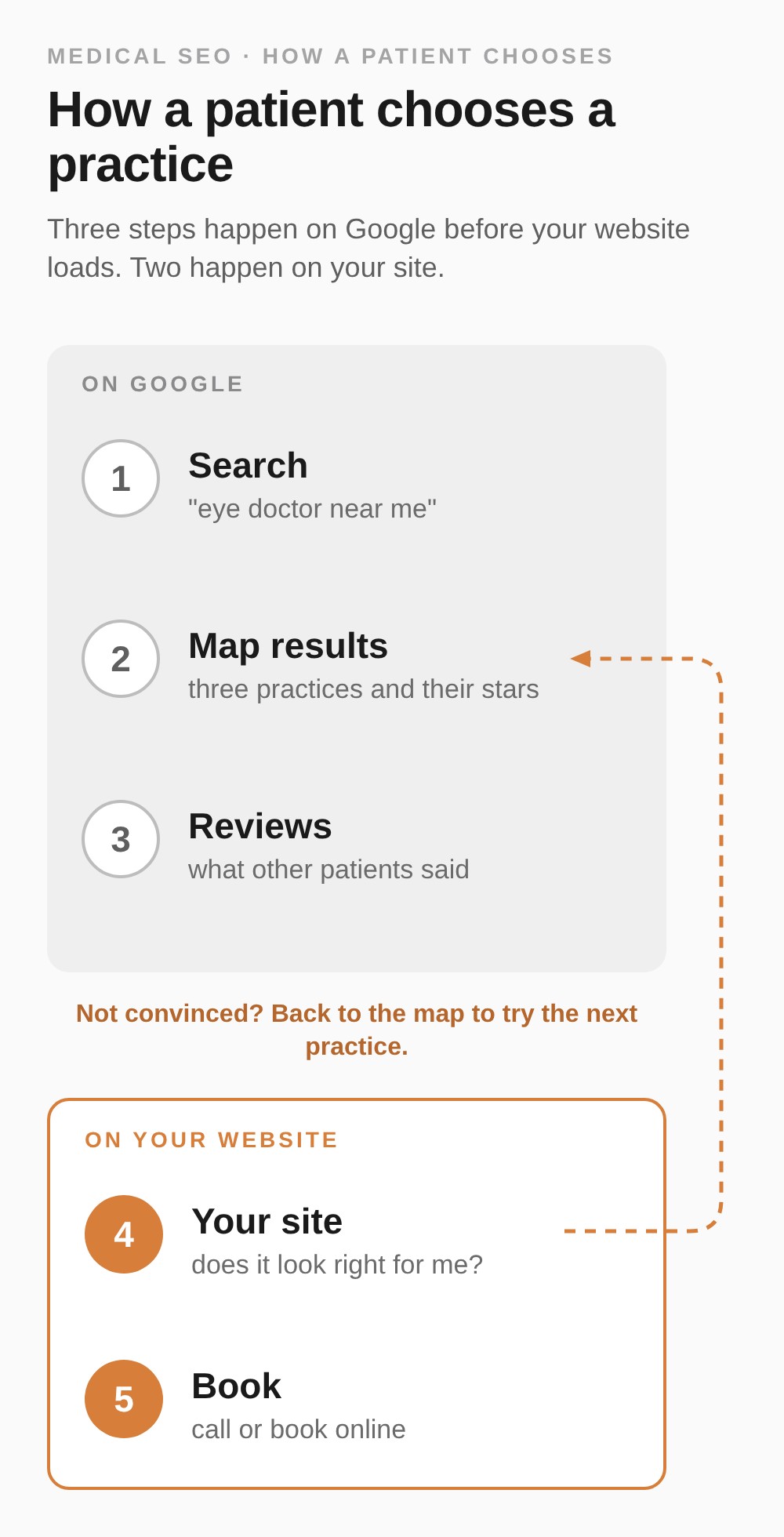
How a patient gets from a search to an appointment. Three of the five steps happen on Google, before your website loads. If your site doesn’t convince them, they go back to the map and try the next practice.
Accuracy matters more in medicine. If a page promises more than a treatment can deliver, patients arrive expecting a result the doctor can’t give. That leads to disappointed patients and bad reviews, and medical advertising rules can turn it into a legal problem too. So every page says only what is true and what the physician is comfortable putting their name to. That works in the practice’s favor, because search engines reward accurate pages.
Ads can’t always fill the gap. Google and Meta restrict or reject ads for many kinds of medical treatment, and some cash-pay practices can’t advertise at all. For a functional medicine practice that prescribes bioidentical hormones, showing up in Google’s regular results isn’t one option among several. It’s the main way new patients find the practice.
You’re up against bigger players. An independent practice competes with large groups that have their own marketing departments, with hospital systems that rank high on Google almost automatically, and with directories like Healthgrades and Zocdoc that often show up above everyone. You won’t win by outspending them. You win with a website that explains what your practice does more clearly than theirs do.
How Patients Search for Medical Care
The single most useful distinction in medical SEO is between people who already know you and people who do not. Someone who types your practice name into Google already knows you exist. Someone who types “retina specialist near me” or “macular degeneration treatment” needs exactly what you do and has never heard of you.
The second group is where new patients come from, and it is usually most of the traffic.
For Arsenault Aesthetics, a med spa client of mine, clicks from searches that didn’t name the practice went from 25 a month to 1,297.
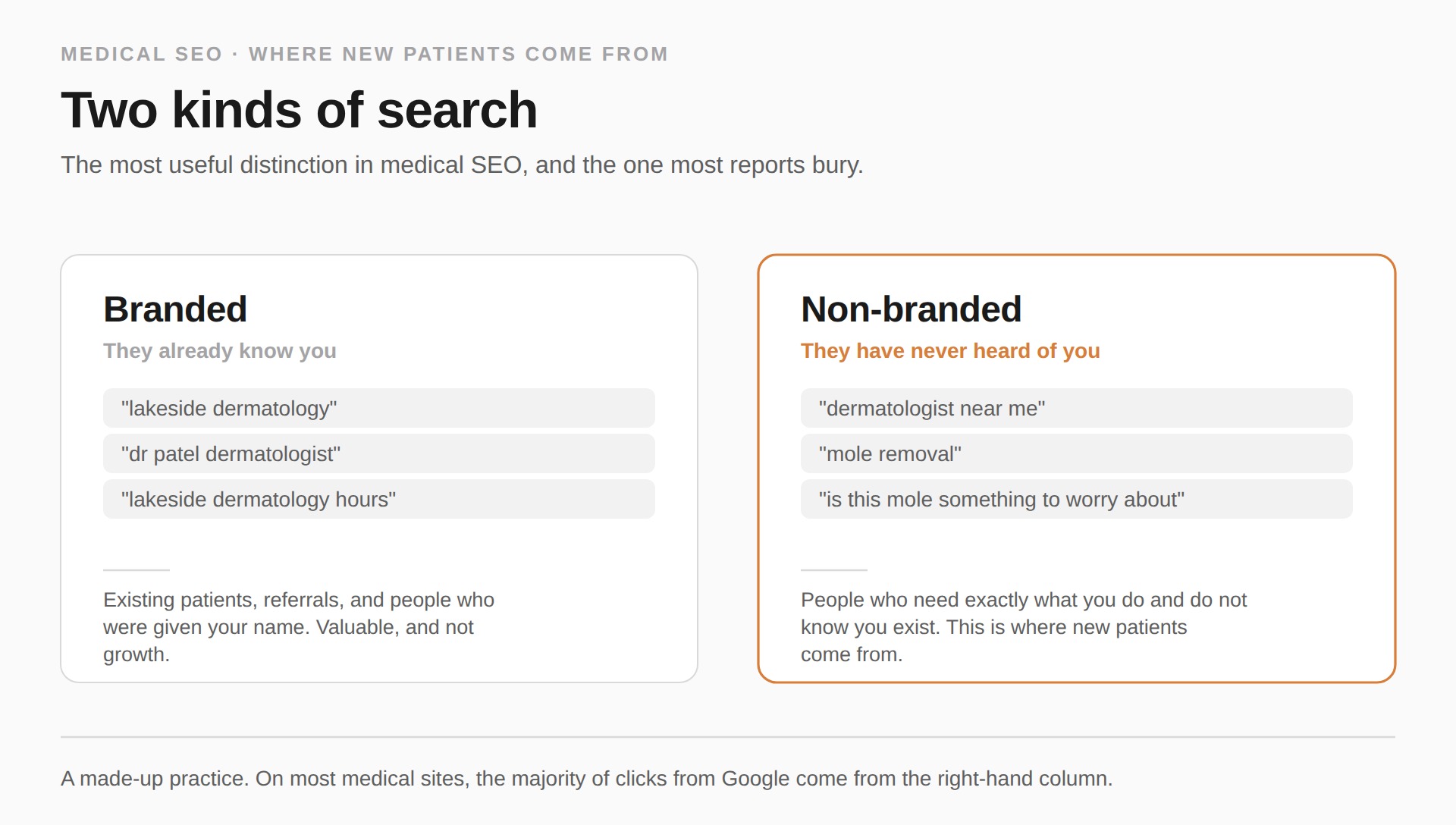

A made-up practice. Non-branded searches are where new patients come from, and most reports bury the distinction.
Those searches are the ones to watch, and most reports don’t lead with them. A site can add thousands of visits from people who will never book an appointment. The visits that count come from people who need what you do and are looking for someone to do it.
The Healthcare Searches That Matter Most
Some searches are worth many times what others are worth. A search with “near me” in it, or the name of a nearby town, comes from someone who is close to deciding.
For the same med spa, searches like these rose 146 percent in a year, and online bookings rose 43 percent.
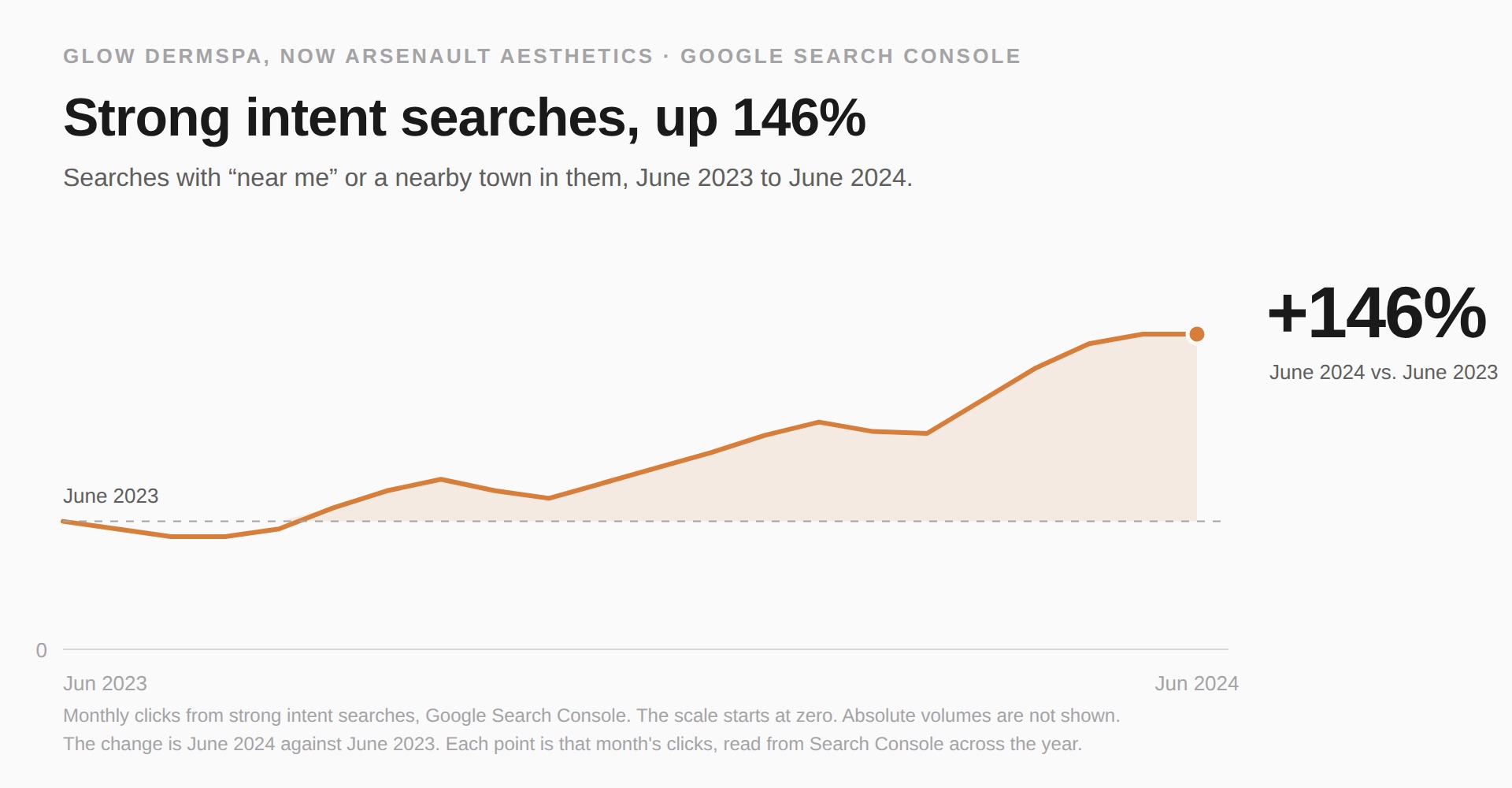
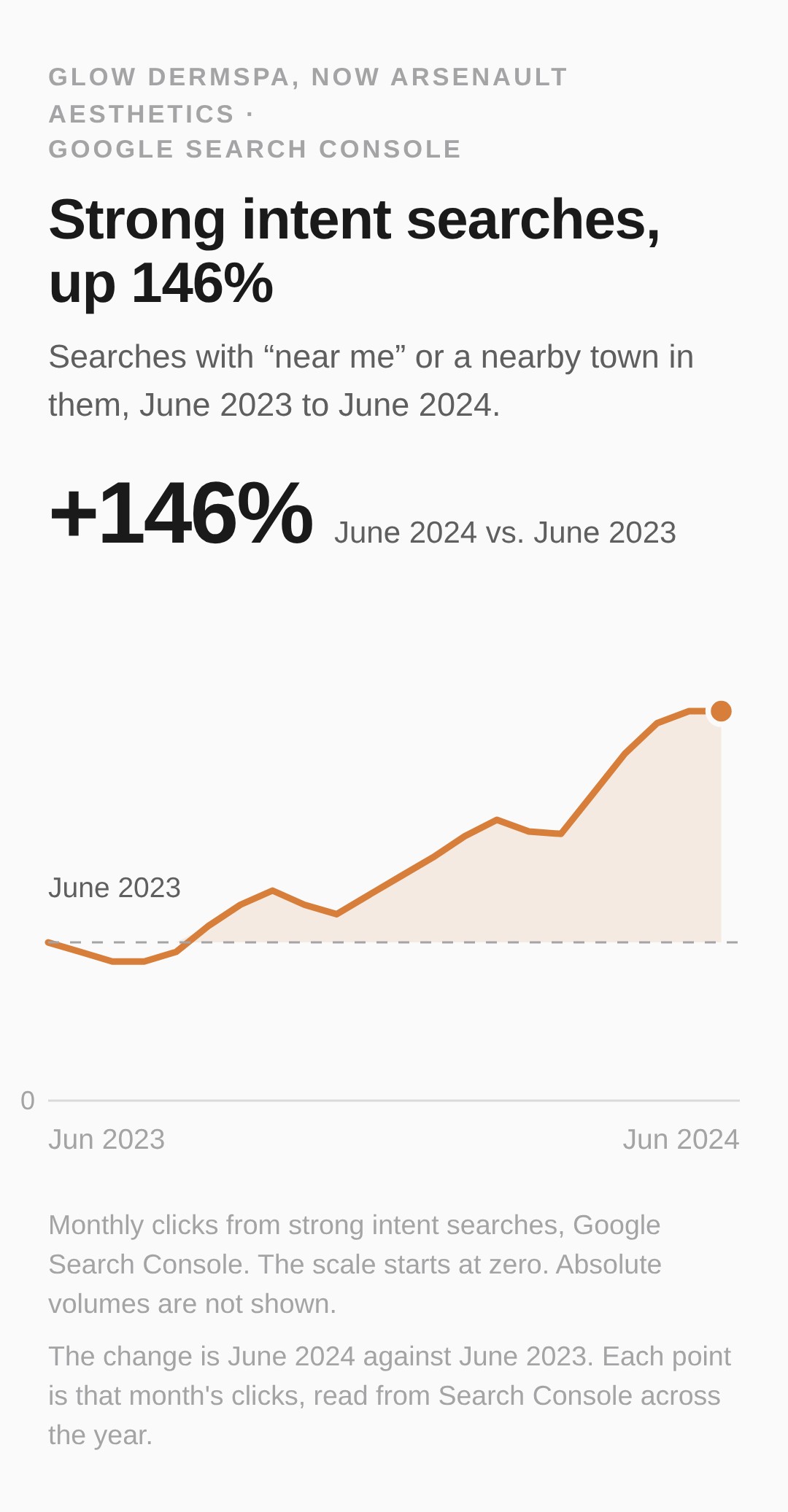
The med spa’s searches with “near me” or a nearby town in them, June 2023 against June 2024.
Searches for a specific condition, treatment or drug are valuable too. Someone searching for one is often further along than someone searching for a specialty.
Condition and symptom searches reach further than you expect
Patients search for what is happening to them, not for what you call it. They search for black spots in their vision before they search for a retina specialist. They search for whether they can drive after an eye injection. They search for what a mole looks like when it is a problem.
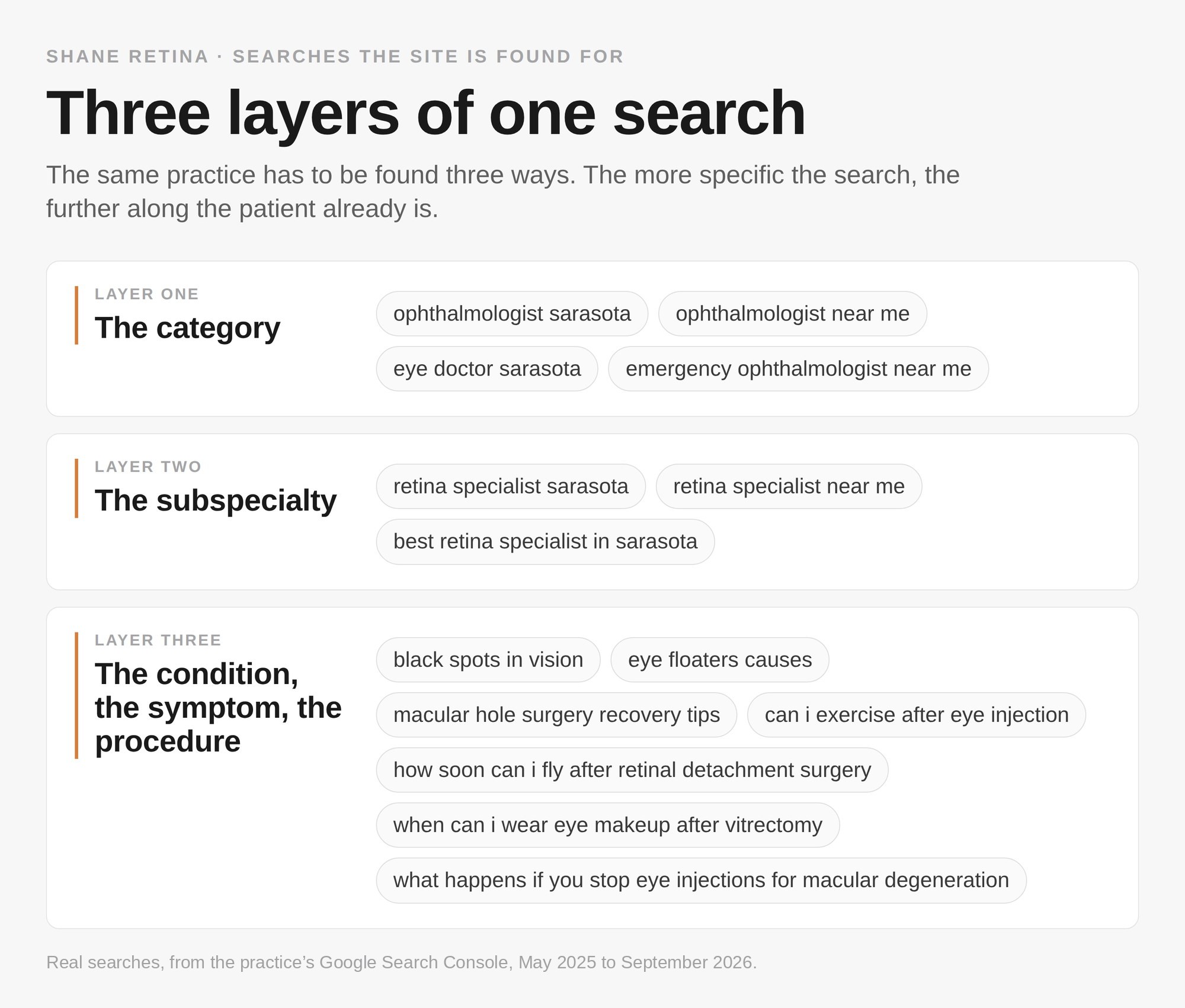
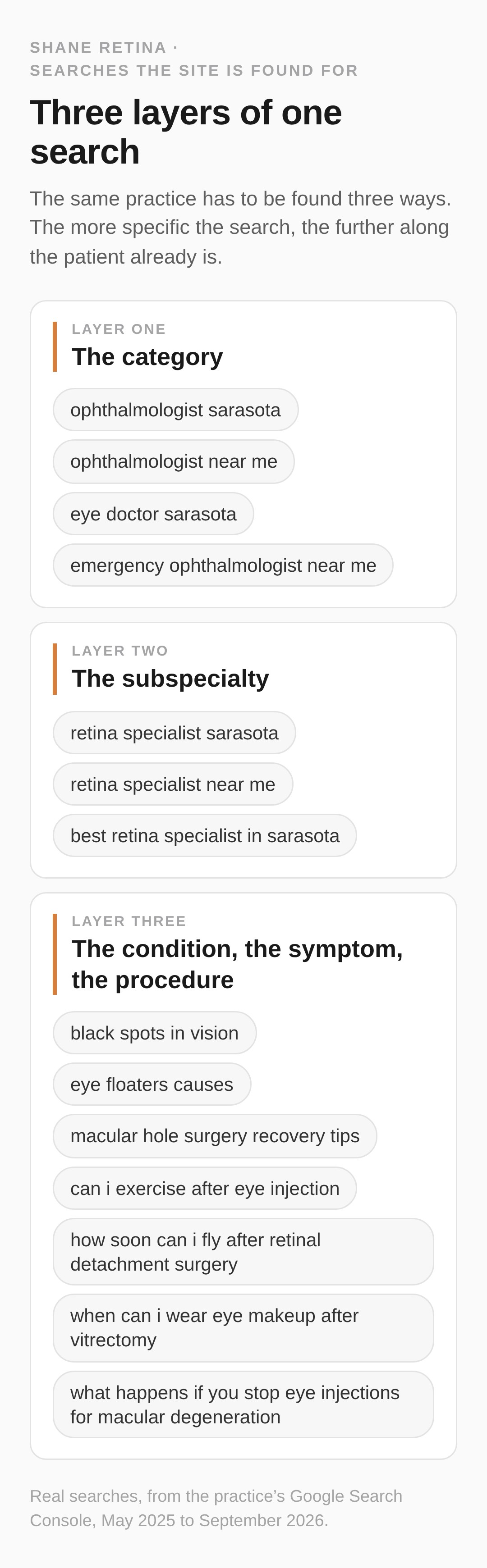
Real searches the Shane Retina site is found for, from its Search Console. The same practice has to be found three ways.
A specialty search can beat the general one
A practice with a real specialty is often better served by owning the specific search than by chasing the broad one. Skin Health Forever, a Tampa dermatology practice with special expertise in treating skin of color, is the first result in Tampa for “black dermatologist,” on the map and in the organic results. Its skin of color page alone has brought more than 17,000 new visitors to the site.
The general search has more volume. The specific search has the patients.
Not every patient chooses
In some specialties the patient is not the one deciding. Most radiology is physician-directed: the patient goes where the referral sends them. A compounding pharmacy like Medrock Pharmacy is chosen by the dermatologist, not the person filling the prescription.
That does not make the website less important. It changes who it is for, and what it has to do. More on that below.
What My Healthcare SEO Services Cover
Healthcare SEO is not a service bolted onto a website. It is most of what the website is. Whether you call it medical SEO, healthcare SEO, or SEO for doctors, here is what I do for a practice.
Getting Your Practice on the Map
Your Google Business Profile, your listings, your reviews, and the page behind each office, so that a patient searching nearby finds you.
More about getting your practice on the map →
Writing for Patients, and for Search
Condition pages, treatment pages, and answers to the questions patients actually ask, written accurately and checked by your physicians.
More about writing for patients and search →
Medical Provider Pages and Location Pages
A full page for every physician and every office. They are the most visited part of a medical website and usually the most neglected.
More about provider and location pages →
Structured Data for Medical Sites
The code that tells Google and AI systems who your practice is, who your providers are, and what each page covers.
More about structured data →
AI Search, and How Practices Get Named
Watching how AI tools answer the questions your patients ask, and building the site so those tools have the facts to describe your practice correctly.
More about AI search →
The Structure of the Site
Which pages exist, what each one is for, and how they connect. A practice that treats many conditions in several offices needs a page for each, not one services page listing everything.
The Technical Side
Speed, mobile rendering, clean URLs and redirects: the technical details that let Google read a good site properly.
Speed and security work →
Measurement, and What to Do With It
Tracking which searches bring in patients, and telling you in plain language every month.
Everything a Growing Practice Throws at a Website
Practices add offices, doctors and services, and some change their names. I plan the website for those changes before they arrive.
Local SEO for Doctors: Getting Practices on the Map
For most practices, the map is where the decision happens. A patient searches, a map appears with a handful of nearby options, and the practice that is not in that group is not being considered.
Getting there and staying there involves your Google Business Profile, your listings across the web, your reviews, and the pages on your site that sit behind each office. It is a discipline of its own, and I have written the whole of it out on a separate page: how local SEO actually works.
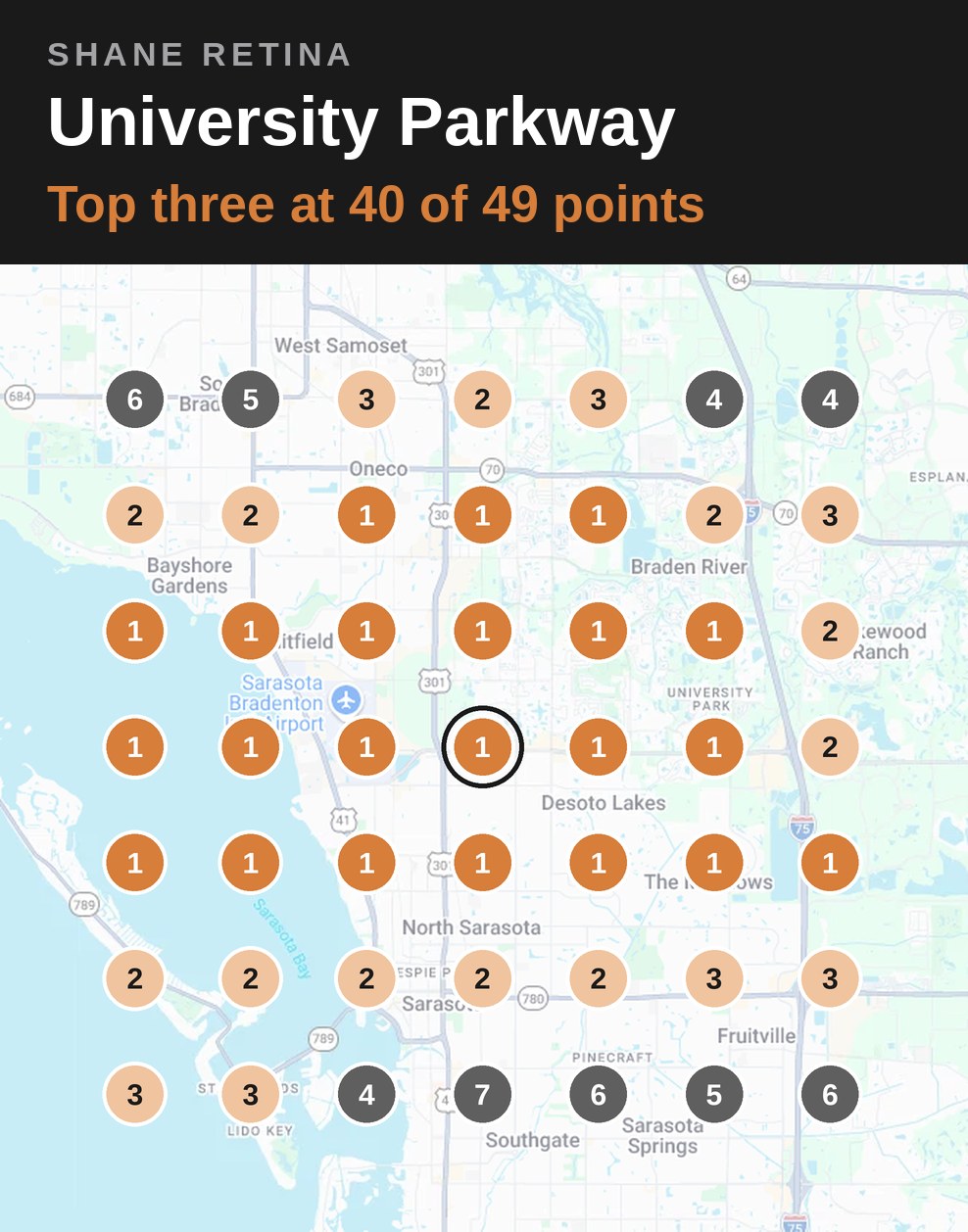

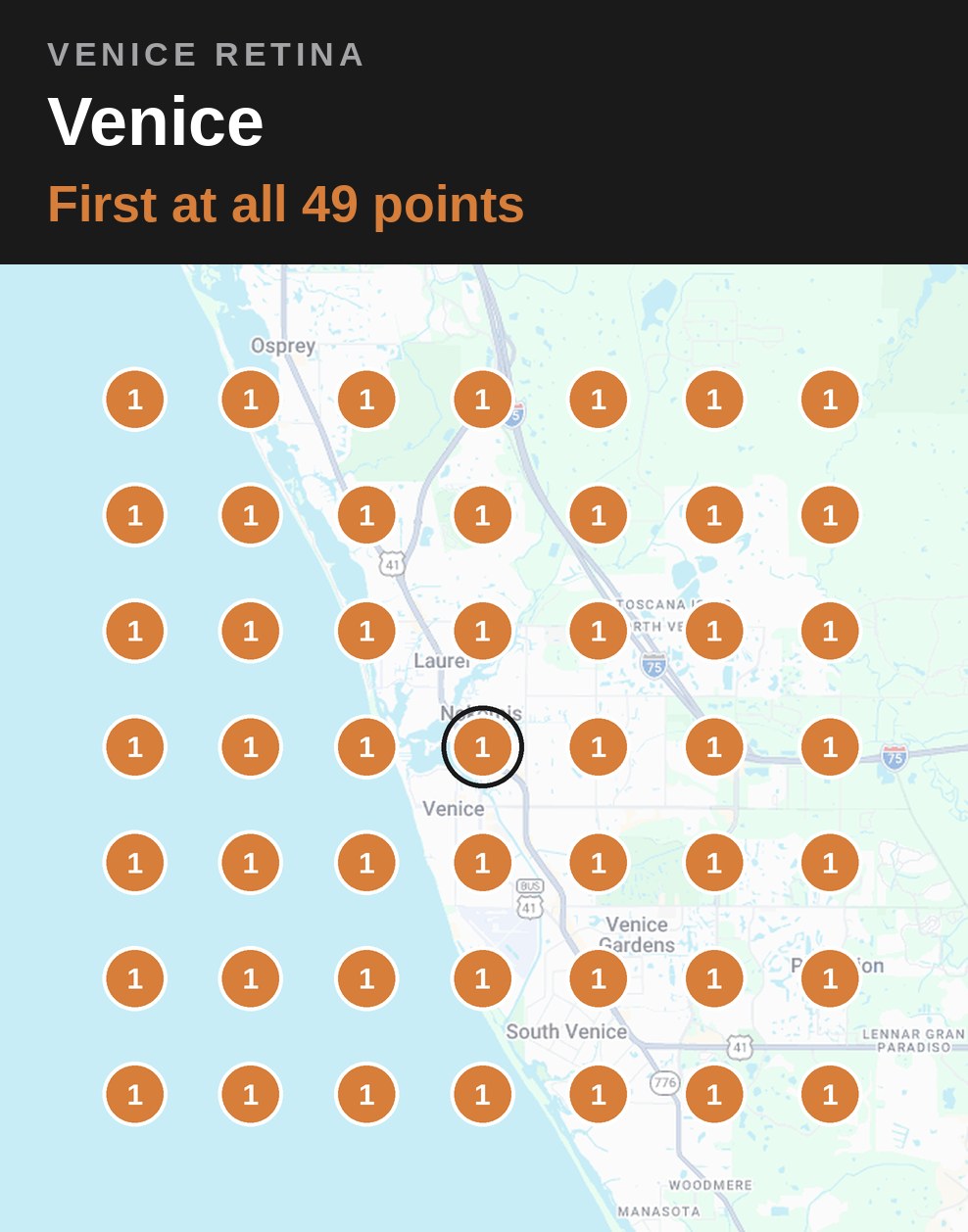
Where three retina offices ranked on Google Maps for “retina specialist,” searched from 49 points around each office, August 2026. Dark orange is first, light orange is second or third, and gray is lower. The ring marks the office.
Where you rank depends on where the patient is standing. Shane Retina’s University Parkway office comes up first across the middle of its map and slips lower toward Southgate, where the practice’s South Sarasota office takes over. Venice Retina, its sister practice, is first everywhere around Venice. Each office holds its own part of the map, which is why each one needs its own page and its own Google listing.
Local search also behaves differently by specialty. For a dermatologist or a med spa it is the main event. For a functional medicine practice drawing patients from across a region, it matters at the end of a long research process rather than the beginning. For a radiology group it is mostly a point of validation: the referred patient checks the listing to confirm the address and form a quick impression, not to choose.
Knowing which of those you are is the first decision, because it decides where the work should go.
Medical Content Written for Patients and Search
The content on a medical site has to be right before it can be good. That means learning the subject well enough to write about it accurately, and then checking it with the people who practice it.
For Shane Retina, that has meant a page for each of its main conditions and treatments, a page for each of its providers, and a FAQ page that answers dozens of patient questions. For Florida Radiology Consultants it has meant more than thirty pages on interventional procedures and more than seventy annotated imaging graphics, each one built with one of the group’s physicians. For Optimal Health Institute of Ohio it meant reading a book Dr. Grubb gave me on bioidentical hormones before writing most of the site’s copy.
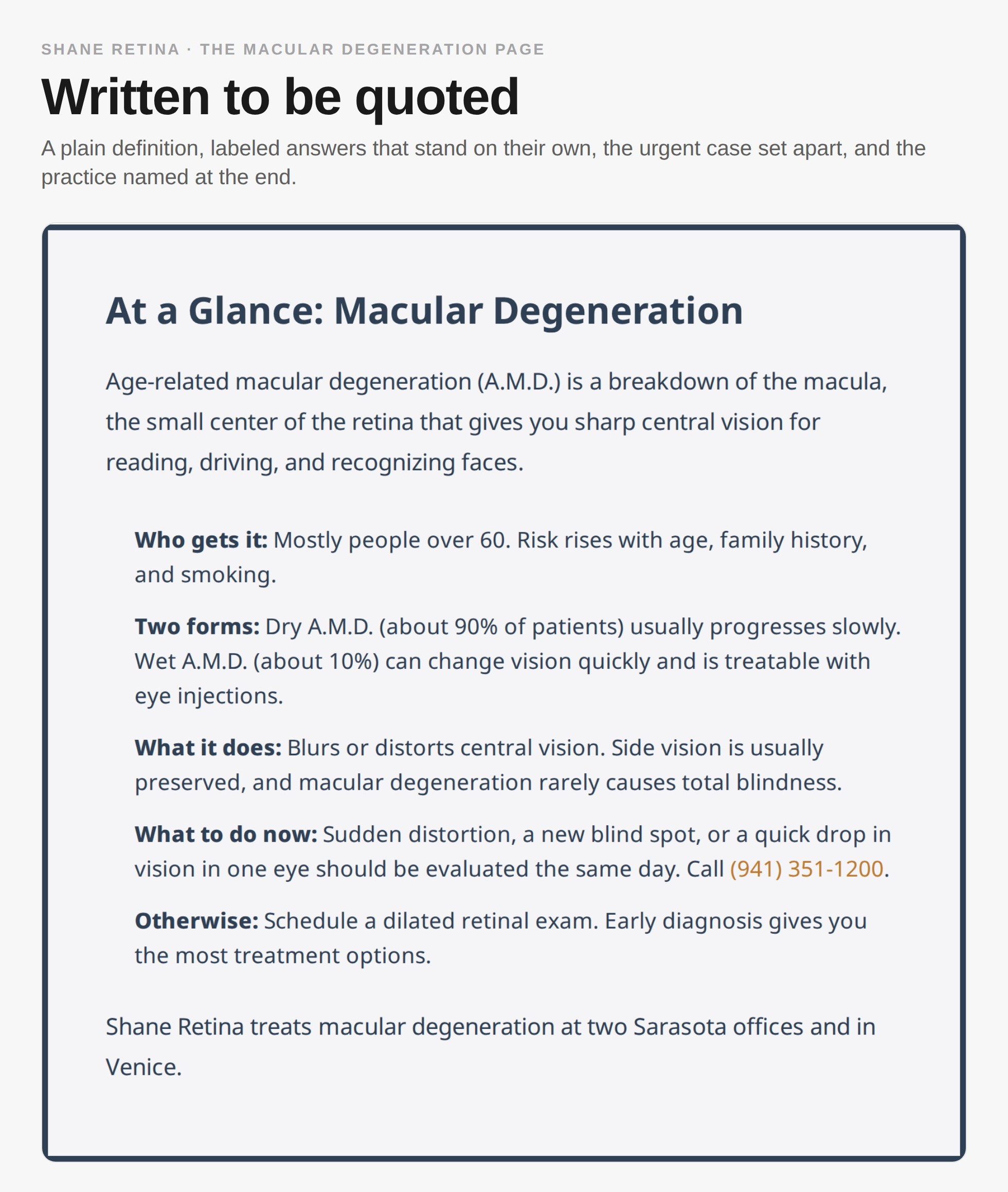
The block that opens the macular degeneration page. A plain definition, labeled answers that stand on their own, and the urgent case set apart. Written to be read by a patient and quoted by a machine.
This is where most medical website SEO fails. Thin pages written by someone who does not understand the medicine read as thin to patients and to search engines alike. A page that answers the question well is an advantage that lasts, because a competitor can’t simply buy it.
It also has a second use. Patients arrive at a consultation having read the page. Staff send the page instead of explaining the same thing for the fortieth time. The content earns its keep twice.
Medical Provider Pages and Location Pages
Provider pages are usually the most-visited part of a medical website, and usually the most neglected. On the Florida Radiology Consultants site, the physician profile pages have drawn more than 15,000 clicks from Google, more than any other part of the site. The searches behind them are the doctors’ own names, which is why physician SEO, and SEO for surgeons in particular, starts with a proper page for each one.
That makes sense once you see who is typing. A referred patient looks up the doctor they are being sent to. So does a candidate considering a job. So does another practice weighing a partnership. The provider page is where a practice is judged, and a stub with a headshot and two lines of biography is a wasted opportunity.
A provider page that works carries training, board certification, fellowships, hospital affiliations, the conditions that physician treats, and answers to the questions patients actually ask them.
Location pages do the same job for places. Every office needs its own page with its address, hours, providers, parking, what happens at that location, and a way to book, written so that a patient searching near one office finds that office rather than the practice’s head location.
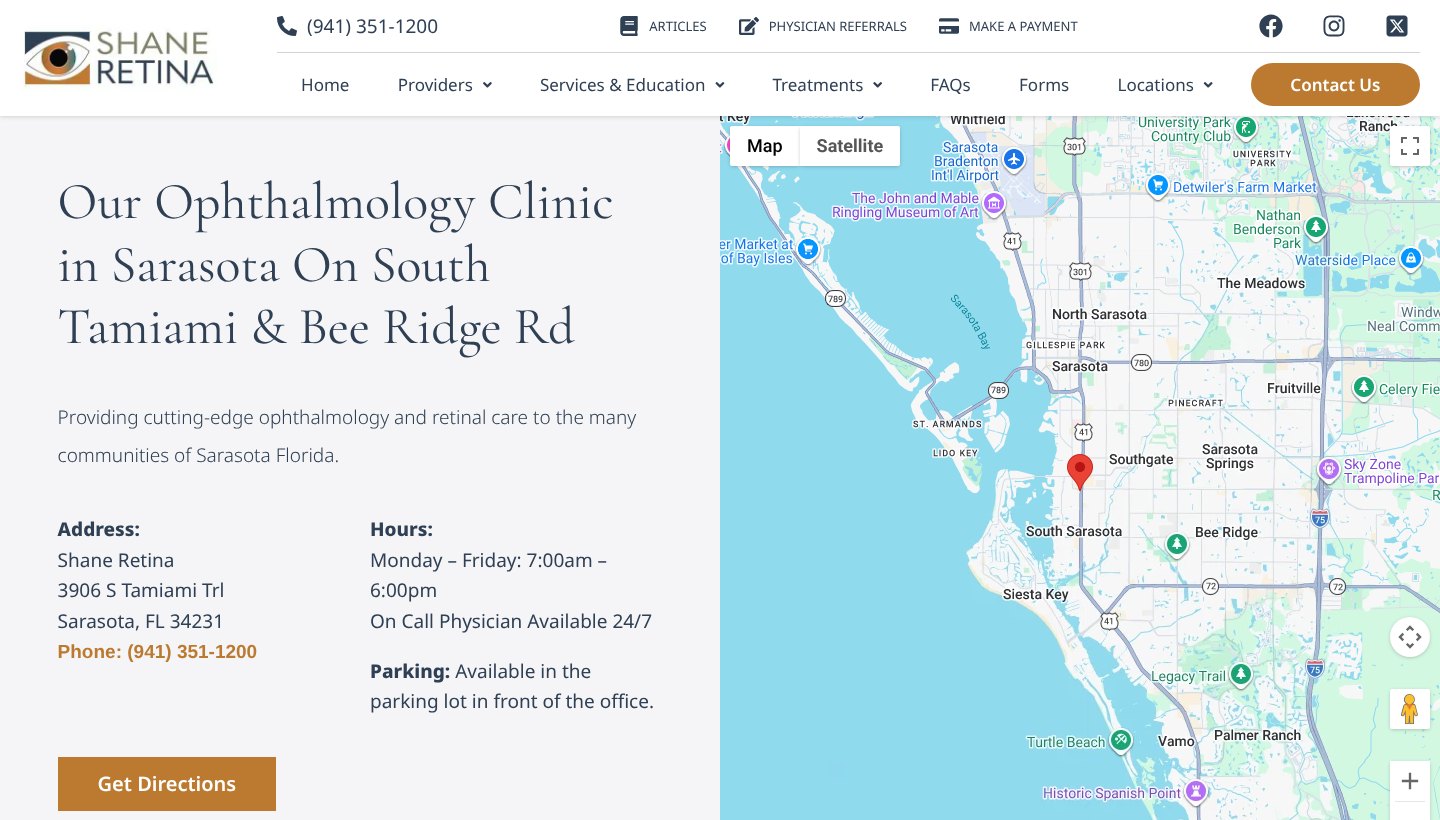
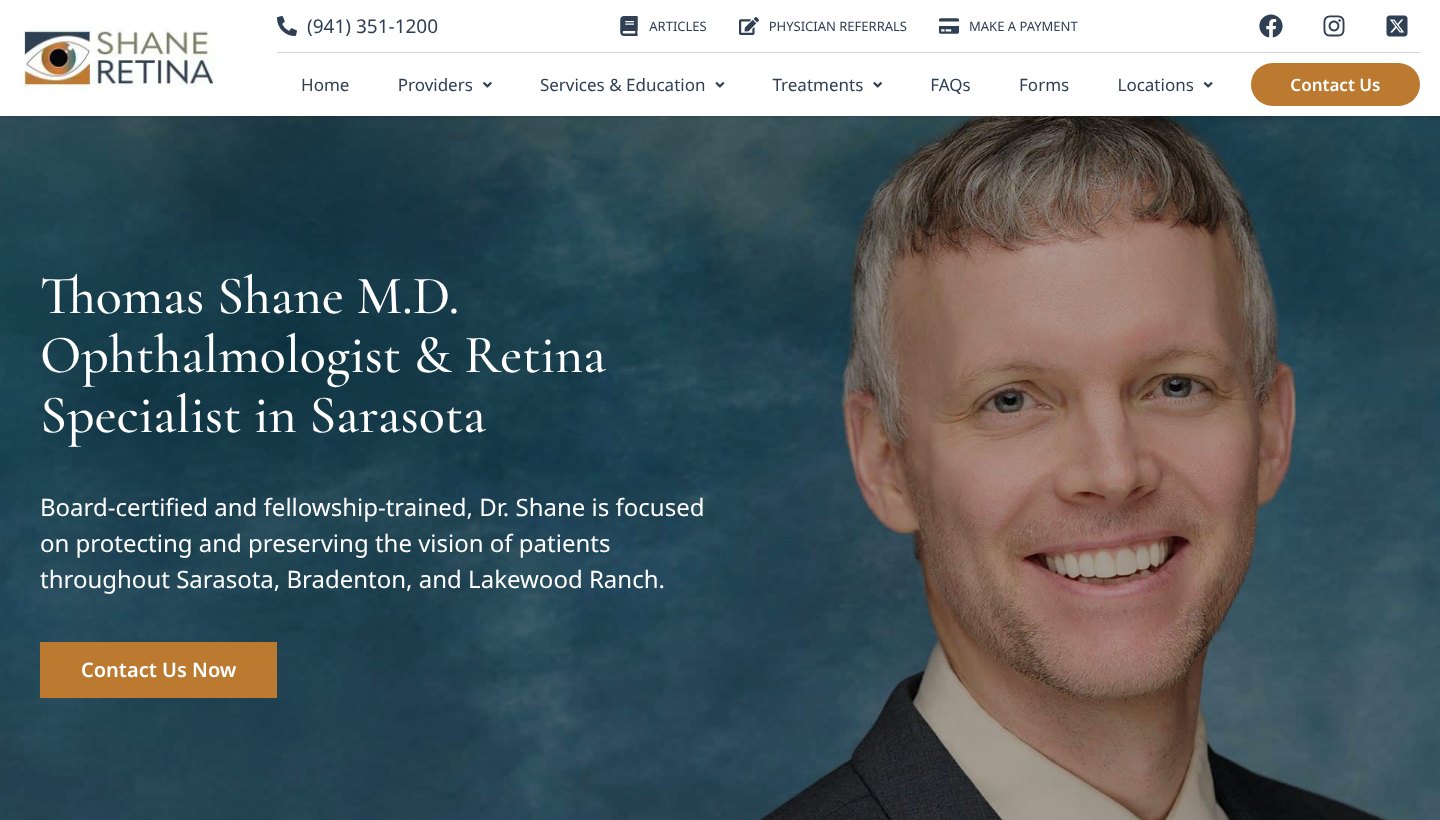
A location page and a provider page from the Shane Retina site: the South Tamiami office in Sarasota, and Dr. Thomas Shane. Each office and each provider has one.
Structured Data for Medical Sites
Medicine has the richest structured data vocabulary of any industry, and almost nobody uses it. There are specific ways to describe and connect a medical organization, a clinic, a physician with their credentials and affiliations, a condition with its symptoms and stages and risk factors, a treatment, and a drug.
Done properly, it builds a detailed map of your practice: how the doctors, offices, conditions and treatments connect to each other. Search engines and AI systems can read that map directly instead of guessing.
Most medical websites never get that far. Their structured data usually comes from an SEO plugin, which fills in the practice’s name, address, phone number and hours. That is the same basic listing a hardware store gets. It doesn’t say which doctors work at which office, what each doctor treats, or which treatments are offered for which conditions. Search engines and AI tools are left to work that out from the page text, and they don’t always get it right.
I build knowledge graphs like this for my clients. The goal is for search engines and AI tools to understand the practice exactly as it is, so it shows up more often, and more accurately, when patients search on Google or ask an AI assistant for a doctor. As AI systems lean more on the code underneath a website to decide what to recommend, that matters more every year.
This is a whole subject, and the page that explains it, with the actual code, is here: schema markup and knowledge graphs for healthcare.
AI Search and How Medical Practices Get Named
Patients now ask AI assistants some of the questions they used to type into Google, and those assistants answer in sentences rather than links. When Google shows an AI answer above the results, or an assistant recommends a practice by name, it had to decide which practice to name.
What goes into that decision is the same material as everything above: accurate content, a clear site structure, complete and consistent listings, real reviews, and structured data that states the facts plainly. There is no separate trick for it. The practices that are easiest to understand are the ones that get named.

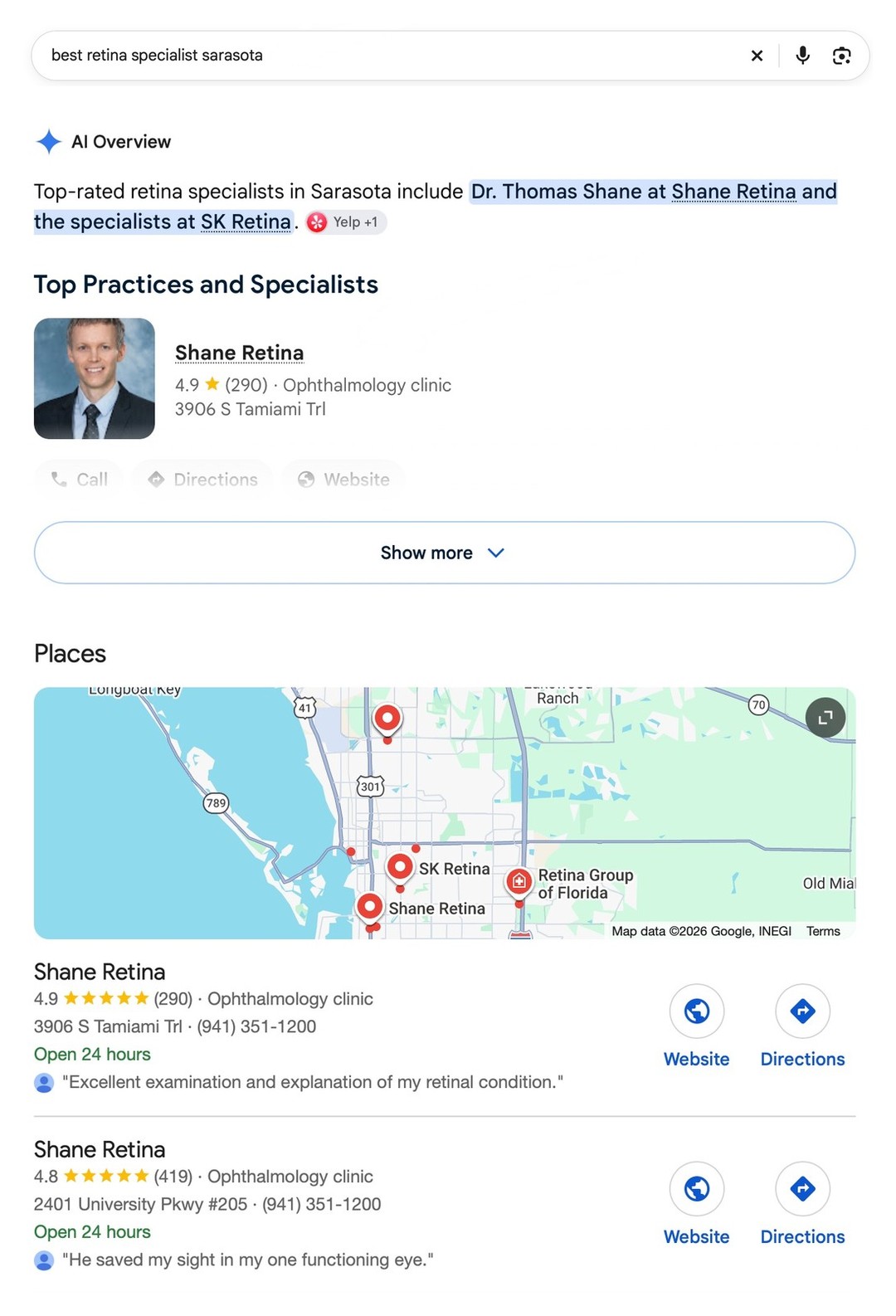
Google, “best retina specialist sarasota,” September 2026: the AI Overview names Dr. Thomas Shane first, and the practice’s two Sarasota offices are the first two places on the map.
I watch how AI tools answer the questions my clients’ patients ask. Then I make sure each site states the facts plainly: who the doctors are, what they treat, and where the offices are. That way an AI tool can find the facts quickly and has little room to get them wrong. At Arsenault Aesthetics, AI assistants have sent nearly nine hundred visits, from almost none in 2024 to dozens a month in 2026.
Healthcare SEO for Recruiting and Referrals
Some practices need doctors as much as they need patients. One group I work with, Florida Radiology Consultants, is the exclusive radiology provider for Lee Health, reading for four acute care hospitals, a children’s hospital and sixteen outpatient facilities. Its website had to attract radiologists in one of the tightest hiring markets in medicine and look right to practices and hospitals considering a partnership, while bringing patients to the group’s interventional radiologists.
That changes the whole build. Job listings get structured so that openings are eligible for Google’s jobs results. There is a page about living in Southwest Florida, written for a candidate who has never considered the region. The pages for radiologists get as much care as the pages for patients, because the standard medical SEO playbook is written only for winning patients.
Since 2024, more than 30 radiologists have joined the group, and its roster is up 37 percent. Hiring more than doubled after the job board went live. The procedure pages do their part too: they have drawn more than 6,400 clicks from Google, from patients looking into a procedure.

When the website’s job is recruiting. Job listings structured so openings are eligible for Google’s jobs results.
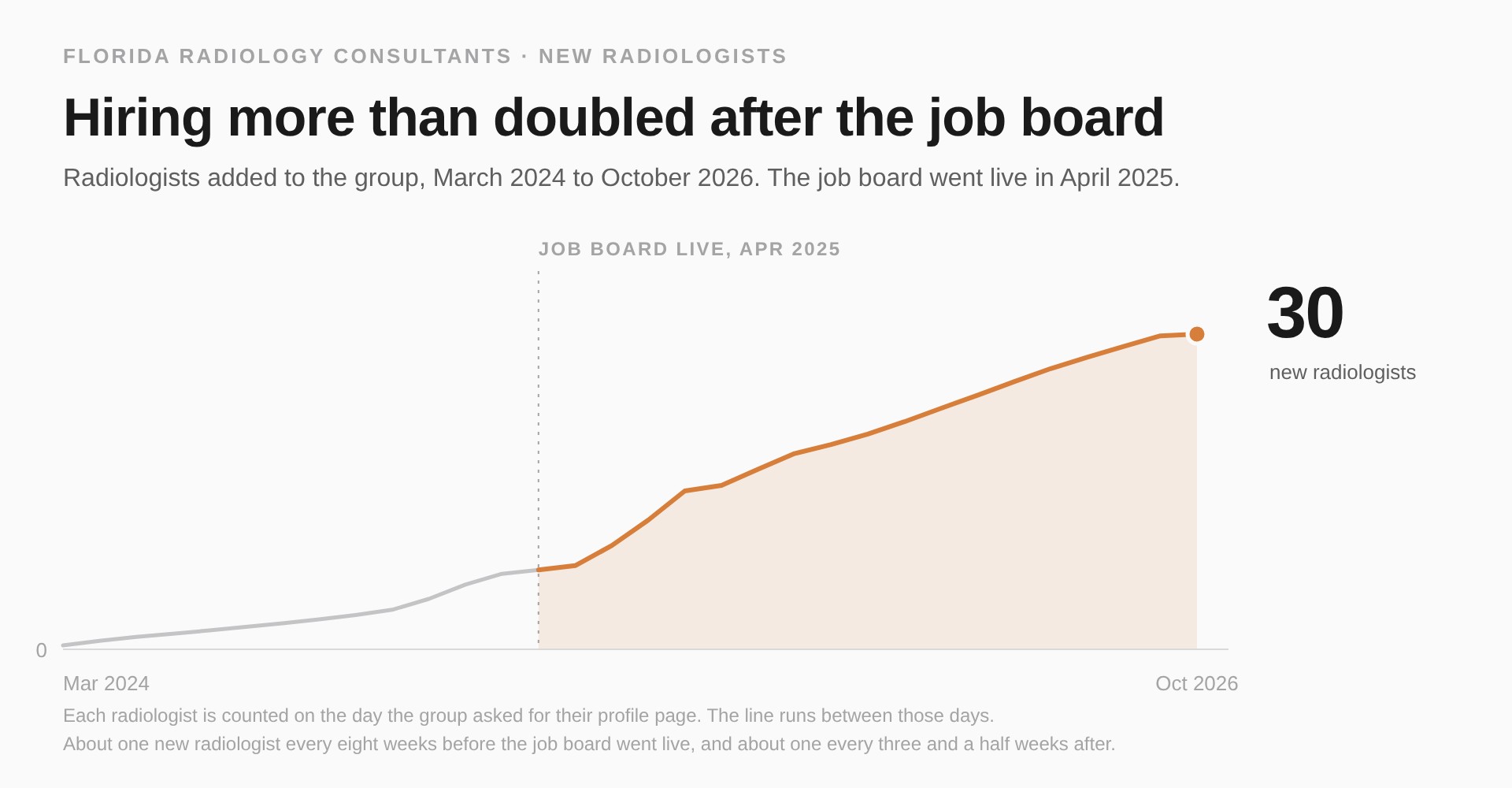
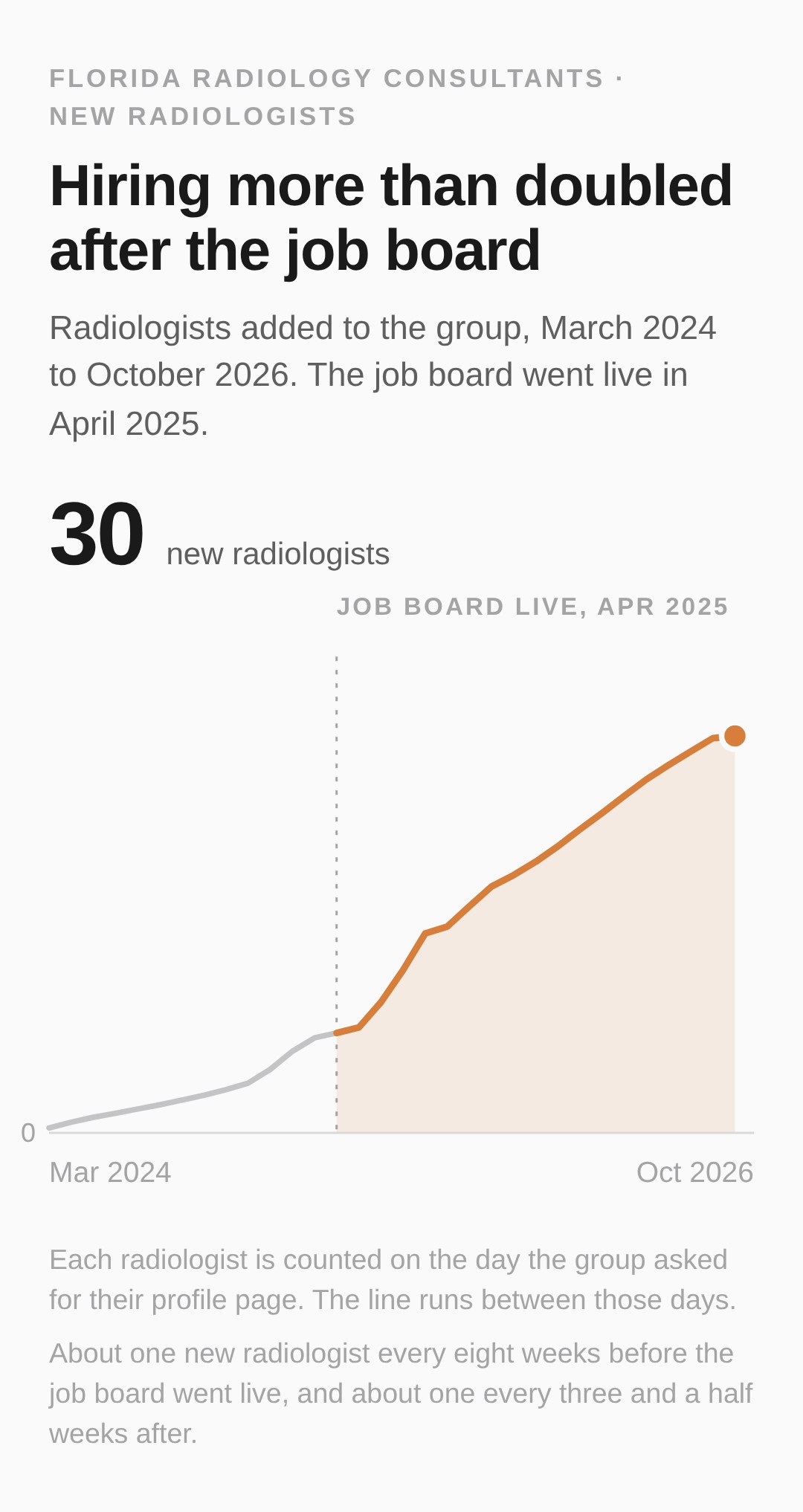
Radiologists who have joined the group since 2024. Gray: before the job board. Orange: after it went live in April 2025.
The same effect shows up in hiring even when nobody planned it. At Skin Health Forever, the new Director of Operations told me the quality of the website was part of what drew him to work there.
A website is a credibility document. The people reading it are not only patients.
Healthcare SEO Results

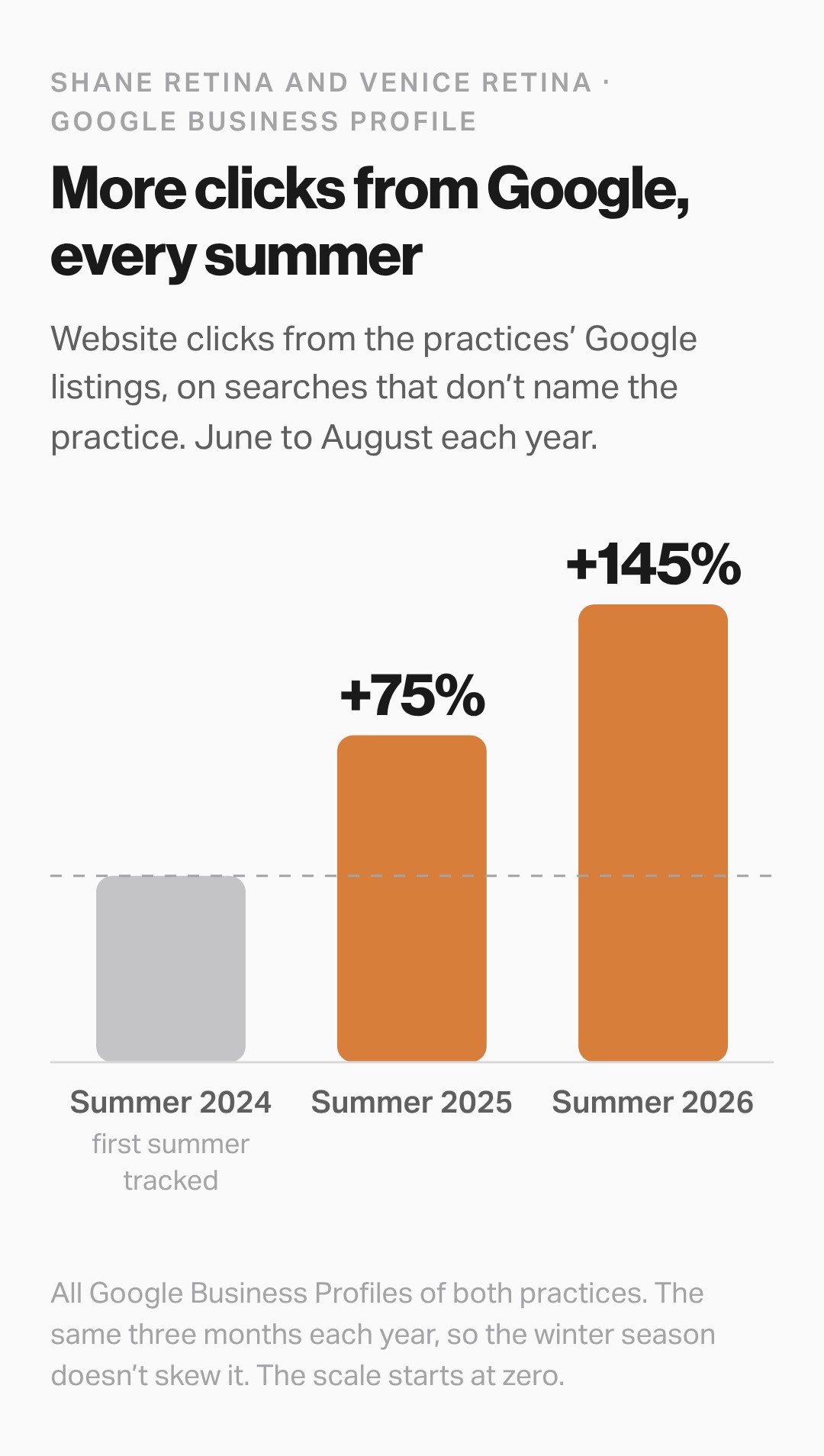
Website clicks from the practices’ Google Business Profiles on searches that don’t name the practice, June to August of each year.
Shane Retina and Venice Retina
They had one doctor in one office when the search work began. They have seven providers in three offices now. Website clicks from their Google listings on searches that don’t name them are up 145 percent over two summers. Venice Retina comes up first on the map for “retina specialist” everywhere around Venice. Around the South Sarasota office, Shane Retina is in Google’s top three map results at 92 percent of the points I check, up from 54 percent in 2023.
Arsenault Dermatology
The practice grew from three offices to seven. After a concentrated round of SEO work at the end of 2024, “near me” searches were up 106 percent from July to September 2025, against the same months a year before, and searches for a dermatologist 70 percent. Non-branded clicks were up on the year before in every quarter.
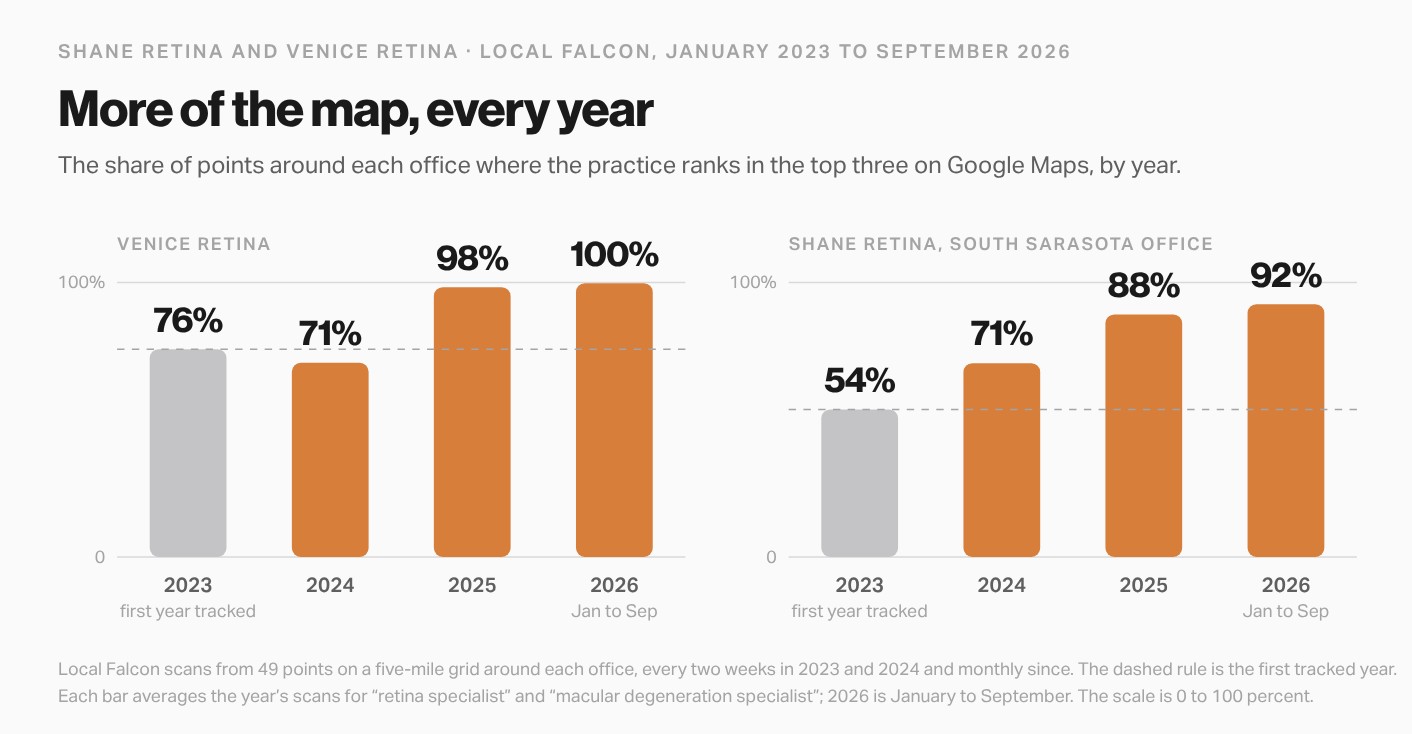
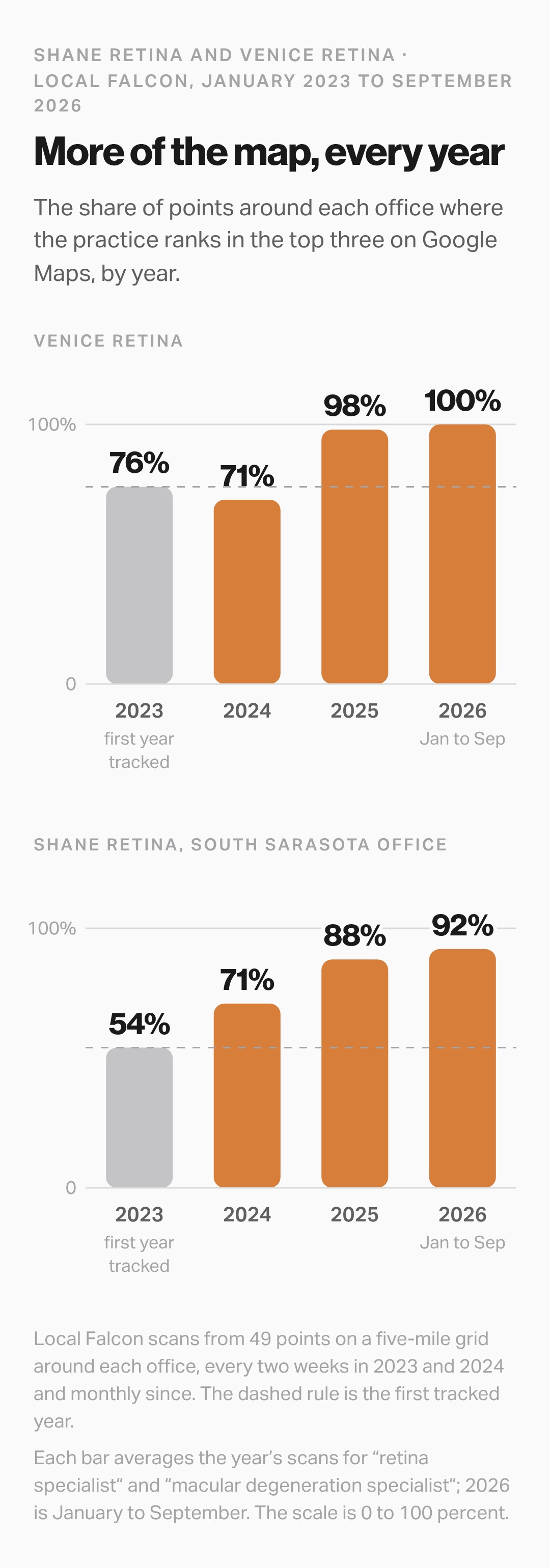
The share of the map around each office where the practice is in Google’s top three, averaged over each year’s checks for “retina specialist” and “macular degeneration specialist.”
Arsenault Aesthetics
The practice launched into one of the most saturated med spa markets in Florida, without the words “med spa” in its name. Clicks from people searching for a treatment or a med spa, not for the practice by name, went from 25 a month to 1,297, and online bookings rose 43 percent.
Florida Radiology Consultants
I rebuilt the group’s website on a new domain. Its physician profiles and procedure pages bring candidates, referring physicians and patients to the group, and more than 30 radiologists have joined since 2024.
Skin Health Forever
This Tampa dermatology practice has a real specialty. Search “black dermatologist tampa” and it is the first organic result, the first map result, and the practice Google’s AI Overview names.
Optimal Health Institute of Ohio
I built the practice’s website in 2016. Dr. Grubb says more than half of her new patient visits come from the web. The site shows up on Google for more than 1,000 different searches, and it has needed very little since.
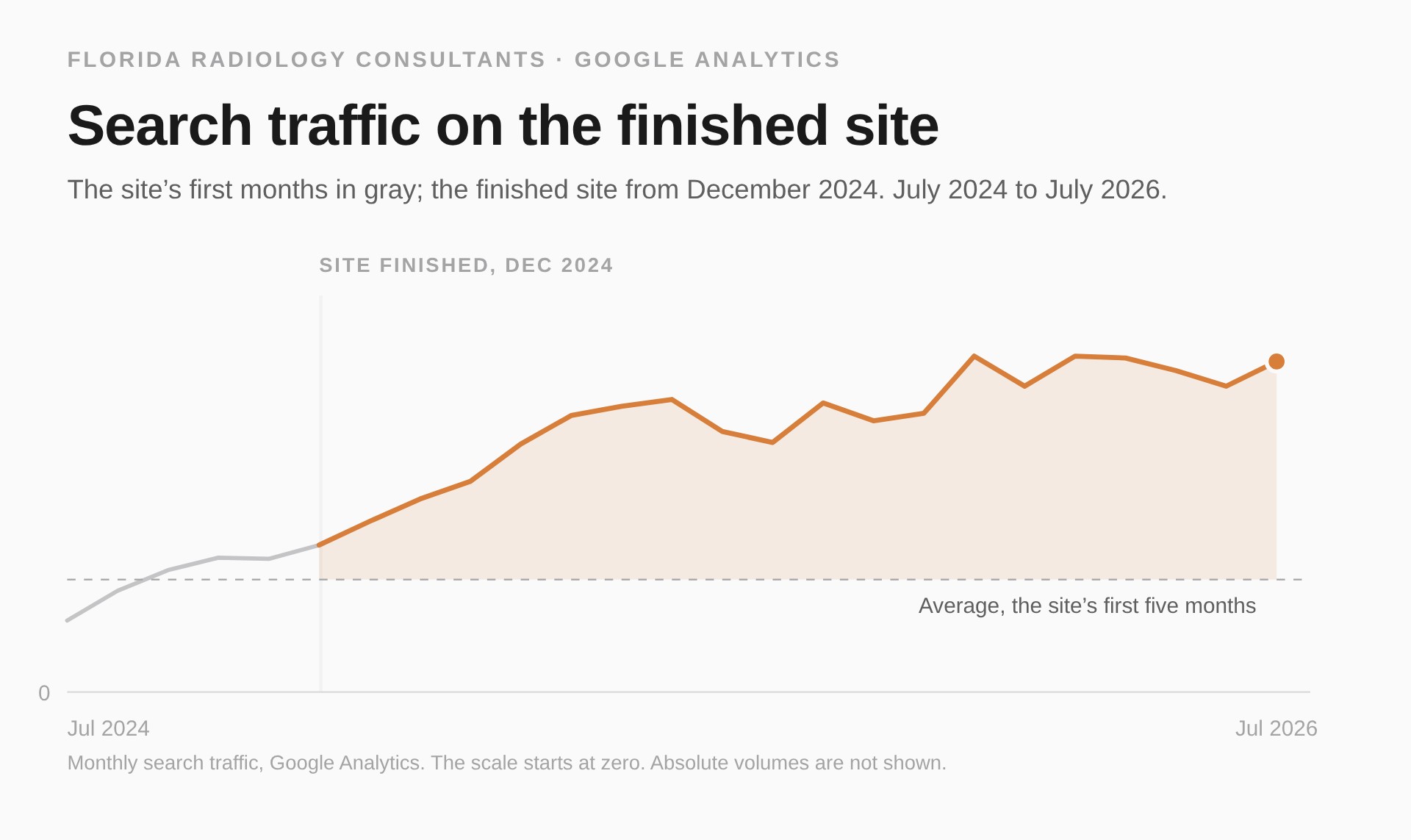
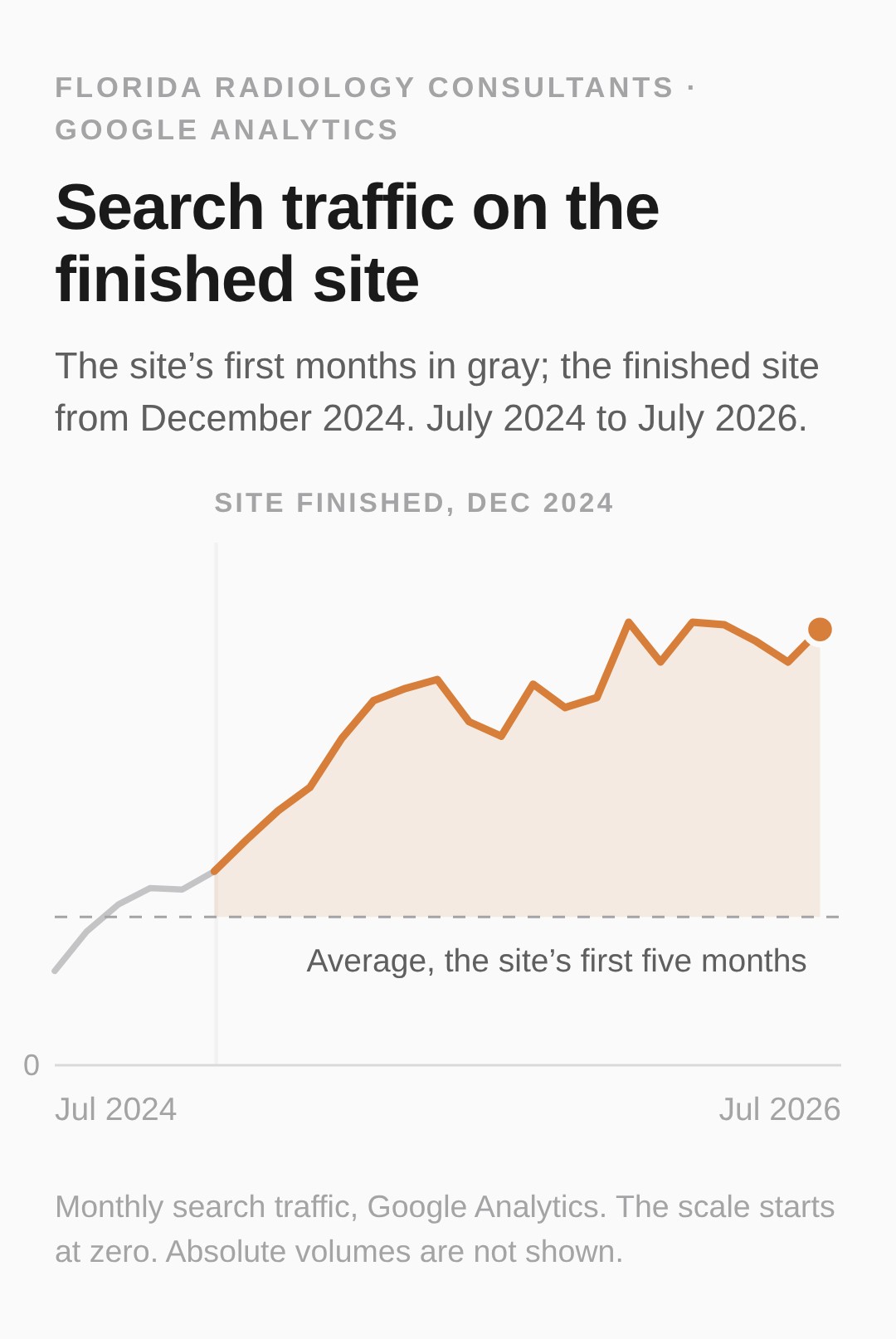
Search traffic from Google Analytics on the Florida Radiology Consultants site, July 2024 to July 2026. Gray: the site’s first five months, while the procedure library and imaging were still going in. Orange: the finished site on its permanent domain, from December 2024.
What You Get From Me
A Partner Who Understands Your Practice and Stays With It
I learn the specialty, the providers, the offices, and what you want more of. Then I keep learning, because practices change. When a practice adds a physician, opens an office, or changes its name, the work changes with it.
Someone on Your Side
I am not an agency with a sales team and a queue. I do the work myself. I tell you what is working and what is not, and I do not sell you things you do not need. If something is not worth doing, I say so.
Steady, Careful Work Toward One Goal
The goal is more of the right patients: people who need what you do, finding you and choosing you. Traffic for its own sake is not the goal, and neither is a ranking report.
A Plain-Language Update Every Month
Every month I send you a short update in plain language. It tells you how the practice is doing, what I worked on, and what I’m planning next. I watch far more data than I send, so the update can focus on what matters most to the practice.
Comparisons That Mean Something
I compare the same months a year apart. A practice on Florida’s Gulf Coast has a season: the winter residents arrive in the fall and leave in the spring, and the phone and the search numbers move with them. Comparing March to February tells you about the calendar. Comparing March to last March tells you about the work.
Related
Local SEO
Maps, profiles, and “near me” searches, explained.
Schema and knowledge graphs
The code that tells machines who you are.
Healthcare practices
Websites and SEO for independent medical practices.
AI search optimization
Showing up in AI answers.
Website redesign
Rebuilding a site without losing what it has earned.
See my work
Case studies, and what happened after launch.
“The results speak for themselves. Since we began working together, our new patient volume has doubled, and approximately half of our patients now come through online marketing. Josh has played a major role in that growth, helping us consistently outperform local competitors in online patient acquisition, including practices much larger than ours. The return on our investment in his services has been exceptional.
He doesn’t simply wait for us to identify problems or request improvements. He continuously monitors our online presence, identifies opportunities, and implements strategies to improve website performance, search engine visibility, patient engagement, and conversions.”
Dr. Thomas Shane · Ophthalmologist & Founder, Shane Retina
How the work happens
Understanding comes first.
Medical SEO starts with understanding the practice, the specialty, and how patients in that specialty actually search. I start by learning what you treat, who your providers are, which procedures you want more of, where your patients come from, and what makes you different from the group down the road. Then I look at what is actually being searched in your area and your specialty, and at what the practices ranking above you are doing.
From there it is a plan with an order to it. The things that are broken get fixed first, then the structure, then the content, then the work that keeps paying off over time. Nothing gets done because it is on a checklist.
Because I do the design, the build, the writing and the search work myself, decisions that usually pass through several different people get made once. The site does not have to be reworked later to fit the SEO, because the SEO was part of how it was built.
Common questions
What people ask.
What is medical SEO?
Medical SEO is the work of making a practice findable by the patients who need it, through search. In practice it covers how the site is structured, what the pages say, how the practice appears on the map and in local listings, and how clearly all of it is described to search engines and AI systems.
Is medical SEO the same as healthcare SEO, or SEO for doctors?
Close enough that I use the terms interchangeably. Medical SEO and healthcare SEO both mean search work for practices, clinics and the businesses around them. “SEO for doctors” usually means the same thing from the physician’s side: getting a specific provider found by name and by specialty. All of it is on this page.
How long does medical SEO take to work?
A new site with strong foundations usually begins gaining traction within three to six months. Local search can move faster. Content and authority build over a longer period than that, and the practices that do well are the ones that keep at it rather than the ones that start hard and stop.
Do you only work with medical practices?
No, but healthcare is where I focus. The list includes dermatology, retina and ophthalmology, radiology, med spa and aesthetics, functional medicine, and a compounding pharmacy. Working across several specialties is useful, because what works in one often has not been tried in another.
How do I tell a good healthcare SEO provider from a bad one?
Ask what they will measure and why. If the answer is total traffic or a ranking report, that is a sign. Ask whether they will write the content or ask you to. Ask who actually does the work. Ask them to explain something technical in plain language, and see whether they can. And be careful with anyone who guarantees a ranking, because nobody can.
Do you guarantee results?
No, and anyone who does is selling something. What I will do is tell you what I think is achievable, work in the order that gets there fastest, and show you what moved.
Can you work with our existing website?
Yes. A good deal of my work is on sites I did not build. I start by getting familiar with how it is put together, then handle improvements from there. Sometimes the right answer is to improve what is there. Sometimes it is to rebuild. I will tell you which, and I will tell you if rebuilding is not worth it.
What about HIPAA?
A public marketing website does not handle protected health information in the normal course of things, and the SEO work itself does not touch patient records. Where it does become a live question is in the details: what an appointment request form collects and where that goes, what analytics and advertising code is allowed to see, and how patient stories and photographs are handled. I build with that in mind.
Do you work with our marketing team or other vendors?
Yes. If you have an agency, an ads team, or someone handling social media, I can work alongside them. It is common, and it works best when everyone knows who owns what. Dr. Thomas Shane of Shane Retina describes it this way: “He works closely with our digital advertising team to ensure that our website, SEO, Google Business Profiles, and paid advertising efforts complement and reinforce one another.”
Will you write the content, or do we have to?
I will write it. You provide the expertise, and your physicians review anything clinical. Most practices do not have the time to write, and content written reluctantly reads that way.
We have several locations. Does that change things?
Yes, and mostly in your favor. Each location is a separate opportunity to be found, with its own page, its own listing, and its own local competition. It also means more to keep consistent. Multi-location practices are a large part of what I work on.
What happens if we change our name?
It gets planned rather than improvised. I have taken many businesses through a name and domain change, handling the redirects, the listings, and everything else that points at the old name. It is one of the riskiest things a practice can do to its search visibility. Done deliberately, it goes smoothly, and the practice keeps its place on the Google map through the change.

Ready to get started?
If your practice should be easier to find than it is, I can help.
Tell me what your practice does best and who you want to reach, and we’ll both get a sense of whether we’re the right match.