


Services · SEO · AI Search
AI Search Optimization
ChatGPT, Claude, Google’s AI and other AI tools recommend the businesses they can find and trust. I work on all of it, and my clients show up in AI answers.
In short
- AI answers are built on Google and the rest of the web. Being named there starts with being found in search.
- I work on all three layers: SEO, answer engine optimization (AEO) and generative engine optimization (GEO).
- An AI Visibility Audit shows where you stand: where you're named, who is named instead, and what to fix first.
- It's part of the SEO work I do for clients, and my clients are named in Google's AI answers and get visits from ChatGPT and other AI tools.
How People Find a Business Now
Your next customer may ask AI before they ever see your website. Someone might ask ChatGPT or Claude for a good dermatologist nearby, or read Google’s AI answer about cataract surgery before scrolling down to a single link. That answer names a few businesses, and people often choose from that short list.
AI assistants send people to websites. ChatGPT, Claude, Perplexity and Gemini now answer many of the questions people used to type into Google, and when they recommend a business, they often link to it. My clients’ websites get visitors from all of them, and those visits are growing. See my clients in AI answers below.
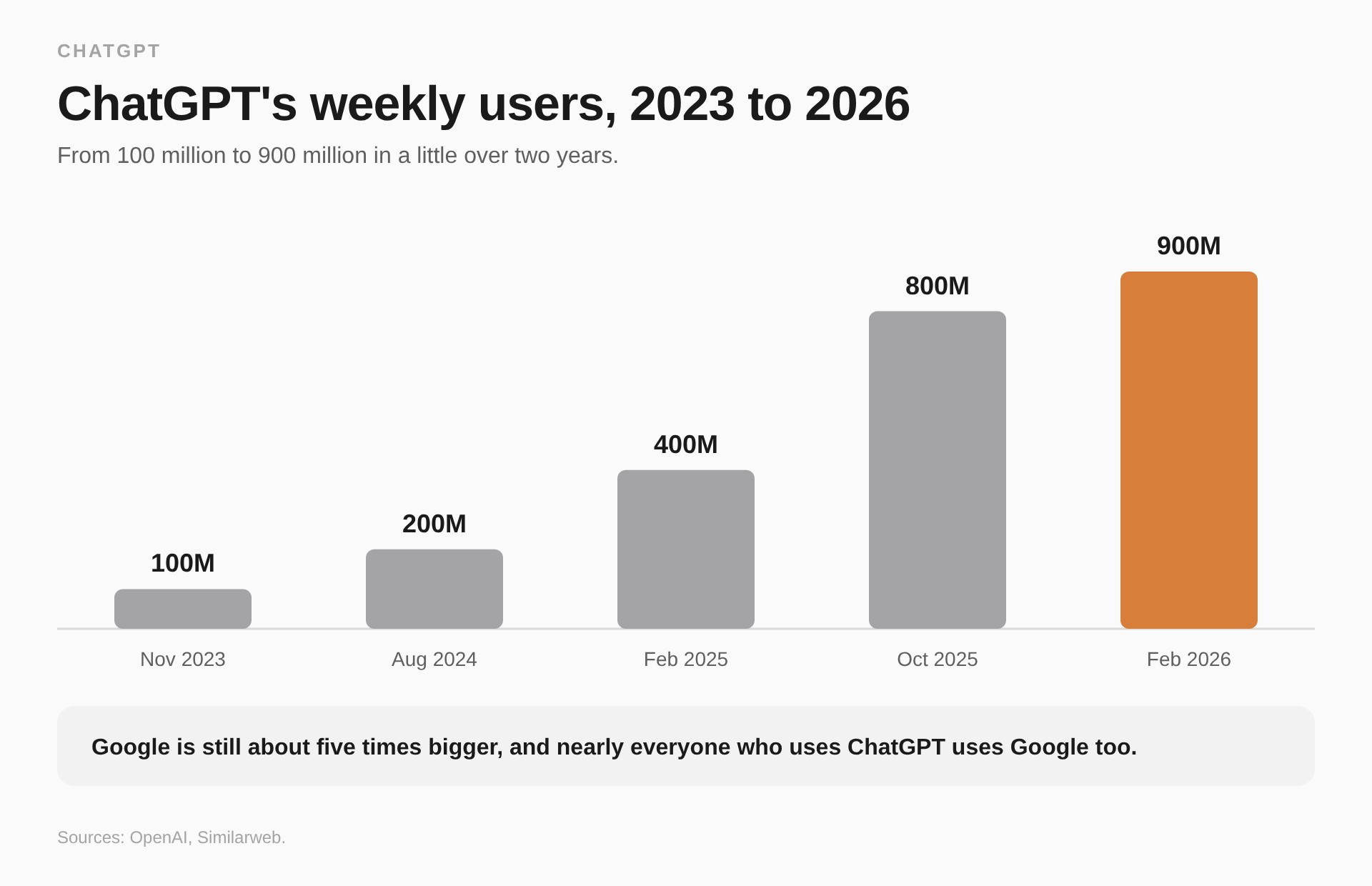
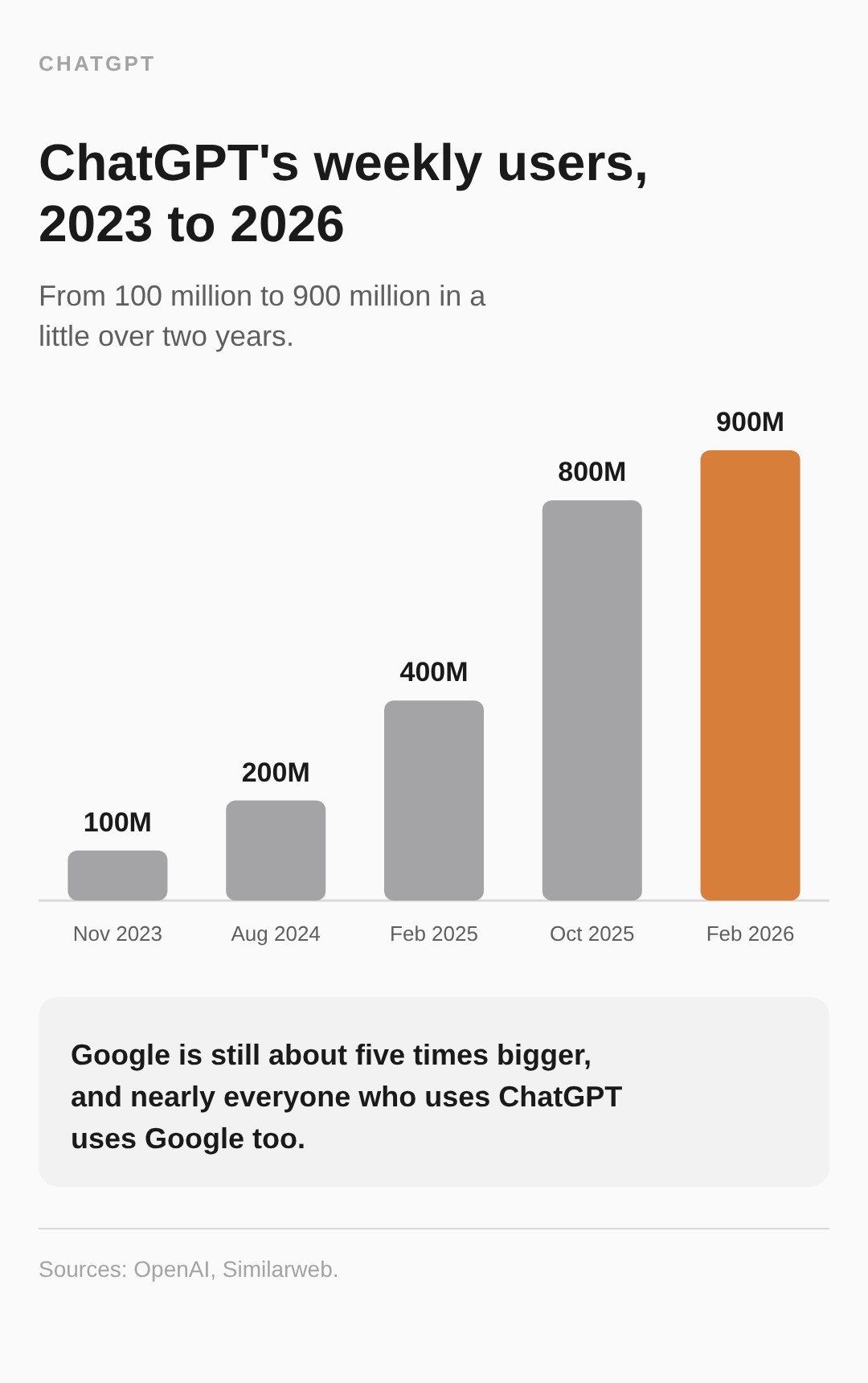
ChatGPT has grown fast, and Google is still much bigger.
People still use Google. Google has about five times as many monthly users as all the AI chatbots combined, and nearly everyone who uses ChatGPT uses Google too. Google now often puts its own AI answer, called an AI Overview, at the top of its results. When it does, fewer people click through to websites, so being part of that answer matters more than it used to.
Local searches still show the map. When someone adds a city or “near me” to a Google search, Google usually shows the map and a list of businesses instead of an AI Overview. In one study, Google showed an AI answer on 92 percent of questions, but on only 15 percent of searches for a business nearby. And when someone asks ChatGPT or Claude for a business nearby, the assistant draws on the same kinds of sources the map does: Business Profiles, reviews and directory listings.
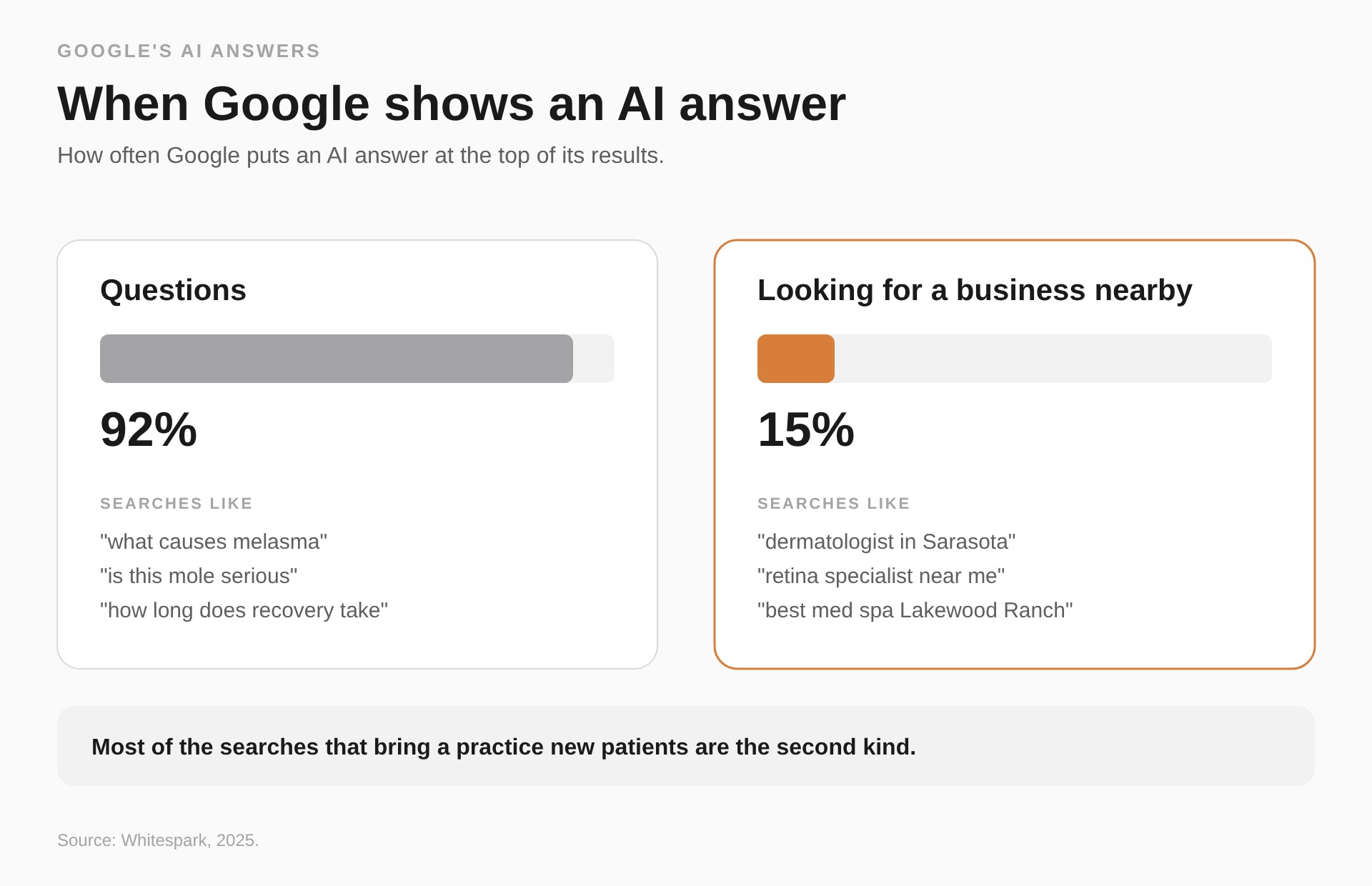

Google shows an AI answer on most questions, and on far fewer searches for a business nearby.
Someone searching “what causes melasma” may read the AI answer and never click, while someone searching “dermatologist in Sarasota” still gets a map and a list of practices to choose from. My work covers both kinds of search, in Google and in the AI assistants.
Starting early is an advantage. More people use AI tools every year, and the businesses those tools name are the ones that gave them something to find. If you start now, you build a lead over competitors who wait, because the pages, reviews, listings and knowledge graph these tools draw on take time to build. You will also be in a much better position as more of your customers and patients move from Google to AI.
“I skate to where the puck is going to be, not where it has been.”
– Wayne Gretzky
SEO, AEO and GEO: What Each One Does
You will hear three names for this work: SEO, AEO and GEO. All three come down to one question: when someone looks for what you do, does your business come up? Each one covers a different place they might look.
SEO: Showing Up in Google's Results
SEO, search engine optimization, is the classic kind. When someone types “dermatologist in Sarasota” into Google, your website shows up in the list of results. It matters for AI too, because Google’s AI answers and ChatGPT both pull from the pages that rank well in Google. So the first job is a fast website, a page for each service and condition people search for, and nothing on the site that keeps Google out by mistake.
AEO: Being the Answer to a Question
AEO, answer engine optimization, is about questions. When someone asks Google “how long does recovery from cataract surgery take,” Google often writes a short answer at the top of the page, above the list of links. AEO means writing your pages so that answer comes from you. I write pages that answer the question in the first lines and then go deeper, add FAQs built from what your customers actually ask, and add code that tells Google what each page covers.

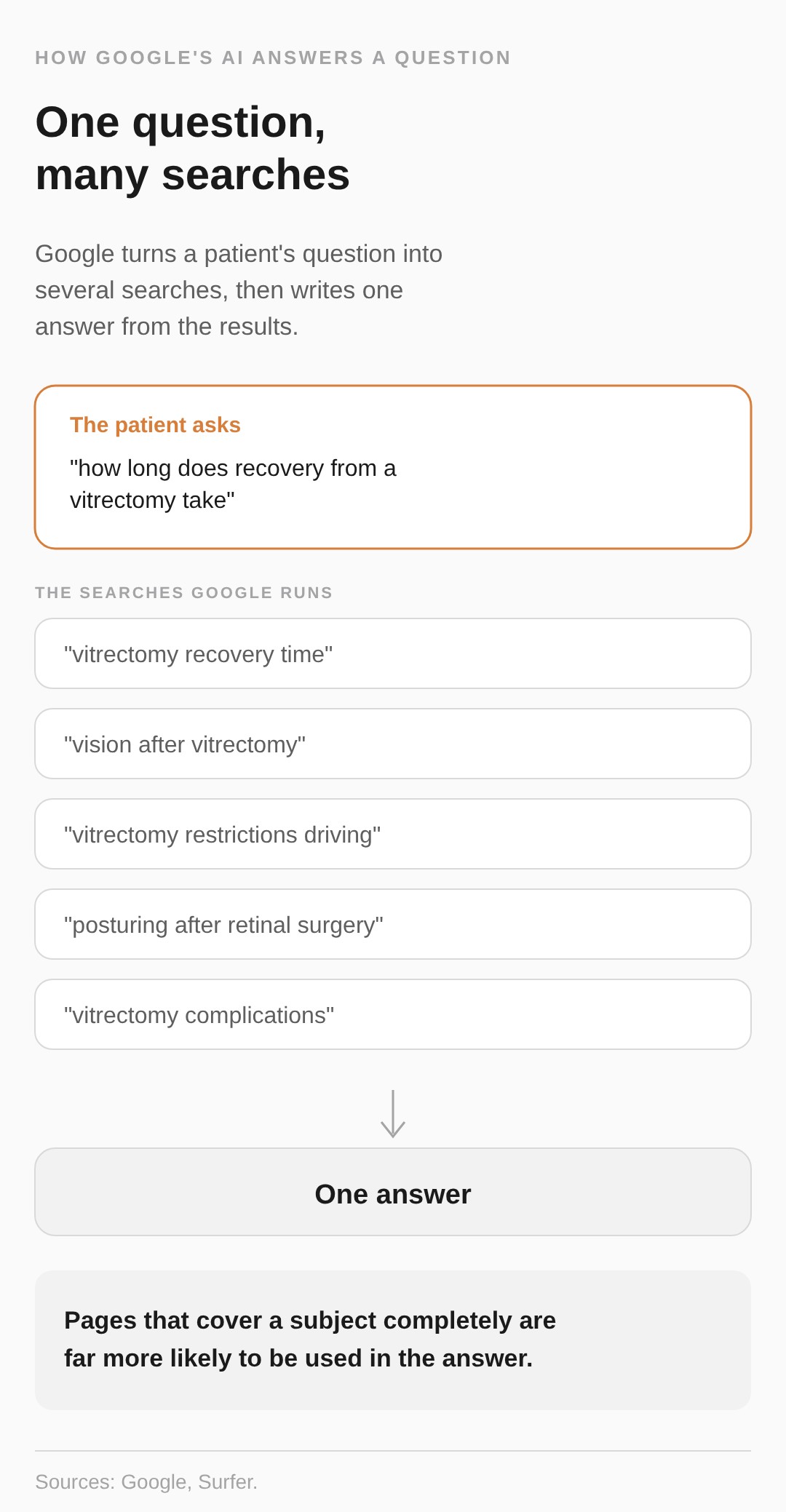
One patient question turns into several Google searches.
GEO: Being Recommended by ChatGPT and Other AI Tools
GEO, generative engine optimization, is about ChatGPT, Claude, Gemini and the other AI tools. When someone asks one of them “who’s the best retina specialist in Sarasota?”, it writes its own answer and names a few businesses. To decide who to name, it reads your website, and also your business profiles, your reviews, the directories you’re listed in and what other sites say about you. When all of that agrees, it can recommend you with confidence. When it doesn’t, it may name someone else.
Much of this is work I have done for my clients for years under the name local SEO. I keep their Business Profiles complete and current, make sure their listings match everywhere, help them get reviews on more than one site, and add code that tells search engines how the business, its people, its locations and its services fit together.
My Clients in AI Answers
AI visibility is something you can check, and I check it regularly for my clients. When I ask for a specialist in a city where I have a client, I can watch the answer being put together from pieces I recognize, like the practice’s Business Profile, its condition pages and the listings we cleaned up. Some of it is public, and anyone can look it up.
Shane Retina. Ask Google for the best retina specialist in Sarasota, and its AI Overview names Dr. Thomas Shane first, with the practice’s two Sarasota offices as the first two places on the map below it.

Google, “best retina specialist sarasota,” September 2026: the AI Overview names Dr. Thomas Shane first, and the two Sarasota offices are the first two places on the map.
Skin Health Forever. Search “black dermatologist tampa,” and the practice is the first organic result, the first map result, and the practice Google’s AI Overview names.
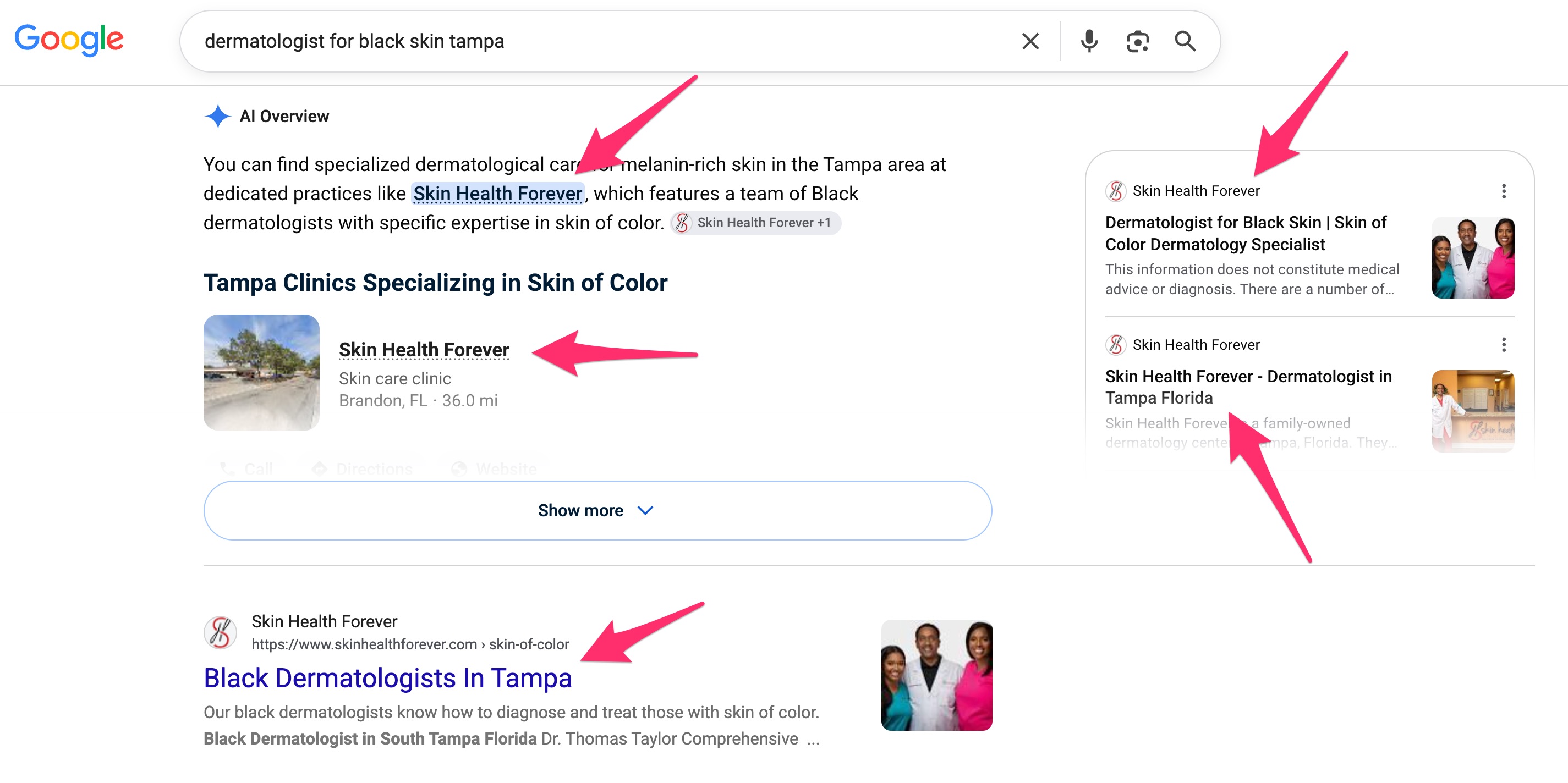
Google results for “dermatologist for black skin tampa,” September 2026: the AI Overview, the map result, and the first organic result all point to the practice.
Visits from AI assistants. The treatment pages I built for Arsenault Aesthetics have found a second audience. By 2026, AI assistants had sent the practice nearly nine hundred visits, from almost none in 2024. Love and Beauty Maui, a wedding hair and makeup studio, gets visitors from ChatGPT, Gemini, Perplexity, and Claude, and those visits roughly doubled from 2025 to 2026.

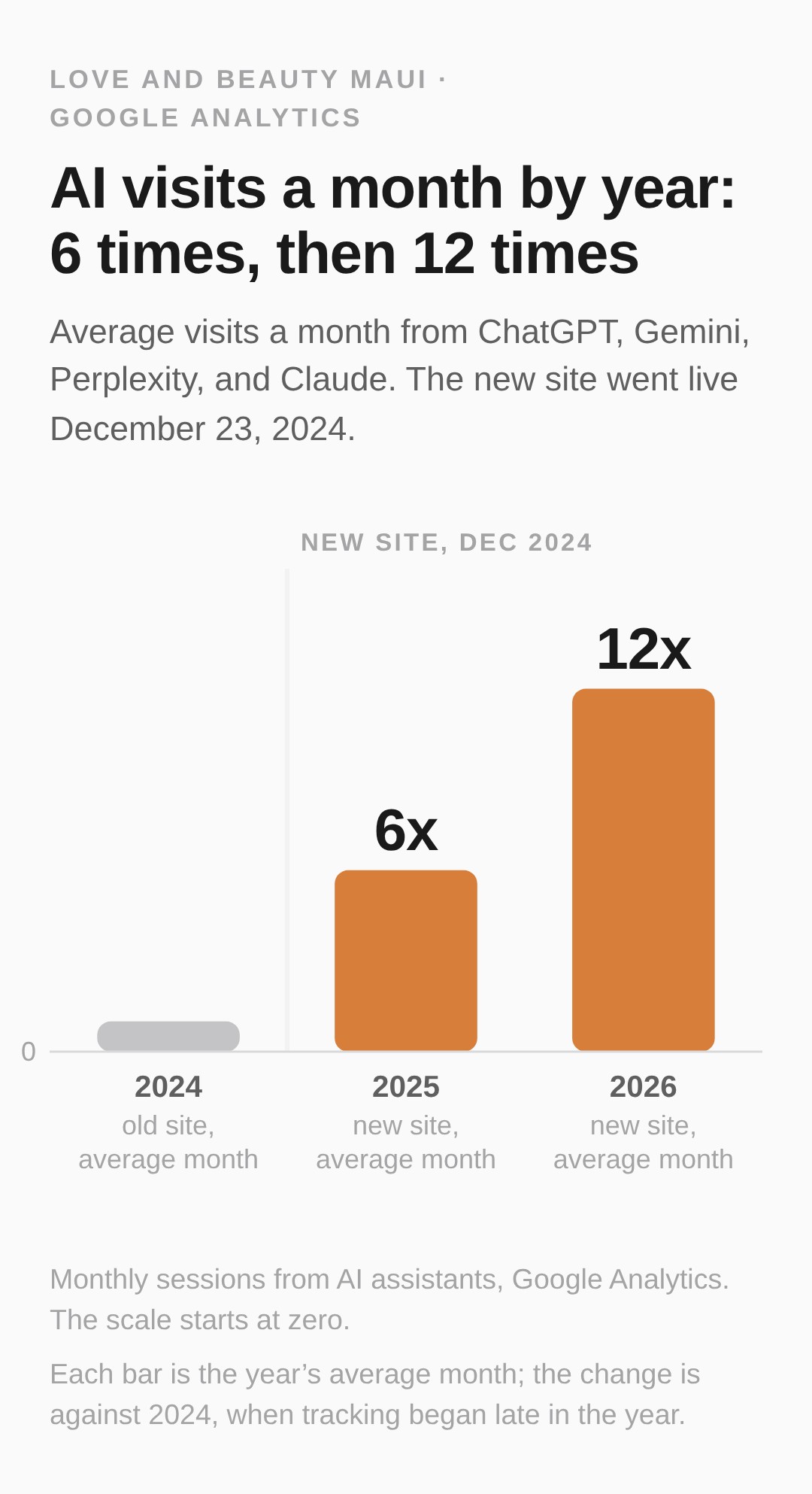
Average AI visits a month to the Love and Beauty Maui site, from Google Analytics: 6 times the old site’s level in 2025, and 12 times in 2026.
“Since launching the new website, our inquiries have become so much more consistent. We’re receiving multiple inquiries almost every day, sometimes significantly more. Before, we’d occasionally experience slow periods without many inquiries. Now, we’re regularly hearing from clients who found us through Google searches and Google Maps. We’ve even had a handful of clients mention finding us through ChatGPT!”
Nikki Quinn · Lead Stylist and Owner, Love and Beauty Maui
The answers change from one run to the next, so I don’t treat any single one as a ranking. Taken together, though, they show these systems reading the pages, profiles and listings I build for my clients.
The AI Visibility Audit
The first step is finding out where you stand. The AI Visibility Audit shows how AI assistants answer the questions your customers ask, where your business is named, who is named instead, and what is holding you back.
What I Check
I start with what matters to your business: the services you most want to be known for, the areas you serve, and your competitors, both the ones getting ahead of you and the ones you are already beating. From those I build a set of questions in your customers’ words, like who is the best specialist in your city or who treats a certain problem.
Then I run each question through the most popular AI tools and see who comes up: whether your business is named, who is named instead, and what the answers say about you.
I also look at what those assistants are reading: your website, your Google Business Profile, your listings and your reviews. Anything that keeps them from finding you, or gives them the wrong facts about you, goes on the list.
What It Shows
You will see where you stand: how often you come up compared with your competitors, anything the AI gets wrong about you, and what to fix first. I walk you through it in plain language.
The audit also gives you a starting point, so later checks can show what has changed.
Ongoing AI Search Optimization
AI search optimization is part of the SEO work I do for clients. What helps you rank in Google is also what the AI answers draw on, so I do both at once.
Content That Answers the Question
I build and improve the pages that cover your services, the conditions you treat and the questions your customers ask, written for your customers and easy for search engines to understand. These are the pages AI tools draw on when they answer.
Profiles, Listings and Reviews
I keep your Google Business Profile complete and current, your listings consistent everywhere, and your reviews active on more than one platform. Local searches still return a map and a list, and the AI systems read the same profiles and listings when someone asks for a business by city.
Structured Data and Knowledge Graphs
I add code to your site that tells search engines and AI tools exactly who you are, where each location is, who works there and what you do.
A Fast, Healthy Website
I keep your website secure, up to date and easy for Google to read. And we decide together which AI tools are allowed to use your site, so nothing gets blocked by accident.
Regular Checks and a Plain-Language Update
I check back on the AI answers regularly, watch the visits AI tools send you, and tell you what changed and what I am working on next, in plain language.
A business that keeps its site, its profiles and its content current gives these tools more to find every month.
“He stays current with evolving SEO practices, digital marketing techniques, and emerging technologies, including AI, and finds practical ways to incorporate them into our marketing strategy.”
Dr. Thomas Shane · Ophthalmologist & Founder, Shane Retina
Structured Data and Knowledge Graphs
I build knowledge graphs for my clients. As AI takes on more of search, a knowledge graph is one of the most important things a website can have.
Structured data is code on your website that visitors never see. It tells search engines who your business is, where each location is, who works there and what you do. A knowledge graph ties all of it together, so Google and AI tools can see your whole business at once. Google uses it to understand your business, and its AI answers are built on what Google understands. Microsoft has said the same kind of code helps its AI tools too.
Every website I build comes with a full knowledge graph. Shane Retina’s knowledge graph covers its offices, its doctors, and the conditions and treatments it offers. Florida Radiology Consultants’ covers the group, its physicians and its services.
I also build it for what AI tools will do next. They are starting to do more than answer questions. They compare businesses for people and help them book appointments. To do that, they need facts they can rely on, and a site with a knowledge graph already has them written down.
AI Search for Medical Practices
Patients are using AI to look into their health. In 2026, Pew Research found that about a third of American adults use AI chatbots for health questions. But they trust their own doctor far more than a chatbot. So they use these tools, then look for somewhere to check what they were told, and that is often the practice’s own website.
Independent practices have ground to make up. In one 2026 test, ChatGPT was asked thousands of the questions patients ask, and it didn’t name a single one of 200 independent practices. It leaned on hospital staff listings, large practice websites and doctors’ credential pages, which hospitals keep up to date as part of running the hospital. An independent practice needs someone to look after those things, and I do that for my clients.
The big health sites own the general questions. When someone asks what causes macular degeneration, AI tools mostly quote places like the Mayo Clinic, Cleveland Clinic and Johns Hopkins. A local practice isn’t going to beat them there, and nobody can promise that it will.
Where patients look for a doctor nearby, a practice can win. Those searches still show the map. And when AI tools recommend a specialist, they lean on what the practice has written about the conditions it treats, and on profiles and listings that agree. Shane Retina and Skin Health Forever are both named in Google’s AI answers for exactly those searches.
Why the Shortcuts Don't Work
Every new kind of search brings a new set of tricks to sell. Some of the ones being sold for AI have already been tested, and they didn’t work. A special file that’s supposed to tell AI how to read your site almost never gets read, and Google says it ignores it. And chasing a higher “authority score” for your website had no clear effect.

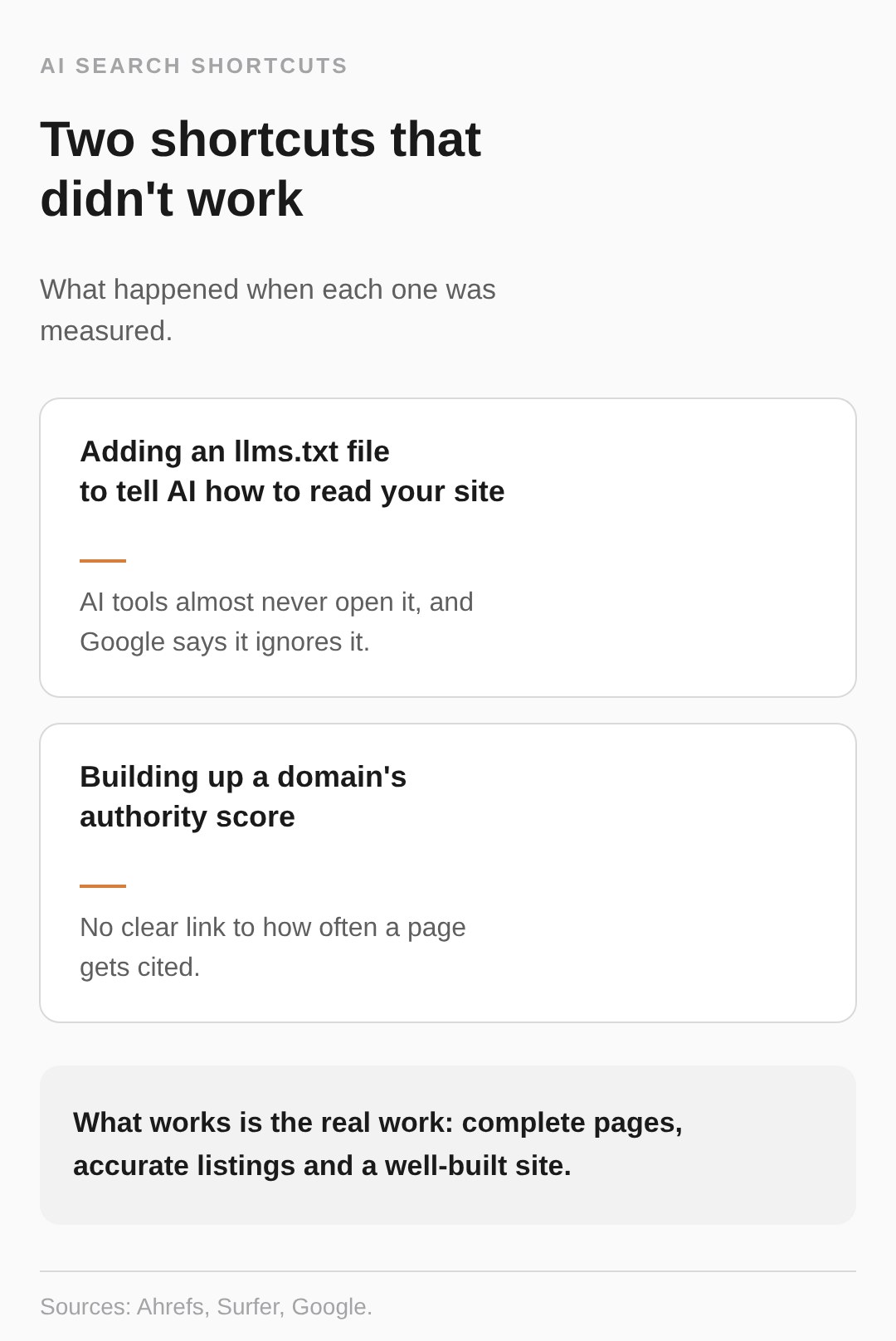
What happened when two popular shortcuts were measured.
The work that holds up is slower. It takes pages that cover a subject completely and answer the main question at the top, a website that is clean and current, and a business described the same way everywhere. That’s what I build for my clients. There’s no shortcut around that work. Doing it well is what sets a business apart.
“The obstacle is the way.”
– Ryan Holiday
How You'll Know It's Working
You will see it in a few places. Google Analytics shows you that ChatGPT, Gemini, Perplexity, Claude and other AI tools are sending traffic to your site. That is how I can show the growth on the Arsenault Aesthetics and Love and Beauty Maui sites. Google also reports how often your site shows up in its AI answers. And checking the AI answers again shows where you come up now compared with where you started.
Some of it stays hidden. Some AI tools don’t pass along where a visitor came from, so those visits get counted as people who typed in your address, and the real number is higher than the report shows. The report also misses the people who read about you in an AI answer and then call you or search your name in Google. The answers also change from one day to the next, which is why I check a full set of questions instead of one. Nobody can sell you a ranking in ChatGPT. I watch these numbers closely and tell you what I see.
Related
SEO and content strategy
Search, local SEO, schema, and AI visibility.
Schema and knowledge graphs
The code that tells machines who you are.
Local SEO
Maps, profiles, and “near me” searches, explained.
Healthcare SEO
SEO for independent practices.
See my work
Case studies, and what happened after launch.
A QUICK CONVERSATION
Want your business found in AI answers? Start with a conversation.
How the work happens
It starts with the audit.
I start with the AI Visibility Audit, which shows where your business comes up in AI answers today and what is holding it back. Then we go through what to fix first, together.
After that, I do the work along with your SEO, and I check back regularly so you can see what is changing.
I started on this before most people were selling it. In May 2024, a client of mine asked me what AI was going to do to search. My answer was the same work, done well: keep building complete, useful content, keep its listings accurate everywhere a search engine or an assistant might look, encourage reviews on more than one platform, and keep testing the AI tools to see how they answer. AI assistants now send that client dozens of visits a month.
Common questions
What people ask.
What is AI search optimization?
It is making sure your business can be found and described correctly by the AI tools people now ask for answers and recommendations: ChatGPT, Claude, Google’s AI, Gemini, Perplexity, Copilot, and whatever new AI tools come along. Most of it is the same work as good SEO, done with those tools in mind.
What's the difference between SEO, AEO and GEO?
SEO gets your website into Google’s list of results. AEO makes your pages the answer Google writes at the top of the page when someone asks a question. GEO gets your business named when ChatGPT, Claude or another AI tool recommends someone. They overlap, and I work on all three together. LLM SEO and ChatGPT SEO are other names for GEO.
What does the AI Visibility Audit show?
Where your business comes up when people ask AI tools the questions your customers ask, who comes up instead, anything the answers get wrong about you, and what to fix first. It also gives you a starting point, so later checks can show what has changed. More on the audit.
Is AI search optimization part of SEO?
Yes. It is part of the SEO work I do for clients. Google’s AI answers are built from Google’s own results, so the work overlaps almost completely. What’s added is checking the AI answers themselves, and closer attention to your profiles, listings and reviews.
Can you guarantee I will show up in ChatGPT?
No, and be careful with anyone who says yes. Ask the same question twice and you can get a different answer. A screenshot of your business in an AI answer shows one moment, and the next answer may be different.
Does structured data help with AI?
Yes. A knowledge graph gives Google and AI tools a clear, complete account of your business, straight from your own website. Google reads it to understand your business, and Google’s AI answers are built on what Google understands. As AI tools get better, they will rely on it more.
Do I need an llms.txt file?
No. Almost none of them are ever requested, and Google says it ignores them. Adding one does no harm, but I wouldn’t pay anyone to do it.
Is AI killing my website traffic?
It is reducing clicks on general questions, like what causes a condition. It has much less effect on searches for a business nearby, which is where most practices get patients. Whether your own traffic is falling, and why, is something your site’s data can answer.
Should I block AI tools from my website?
That is your call, and it is worth making on purpose. Many businesses keep AI tools from using their content for training but still let them find and recommend the business. Some hosting and security services now block AI tools by default, and the wrong setting can even hide a site from Google, so it is worth having someone check.
How do I know if AI is sending me anything?
Google Analytics shows you. It lists the visits ChatGPT, Gemini, Perplexity, Claude and other AI tools send to your site. Some of those visits don’t say where they came from, so the real number is higher than the report shows. Those visits also count only the people who clicked through to your website. They don’t count the people who read about you in an AI answer and then call you, or type your name into Google. The number of people who see your business in these tools is most likely much higher. Google also reports how often your site shows up in its AI answers. I watch both and report what I see.
Do you do this for businesses that are not medical practices?
Yes. Most of it applies to any business. Love and Beauty Maui, a wedding hair and makeup studio, gets visitors from AI assistants too. The medical specifics are here because that is where most of my work is, and because health is one of the most affected categories. If you run a business outside healthcare, the broad version of this service lives at Freelance Web Designer.
Is it too early to bother with this?
No. Starting early is the advantage. Your pages, reviews and listings take time to build, so every month you start before your competitors is a month they have to make up. You will also be in a much better position as more of your customers and patients move from Google to AI. And the same work helps you rank in Google today, so none of it is wasted.

Ready to get started?
If you want your business to show up in AI answers, I can help.
Tell me what your business does best and who you want to reach, and we’ll both get a sense of whether we’re the right match.