


Services · SEO · Structured Data
Schema and Knowledge Graphs
Google and AI tools are trying to understand your business from your website. I build custom schema and connected knowledge graphs that tell them who you are, what you do, and how your people, locations, services and expertise fit together. That is knowledge graph SEO: a model behind your website that search engines and AI systems can read to get a deeper understanding of your business.
In short
- Schema labels the facts about your business.
- A knowledge graph connects those facts so they describe the business as a whole.
- I design and build it around your organization, then keep it current as the business grows.
What Structured Data Is
Structured data is code that states the key facts on your website in a form search engines and AI tools can read without guessing: this is the organization, this is its location, this person works here, and this service is offered there.
Your website already says all of this in writing, and a person reading it fills in the gaps without thinking. Take a line like “We have been caring for families in Bradenton since 1998.” You know right away that the business is in Bradenton and opened in 1998. A search engine or AI tool has to work that out. It has to decide whether Bradenton is where the office is or just where some families live, whether 1998 is the year the business opened, and whether it is a doctor, a dentist or a daycare. AI tools are good at this, but they can still get it wrong, and they have to work it out again every time they read the page. Structured data answers those questions for them.
Structured data is written in a shared language called Schema.org. Google, Microsoft and Yahoo created it together in 2011 so that every website could describe itself to machines the same way. It has labels for organizations, people, places, services, products and medical conditions, and for how they connect. Google and Microsoft read it when they crawl your site, and the AI answers built on their search results draw on what it tells them. Schema markup is that language applied to your business.
The code sits within your pages without changing what visitors see.
What Schema Markup Looks Like
Structured data is usually written in a format called JSON-LD. Here is a basic example, the kind most websites start with.


Basic business JSON-LD showing identity, address, contact information, and opening hours.
Each label tells search engines exactly what a piece of information is: the business name, the address, the hours.
This is local business schema: the basic facts about one business.
Your website may already have something like this on it. Most websites fall into one of three groups:
- None at all. Search engines and AI tools have to work everything out from the writing.
- The basics. The business name, address, phone number and hours. Many websites have this without the owner knowing, because the tools they were built with add it automatically. It’s a start, but it leaves out most of what makes the business what it is.
- A full knowledge graph. This is what I build. It includes the basics, plus your people, your services, your other locations and how they all connect. Search engines and AI tools get a complete description of your business, with nothing left to guess.
What a Knowledge Graph Adds
A knowledge graph describes the whole business: its people, its places, its services, and how they all connect. What that covers depends on the kind of business:
- Medical practice: each office and its hours, each doctor’s training, the conditions they treat, and which doctor sees patients where.
- Med spa: each treatment and what it’s for, the providers who perform it, and the locations and specials where it’s offered.
- Law firm: each practice area, each attorney’s education and bar admissions, and the office each attorney works from.
- Custom home builder: the services, the towns it builds in, the licensed team, and the finished projects in each area.
- Insurance agency: each type of coverage, the carriers it represents, its licensed agents, and the communities it serves.
In each case, the graph shows how those pieces connect. This is also called entity SEO.
Put together, those connections form a map of your whole business. People understand a map by looking at it, so the maps we use are drawn. Search engines and AI tools understand data, so this map is written in code, in a format they can read directly. That format does for them what a drawn map does for us. It shows the whole business at once, which helps them understand it better than any one page could. And the better they understand it, the better they can match it to the people searching for what you do.
A knowledge graph also ties your business to the rest of its online presence. It brings together your Facebook page, your other social media accounts, your Google Business Profile and directory listings like Yelp or Healthgrades, and tells search engines and AI tools that all of them belong to the same business. It does the same for the profiles of the people on your team. So when those systems come across you somewhere else, they know it’s you.
What That Looks Like in Practice
For Shane Retina, I built a knowledge graph around the practice, its three offices and its seven providers, linked to the conditions, treatments and patient questions on the site. I keep it current as the practice grows.
The graph holds each office’s address and hours, each provider’s training and affiliations, and the symptoms, risk factors, tests and treatments on every condition page.

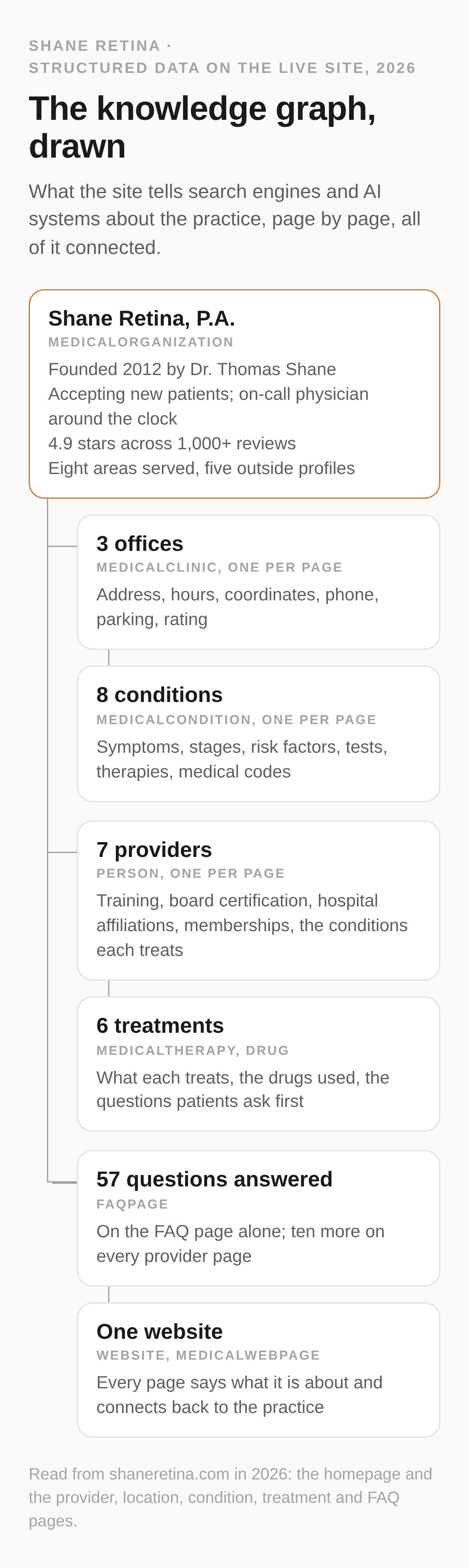
Shane Retina’s knowledge graph, showing the organization, offices, providers, conditions, treatments, and patient questions.
What a Knowledge Graph Does for a Business
Search engines and AI tools understand your business
The graph hands search engines and AI tools the whole map of your business all together, in your own words. They can see how your people, places and services connect, which gives them a deeper, more accurate understanding of what your business is and what it does.
Accurate Answers About Your Business
Your hours, your locations, who works where and what each person does are stated plainly in code, so the answers people get about your business are accurate. It also helps Google tell your business apart from others with similar names.
Your people get credit for what they know
The graph connects each person’s credentials, like a doctor’s training or an attorney’s bar admissions, to the services they offer and the articles they wrote. When someone searches for that kind of expertise, search engines can see who has it.
Richer Listings in Google
Structured data can earn a page a richer listing in Google, such as breadcrumbs, product details or job postings. I add the ones that fit the business.
Why a Knowledge Graph Lasts
A knowledge graph is something your business owns and keeps building on. I gather the facts about your people, your locations and your services once, and they become a complete description of your business that search engines and AI tools can read.
It is future-proof for three reasons:
- It is written in a shared standard. No single company owns Schema.org. Google and Microsoft both read it, and any new search engine or AI tool can read the same format.
- It works however people search. Map results, AI answers and chat tools all need the same facts about your business, and the graph gives them those facts.
- It grows with the business. Each new location, person or service is added to the same graph, so it keeps getting more complete over time.
The work is built to keep paying off as the tools change. Most marketing stops working when you stop paying for it. A knowledge graph keeps working after it is built, and every new search engine or AI tool that reads it is one more place your business is described correctly.
The payoff can grow over time, too. Most businesses have no structured data or only the basics, so as these tools rely on it more, a business with a full knowledge graph is ahead of the ones around it. The sooner it is built, the bigger that head start.
Why Knowledge Graph SEO Matters Beyond Google
When someone asks Google, ChatGPT or another AI tool about a business like yours, it answers with what it can find about you online. Your website should be the clearest, most accurate source it finds.
AI-powered search summarizes what it finds about businesses, so people often learn about yours before they ever visit your site.
As AI systems get more capable, they will rely more and more on the code behind a website. They already compare businesses for people, and they are starting to book appointments on their own. To do that well, they need accurate facts they can read, and a knowledge graph is where they find them.
So I focus on the source: clear writing on the page, and a graph that describes your people, places and services accurately and shows how they connect.
I build with Schema.org’s full vocabulary. If a relationship is true about your business, it belongs in the graph, whether or not it ever earns a badge in search results.
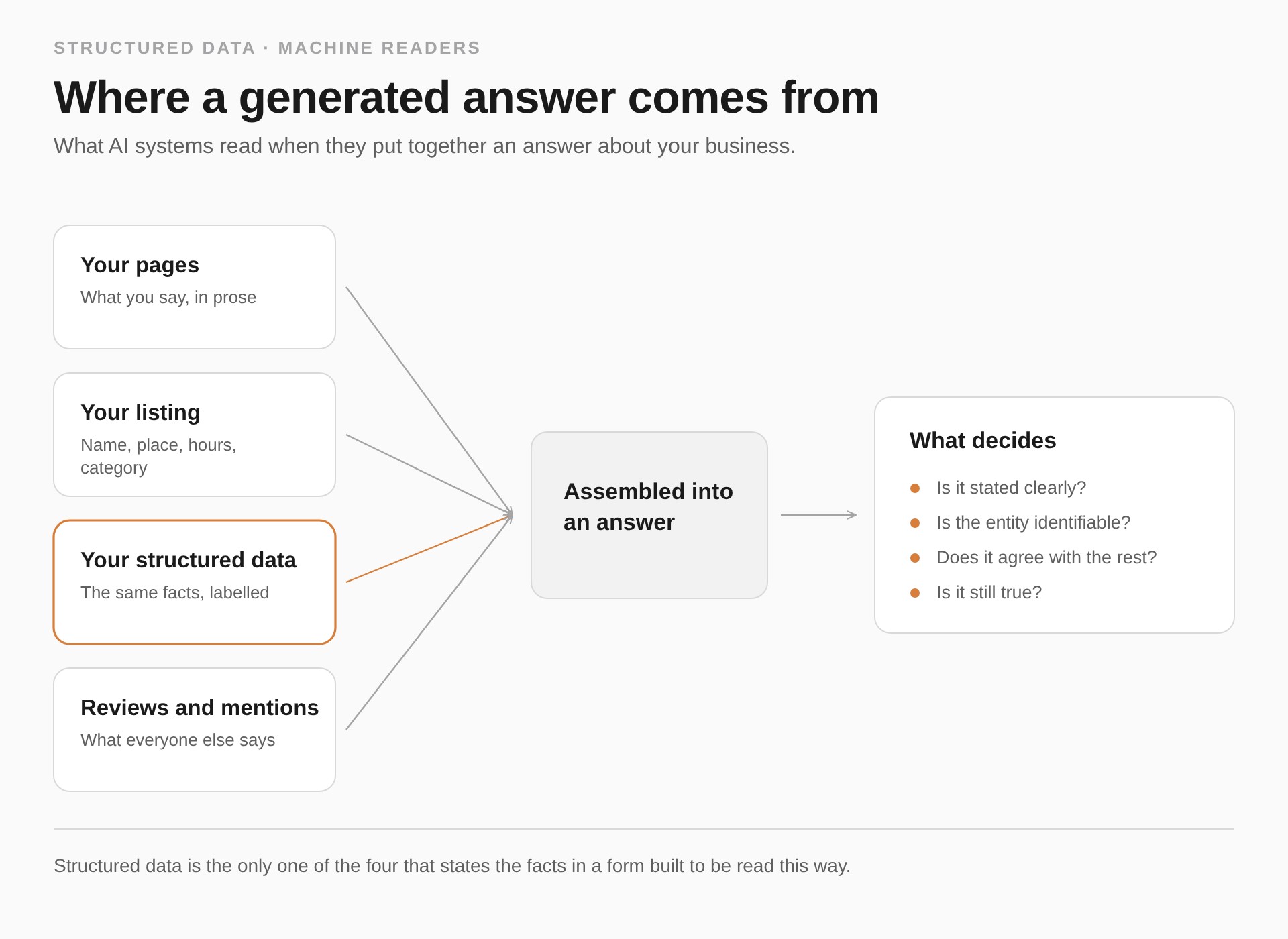
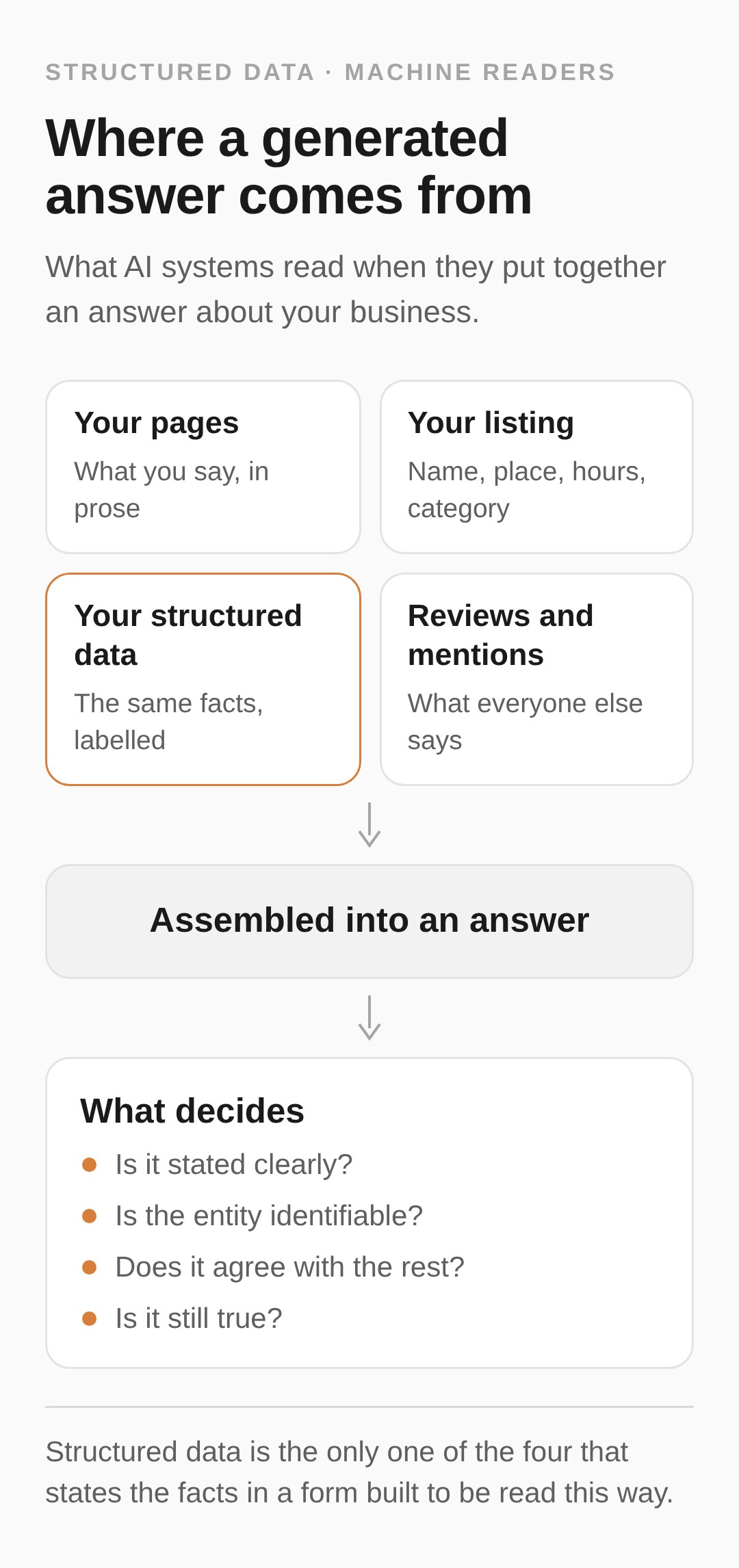
AI systems build their answers from four kinds of sources, and structured data is one of them.
A knowledge graph is one part of getting your business into AI answers. The other parts, like your website’s content, your Google Business Profile and your reviews, are covered on the AI search optimization page.
Structured Data for Medical Practices
A medical practice is the kind of business a detailed graph describes best.
It has an organization, offices, physicians, credentials, specialties, services, and a body of medical information. The relationships between them are part of what patients, referring physicians, and prospective hires need to understand.
Schema.org has a large medical vocabulary of its own, for describing conditions, symptoms, tests, therapies and drugs, and how they relate. This is called medical schema markup. I use the parts that match the practice and what it publishes.

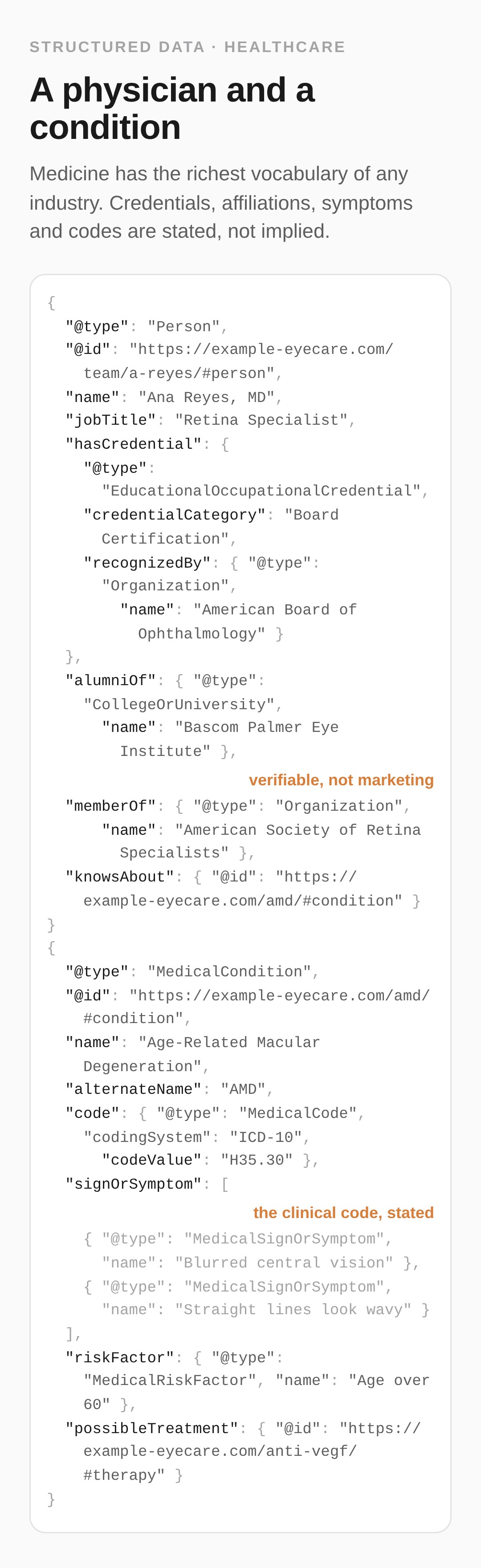
Code describing a retina specialist and macular degeneration, with her credentials and the condition’s medical code.
The Right Facts Attached to the Right Provider
A provider’s training, affiliations and role are described once and connected to their bio, their office pages and anything they have written, so search engines see one person everywhere.
Clinical Detail, in Plain Language
The page explains a condition in words patients understand, while the code names the condition precisely and connects it to the tests and treatments on the page.
Clear Distinctions Between Locations
A practice with several offices needs an accurate account of which providers and services belong at each one, and the graph records that office by office.
Recruiting, Too
For Florida Radiology Consultants, a group of more than 60 radiologists, I built a knowledge graph across the whole site, more than 130 pages, describing the group, its physicians and its services. Every opening on its job board is structured for Google’s job results, because the site’s first priority is recruiting radiologists. The website serves candidates and partners as well as patients.

The careers page and job board I built for Florida Radiology Consultants.
The wider work, including content, provider pages, and local visibility, is covered on the healthcare SEO page.
How I Build It
My schema markup service is custom work. I design the graph around your business, check the code page by page, and take responsibility for the facts in it.
Audit What Is Already There
I check what structured data your site has now, including anything its tools add automatically, and look for missing information, conflicting details and code that no longer matches the page.
Map the Business
With you, I work out what belongs in the graph, such as your locations, your people and your services, and how they connect. Anything missing from the website gets fixed on the page too.
Build the Connections
I describe every person, place and service in Schema.org’s terms and connect each one to the others it relates to, across the pages where it appears.
I use AI to speed up the repetitive code work. I make the decisions about what goes in the graph, and I check the result.
Validate and Maintain
I test the code, make sure it matches what the page says, and check that it qualifies for Google’s richer listings. I also check every fact against the business.
As the business changes, the graph changes with it. New locations, people and services are added to what is already there.
Every website I build comes with a full knowledge graph, built at the same time as the site. If you already have a website and want a knowledge graph added to it, I have options for that too.
Related
SEO and content strategy
Search, local SEO, schema, and AI visibility.
AI search optimization
Showing up in AI answers.
Healthcare SEO
SEO for independent practices.
Local SEO
Maps, profiles, and “near me” searches, explained.
See my work
Case studies, and what happened after launch.
Related
SEO and content strategy
Search, local SEO, schema, and AI visibility.
AI search optimization
Showing up in AI answers.
Healthcare SEO
SEO for independent practices.
Local SEO
Maps, profiles, and “near me” searches, explained.
See my work
Case studies, and what happened after launch.
A QUICK CONVERSATION
Not sure what your structured data says about you? Start with a conversation.
“As physicians and practice owners, our expertise is in taking care of patients, not navigating the complexities of websites, search algorithms, and digital marketing platforms. Josh allows us to focus on practicing medicine while knowing that an essential component of our business growth is in capable hands.”
Dr. Thomas Shane · Ophthalmologist & Founder, Shane Retina
Common questions
What people ask.
What is schema markup?
Schema markup is code that describes your website’s content using a shared vocabulary called Schema.org. It labels facts about your organization, people, places and services, and defines how they relate. Put all of those relationships together and you get a map of your whole business, called a knowledge graph. Search engines and AI tools can follow that map to answer questions no single page answers. It sits within the page without changing its appearance.
What is a knowledge graph?
A knowledge graph is a detailed description of your business, written in code that search engines and AI tools can read. It covers the organization, its locations, its people, its services, and the subjects on its website. The connections let search engines see how it all fits together.
Does schema markup help SEO?
Yes. It helps search engines understand your pages and can earn them richer listings in Google. I build it into the whole site, alongside useful content and clear internal links.
Will a knowledge graph make AI systems recommend my business?
No one can make an AI system recommend a business. A knowledge graph gives those systems a clear, complete account of your business, straight from your own website. As they get better, they will rely on that code more, and a business that has described itself well will be ready.
Doesn't my website already have this?
It may have the basics. Many websites do, because the tools they were built with add them automatically. What those tools can’t add is knowledge of your business: who works where, whose qualifications are whose, and what each service treats. I start by checking what your site has now, then build the rest.
Can you add this to a site you did not build?
Yes. I start with the site’s existing content and code, then decide what to keep, extend or replace. Where the content is incomplete or contradictory, that gets addressed alongside the structured data.
How do I know the work is doing its job?
First, by checking the code itself: whether it is valid, everything is connected correctly, and the facts match the business. I also watch Google’s own reports for errors and richer listings, which you can see too.
Do I need a full graph for a simple business?
Yes. Every business benefits from a complete description of itself. A single-location business just has fewer pieces to connect than a practice with several offices, providers and specialties.
What happens when my business changes?
The graph gets updated along with the content it describes. When a provider joins or an office opens, I add them to the graph and connect them to the rest.

Let's build your knowledge graph
Give your website a structure that reflects the business you have built.
Tell me about your business and your website, and we’ll both get a sense of whether we’re the right match.