


Services · Web Design · Website Redesign
Website Redesign
A new website built around your business today, without losing the Google rankings your old one earned.
In short
- A redesign rebuilds your website around what your business is now, not what it was when the site went up.
- What the old site earned is protected: the rankings, the links, and the content that works.
- The new site is built beside the live one, so your current site stays up until the switch.
- Most of the businesses I work with already had a website when they came to me.
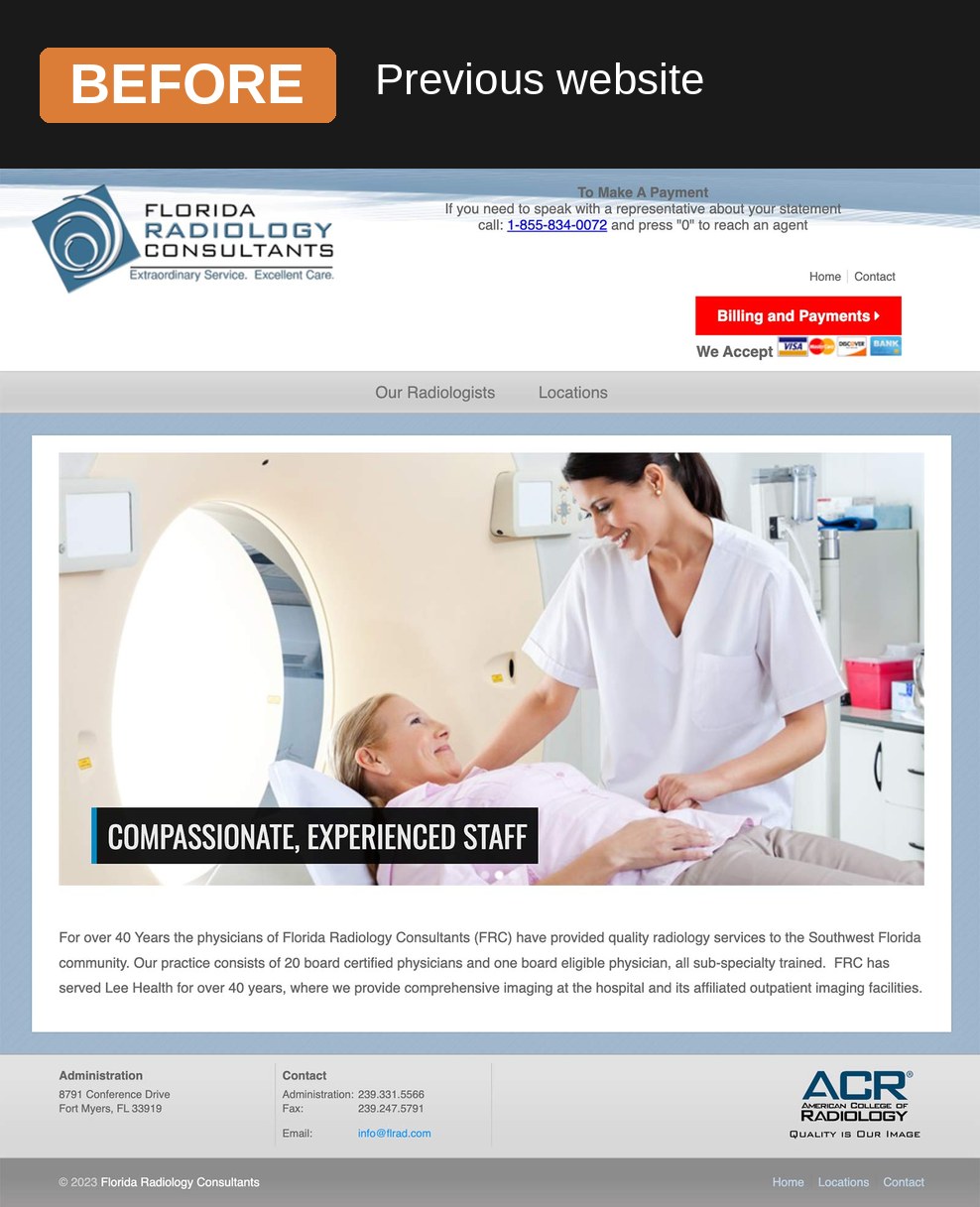

Before: a radiology group’s previous website. After: the site I rebuilt for them on a new domain.
When a Website Needs a Redesign
A website ages in two ways, and only one of them is about looks. Knowing which kind you have is where website redesign services should start.
The obvious kind of aging is visual. Design conventions move, phones change, and a site that looked sharp in 2018 starts to read as dated next to the practice or business down the street. Visitors notice this faster than owners do, because owners stop looking at their own site.
The expensive kind of aging is fit. The business grew and the website did not. You added a location, a service, a partner, or a whole line of work, and the site still describes the smaller operation you used to be. The content is thin where your customers have questions. Updating anything means calling somebody, so nobody updates anything. It is slow on the phones most of your visitors are holding. Or it sits on a platform or a theme that nobody maintains anymore, and every change risks breaking something else.
Any one of these is survivable. A redesign is called for when they stack up, because at that point the website has stopped doing its job, which is to represent the business accurately and bring customers through the front door.
Notice that age by itself is not on the list. A website built right can run for a long time. A site I built in 2016 for a functional medicine practice is still the one its patients see, and it has needed very little since. That story is on the WordPress maintenance page. The question is never how old the site is. It is whether the site still tells the truth about your business.
Refresh, Redesign, or Rebuild
These words get used interchangeably, along with revamp and relaunch, and they should not be, because they describe different amounts of work.
A refresh keeps the structure and updates the surface. Same pages, same platform, new typography, new colors, new imagery, tightened copy. A refresh is right when the site’s bones are good and only the presentation has aged.
A redesign rethinks the website itself. The structure, the content and the design are all reconsidered against what the business is now, and the site is rebuilt page by page.
A rebuild replaces the foundation too. Sometimes the platform is the problem: an abandoned theme, a builder the business has outgrown, a system nobody can safely touch. Then the site moves to a new foundation, and the project includes a migration. Most of my redesigns are rebuilds too. I start the new site from scratch on the tools I build with, so the design and the foundation are both new.
You do not need to know which one you need. Sorting that out is the first thing I do when I look at a site, and the answer is not always the biggest one. Good bones are worth keeping. When what you have can be refreshed instead of rebuilt, that is what I will tell you.
What a Redesign Actually Changes
A redesign is not a new coat of paint. Done right, it works through every layer of the website, in order.
Structure comes first. What pages exist, what each one is for, and how a visitor moves between them. In a redesign, structure gets decided with evidence the original build never had: which pages people actually visit, what they search for, where they leave. How I think about structure and design is laid out on the web design page, and all of it applies here.
Content is rewritten to match the business you are now. This is the heart of most redesigns. The services you have added get real pages. The questions your customers ask get answered. What was thin gets depth, because thorough content is what earns search traffic and what convinces a careful reader. And what still works is kept. Plenty of older sites contain writing that earns its place, and the judgment to recognize it matters as much as replacing what doesn’t.
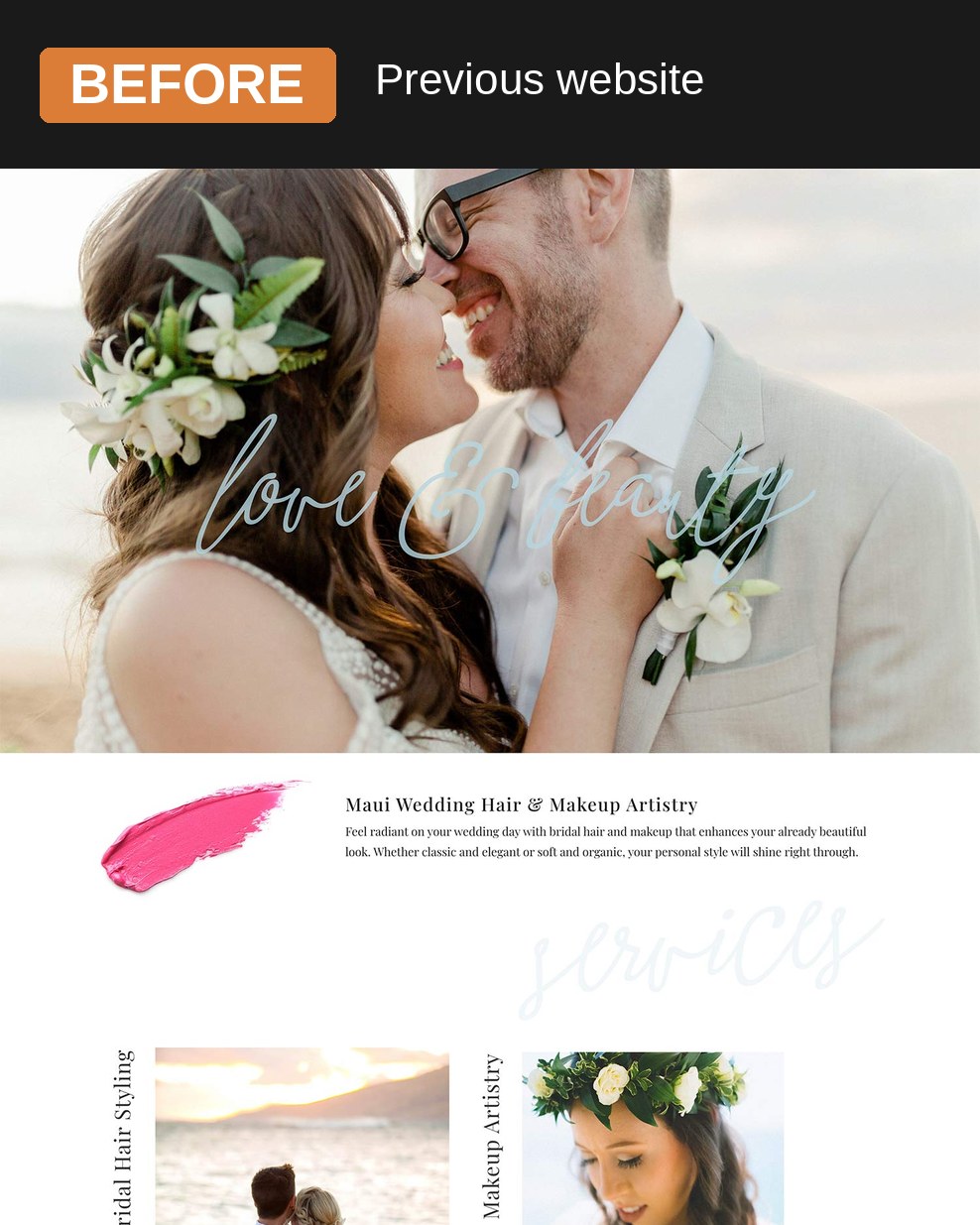

Before: a Maui wedding hair and makeup studio’s previous homepage. After: the new site, built around real photographs of her work.
“Before working with Josh, my website felt dated, generic, and didn’t reflect the quality of work my team and I were producing. … The entire website feels elevated, professional, and inviting, but still captures our relaxed aloha vibe. Josh really understood how to blend luxury with our down-to-earth personality. The beautiful fonts, layout, and imagery make you want to keep scrolling. It finally looks and feels like the established, high-end bridal beauty company we’ve worked so hard to become.”
Nikki Quinn · Lead Stylist and Owner, Love and Beauty Maui
Design is the layer you can see. New typography, color, imagery and layout, built around the site’s actual jobs rather than around decoration.
Performance is part of the design. The new site should load fast and feel solid on a phone as well as a desktop, because a slow site reads as a broken site no matter how it looks.
The through line is subtraction as much as addition. Old websites accumulate: pages nobody reads, menus that grew one item at a time, five ways of saying the same thing. A redesign is the moment to take away everything that is not doing work.
“Perfection is achieved, not when there is nothing more to add, but when there is nothing left to take away.”
– Antoine de Saint-Exupéry
The Part Most Redesigns Get Wrong: Your Rankings
Here is the most expensive mistake in website redesigns, and it is a common one.
A business launches a beautiful new site. The page addresses change and nothing redirects the old ones. Content gets trimmed because the old pages felt cluttered. Titles and descriptions become whatever the new template generated. Within a month, search traffic has fallen off a cliff, and the phone is quieter than it was before all that money was spent. If you have lived some version of this, it did not have to happen.
Your current website has earned things that never show up in a design review. Positions in search results. Links from other sites pointing at specific pages. Content that quietly answers the questions your customers type into Google. A redesign that ignores all of that is a redesign priced on how it looks, and it can cost more in lost business than it costs in fees. This is why it is so important to work with a professional on a redesign: someone who knows how to protect what your current site has earned while building the new one.
Protecting it is not complicated. It is deliberate work, done in order:
Inventory before anything changes. What ranks, which pages earn visits, and which pages other sites link to.
Keep addresses where possible, and map the rest. Old addresses lead to the right page on the new site, so visitors and search engines don’t hit dead ends.
Keep the content that earns traffic. Improved and reorganized, not deleted because it was inconvenient to a layout.
Keep the titles and descriptions that work. A new site often replaces them with generic ones from the template. The ones that earn clicks get carried over, and the rest are written by hand.
Rebuild the structured data. The new site should describe itself to search engines and AI systems at least as well as the old one did.
Verify after launch. Watching how search engines take the new site, and catching anything that slipped.
This extends all the way to a new name or a new domain, the riskiest move a business can make online. I have taken many businesses through a full name and domain change with the redirects, the listings and the structured data handled together.
Done this way, a redesign doesn’t cost you your rankings: the website changes without losing the SEO it built, and it is often what gets them moving. A new name and a new domain is the hardest case in website migration SEO, and two of my clients show how it can go. When Retina Care Consultants became Shane Retina, the old addresses were sent to the new ones and the Google profiles were renamed on launch day. Within a few months, its South Sarasota office ranked higher on Google Maps for “retina specialist” than it had before the change. When Glow Dermspa became Arsenault Aesthetics, with a new name, a new domain and a new site, the practice held its spots on the Google map, and its best month for online bookings came two months after the switch.
Rebuilding on WordPress
Redesigns arrive from everywhere. Site builders like Wix and Squarespace. Agency systems the agency no longer supports. Themes that stopped updating years ago. And plenty of WordPress sites that were simply built badly, where a WordPress website redesign starts with sorting what is worth keeping.
I rebuild on WordPress, with the Astra theme and Elementor. It is the platform behind a large share of the web for good reasons: it is fast when it is built with care, and it grows with the business. If you can type, you can make basic updates yourself, and I set sites up so that stays true.


Before: a compounding pharmacy’s previous website. After: the site I built for the doctors who prescribe and the patients who send prescriptions in.
A compounding pharmacy came to me with a website built on a template it could not change or add to. I designed a new logo and built a website for two audiences: the doctors who write the prescriptions and the patients who send them in. As the pharmacy grew from serving one state to more than 30, and from one pharmacy to three, the same site took on everything it needed, and today the pharmacy’s own team runs it and builds on it. The full story is in the case study.
A redesign is also the natural moment to leave a platform that has been fighting you. The move happens once, and it is planned.
Redesigns I Have Done
Most of my case studies began with a website the business already had, so the website redesign examples below come with their results.
Arsenault Dermatology has never needed a full rebuild. The homepage has been redesigned several times, and the rest of the site has grown in place as the practice went from three offices to seven.
Shane Retina was redesigned a few pages at a time. Most of the content was kept, because it was already doing its job, and the search positions the practice had earned came through and kept climbing.
Florida Radiology Consultants was rebuilt on a new domain, built to recruit radiologists and win partners for the group. More than 30 radiologists have joined since 2024, and its procedure pages bring patients in from Google.
Medrock Pharmacy grew from serving one state to more than 30, and from one Florida pharmacy to three, and the same website took all of it on.
Skin Health Forever wanted a clear front door: who the practice is, what it treats, and how to book. The new site is built around its special expertise in skin of color, and it is the practice Google shows first when someone in Tampa searches for a Black dermatologist.
Love and Beauty Maui does stunning wedding hair and makeup, and its old website hid it. The new site is built around real photographs of its brides, and monthly leads and inquiries are up 51 percent since the site launched.
Optimal Health Institute of Ohio is the long view. The practice’s first website went live before it was finished. I finished it, then built a full new site on a new domain in 2016, and that site is still the one patients see.
Redesigning a Medical Practice's Website
Most of my redesign work is for medical practices, and a healthcare website redesign has more to protect than most.
A practice website serves several audiences at once: patients deciding where to go, physicians deciding where to refer, and candidates deciding where to work. It carries provider pages and location pages that hold positions in local search. It is wired into the rest of the practice’s presence, because profiles, listings, directories and reviews all point at specific pages. And it has working parts that must not break on launch day, from patient forms to portal links to online booking.
A redesign has to respect all of that. Provider and location pages are rebuilt so the local visibility they carry is preserved. The addresses that profiles and directories point at get mapped to their replacements. Forms, portals and booking links are tested before the switch, not after. And the content is written to the standard medical content deserves: accurate, specific, and useful to a patient who is deciding.
This is the work behind my redesigns for dermatology, retina, radiology, pharmacy and functional medicine practices, and it is why the healthcare side of my practice exists. How I approach search for medical practices in particular is covered under healthcare SEO.
How a Redesign Runs
A redesign follows the same six steps as any project of mine, from the first message to launch. The website redesign strategy, and the checklist behind it, are settled in discovery and the plan. The whole process is described on the process page. Four things are different when a site already exists.
It starts with an audit. Before anything is designed, I go through what you have: what works, what ranks, what is broken, what is missing. The redesign is planned from evidence, not from taste.
The content gets an inventory. Every page is marked keep, rewrite, merge, or retire. This is where the site gets smaller and better at the same time.
The redirect map is part of the build. It is decided while the structure is decided, not remembered at the end.
The new site is built beside the old one. Your current site keeps running until the new one is ready, and the switch happens when it is done. There is no gap where your business is offline.
Most redesigns take two to three months from start to launch, depending on scope and how quickly feedback comes back. You are involved where your input matters and left alone otherwise, because you have a business to run.
What a Redesign Costs
There is no price list, because there is no standard redesign. The cost is driven by the size of the site, how much content can be kept against how much has to be written new, what the site needs to do, and the condition of what exists today.
What I can tell you is how to think about the number. Weigh the cost of a redesign against what your current website is already costing you: the patients or customers who looked and went elsewhere, the referrals who could not find what they needed, and the hours your staff spends working around a site that does not help them.
“An underperforming website charges you every month. It just never sends an invoice.”
– Josh
I do not quote a project before understanding it. Tell me about your site and your business, and after a conversation you will get a clear scope and a number for your project, not a package off a shelf. The process page explains why I work that way.
Related
Web design and development
How a site is structured and built to last.
SEO and content strategy
Search, local SEO, schema, and AI visibility.
WordPress maintenance
Updates, backups, security, and someone who answers.
Platforms and tools
The stack I build on, and why.
See my work
Case studies, and what happened after launch.
“It’s my true pleasure to share a few kind words for Josh Miller. He stepped in and helped resurrect a dying website that was rife with programming errors and contradictions trapped in the header and footer. Our load speeds were abysmal and I was honestly not sure whether the site could be saved. But saved it was!
Josh did a bang-up job working with us, correcting errors that could be corrected and providing terrific insight into what needed to be done. We ultimately moved the entire site to a new shell, getting away from the header and footer issues. Everything was seamless.
And, in addition to this technical expertise, Josh is a fantastic graphic designer as well. He recreated our homepage to something much more modern and appreciated. Thank you Josh for your terrific work. Looking forward to many more happy years working together.”
Michael Arsenault, MD, MBA · CEO, Arsenault Dermatology
How the work happens
A redesign starts with what your site has earned, not with a blank page.
First the audit: what the current site does well, what it ranks for, and where it fails. Then the plan: the structure, the content inventory, and the redirect map, decided together, before anything is designed.
The new site is built beside the live one and switched over when it is ready, with the old site’s addresses, content and visibility carried across on purpose.
After launch, I watch how search engines take the change and fix anything that slipped. From there, the site can roll into ongoing care, where it keeps getting better instead of starting to age again.
Common questions
What people ask.
How often should a website be redesigned?
There is no schedule. The common advice says every four to six years, and it is a reasonable average, but the real trigger is fit: the site no longer represents the business, will not do something the business needs, or sits on technology that is holding you back. A site built right and maintained can run far longer than the average. One of mine has since 2016.
How long does a website redesign take?
Most take two to three months from start to launch, depending on the size of the site and how quickly feedback comes back. A clear timeline is set at the start, and your current site stays up the whole time.
How much does a website redesign cost?
It depends on the size of the site, how much content is kept against how much is written new, and what the site needs to do. I do not quote a project before understanding it, so the number comes after a conversation, with a clear scope attached. It is an investment in work you should not have to redo.
Will a redesign hurt my search rankings?
Not if it is done properly. Rankings get hurt when addresses change without redirects, when content that earned traffic gets deleted, and when metadata gets thrown away. All of that is preventable, and protecting it is built into how I run a redesign. The rankings section above walks through exactly how.
Why did my traffic drop after a redesign?
Almost always one of a few causes: old addresses that no longer lead anywhere, content that was cut, metadata that was replaced with defaults, or a technical setting left over from the staging site. If this has already happened to you, it is usually diagnosable, and often recoverable. It is worth having someone look sooner rather than later.
Can you redesign a site somebody else built?
Yes. Most redesigns start exactly that way, and much of my career has been improving or replacing other people’s work. I will also tell you what the previous person got right. Good bones get kept.
Do we lose everything, or can parts of the site be kept?
Keeping what works is the point of starting with an audit. Content that earns its place stays and gets improved. Pages, photography and writing that still serve the business come along. A redesign replaces what is failing, not everything you have ever paid for.
Will the website go down during the redesign?
No. The new site is built separately while your current site keeps running, and the switch happens once the new site is ready and checked. Your business stays reachable the entire time.
What platform will the redesigned site be on?
WordPress, with the Astra theme and Elementor. It is reliable, and it is fast when built with care. The whole stack, and why I chose it, is laid out on the platforms and tools page.

Ready for a better website?
If your website no longer represents your business, that is fixable.
Tell me about the site you have and what you want it to do, and we’ll both get a sense of whether we’re the right match.