


Industries · Healthcare
Healthcare Website Design and Marketing for Independent Practices
I help the right patients find your practice, and I build you a website that gives them a reason to choose it.
Website design, SEO and local search for independent medical practices, all from one person. Each site is built to bring in new patients and keep growing after launch.





How patients choose
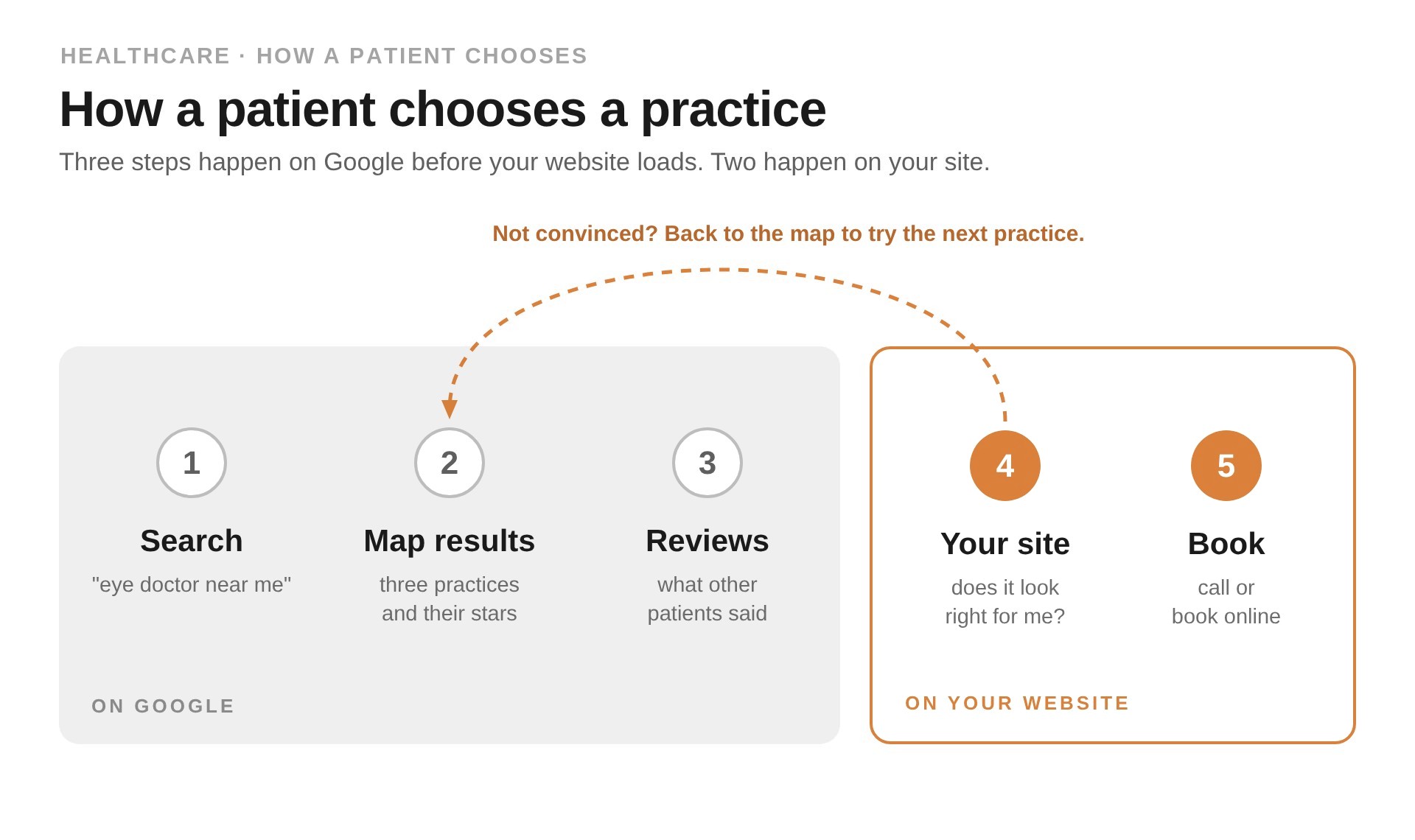
Most new patients find a practice on Google and decide before they ever call.
Patients start with what they need: a symptom, a treatment, or a specialist close to home. They check the map, read reviews and open one or two practice websites. By the time they reach yours, they already have a first impression of your practice.
Your website has to confirm that impression. Patients want to see a practice they can trust with their health and a clear way to book, and many of them are worried when they search.
Each specialty has its own version of this. Med spa clients compare photos and results. Functional medicine patients read for weeks before they book. Most radiology patients are sent by their doctor, so a radiology website also has to win over referring doctors, job candidates and partners. The specialty pages below cover each one.
That is why the work covers the Google listing and the reviews as well as the website.
“People ignore design that ignores people.”
Frank Chimero
Specialties
Every specialty is different, so each one has a page of its own.
I work with independent practices across several specialties. What works in one often helps in another. Each page below shows how I work in that field, with results from my clients.
Ophthalmology
Ophthalmology practices and subspecialties, including retina.
Med Spas
Med spas and aesthetic clinics, where clients choose by what they see.
Radiology
Diagnostic and interventional radiology groups and imaging centers.
Functional Medicine
Functional medicine, naturopathic and integrative practices.
Don’t see your specialty? I have also built websites in spine care, home care and veterinary medicine. If you run an independent practice and want to grow, it’s worth a conversation.
What a medical practice needs to get right online.
- 01
A website that reflects the practice patients will walk into.
- 02
A page for each condition and treatment patients search for.
- 03
Accurate Google listings and a strong place on the local map.
“As physicians and practice owners, our expertise is in taking care of patients, not navigating the complexities of websites, search algorithms, and digital marketing platforms. Josh allows us to focus on practicing medicine while knowing that an essential component of our business growth is in capable hands.”
Dr. Thomas Shane · Ophthalmologist & Founder, Shane Retina
How I help healthcare practices grow
Healthcare website design, SEO and local search, built to bring the right patients to your practice.
Each part of this work makes the others stronger. A well-built website helps the Google listing rank, the listing sends patients to the right pages, and structured data helps Google and AI tools understand all of it.
EARNING TRUST
Healthcare Website Design and Development
Your website is where patients decide. Good medical practice website design makes it easy to see what the practice does, who it helps and how to book, so patients feel confident choosing you. The design should also feel like the practice. The look, the photography and the words should give patients an accurate sense of it before they walk in.
Healthcare website design asks more of a site than most businesses need. A practice can have several offices, many providers and a long list of conditions and treatments, and each patient should reach the right page quickly. A website is a credibility document. The people reading it are not only patients. Referring doctors, job candidates and partners read it too.
I have designed websites for independent practices since 2014, and some of my clients have been with me for more than 10 years. Each practice I work with gets the benefit of what I have learned across every specialty I work in.
My approach starts with the practice. Before I design anything, I learn what sets it apart and which patients it most wants to reach. A website is only as good as the thinking behind it. I plan the site, write the pages and design it myself, so it fits how your patients look for care and how your practice runs.

Shane Retina’s homepage. See the case study →
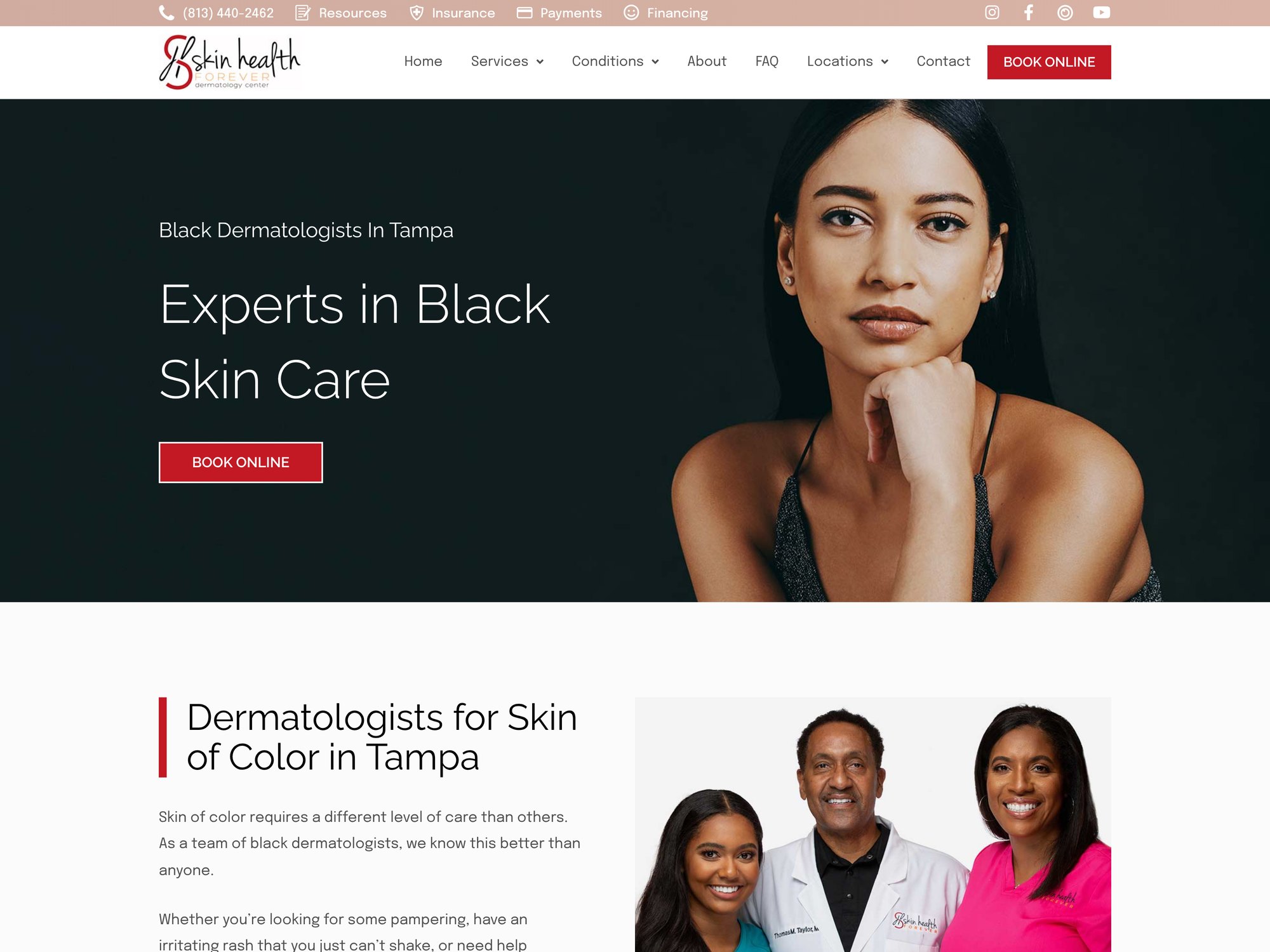
Skin Health Forever’s skin of color page. See the case study →
BEING FOUND
Healthcare SEO
Most new patients search for what they need before they know your name: a condition, a treatment, or a specialist near them. Healthcare SEO puts your practice in front of them while they search.
Healthcare SEO is search engine optimization built for medical practices. Google holds health information to a higher standard than most subjects, so accuracy and trust count for more. It takes a page for each condition, treatment and provider, written accurately in the words patients use, on a site Google can read clearly.
I build SEO into the website from the start, so the site doesn’t have to be reworked later to fit it. I judge the work by what matters to the practice, which is more of the right patients. For Arsenault Dermatology, a concentrated round of SEO work in late 2024 more than doubled visits from “near me” searches the following summer.
The work starts with your practice: what you treat and which patients you want more of. Then I look at what people in your area actually search for, and at what the practices ranking above you are doing. I write and build the pages myself, and I keep adding to them as the practice grows.
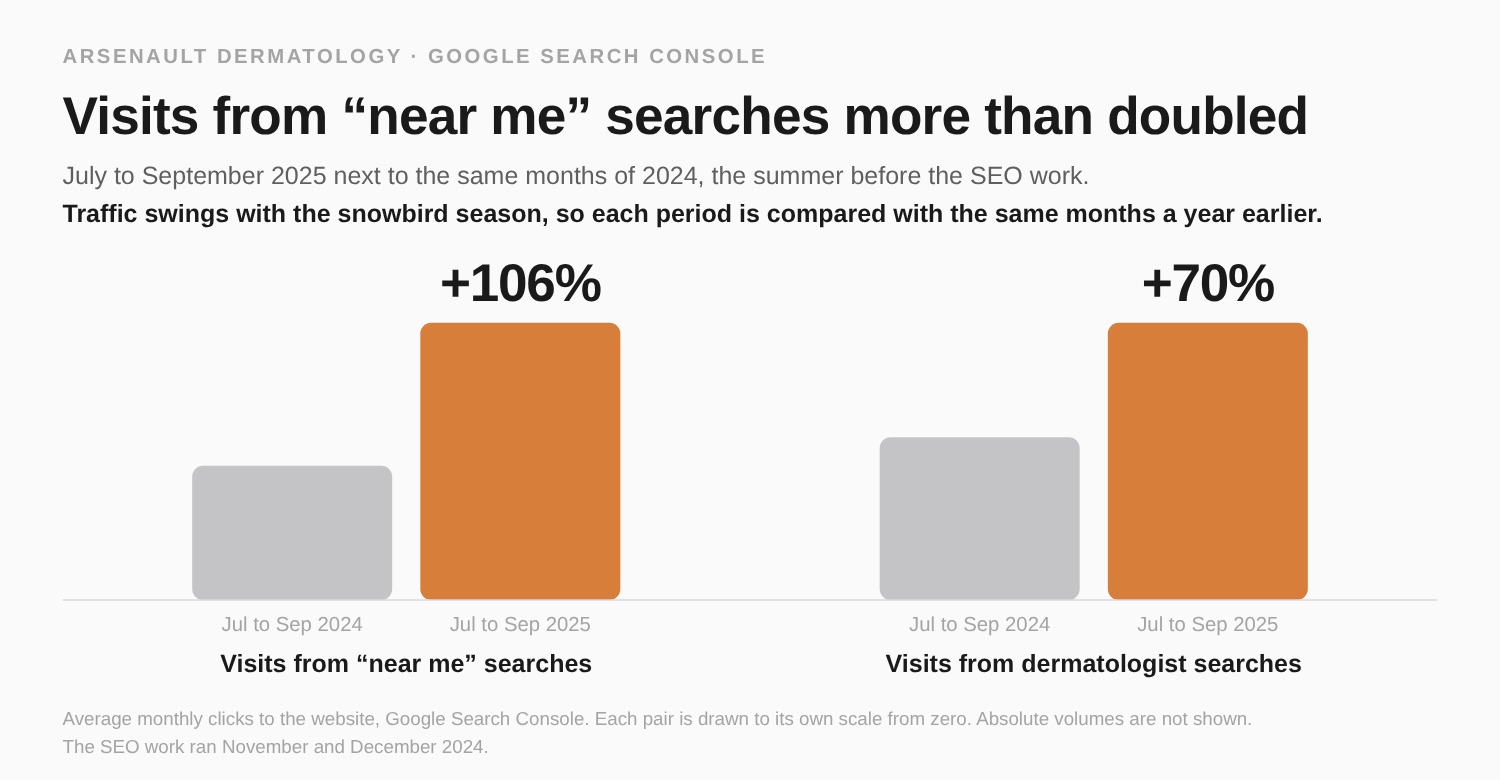
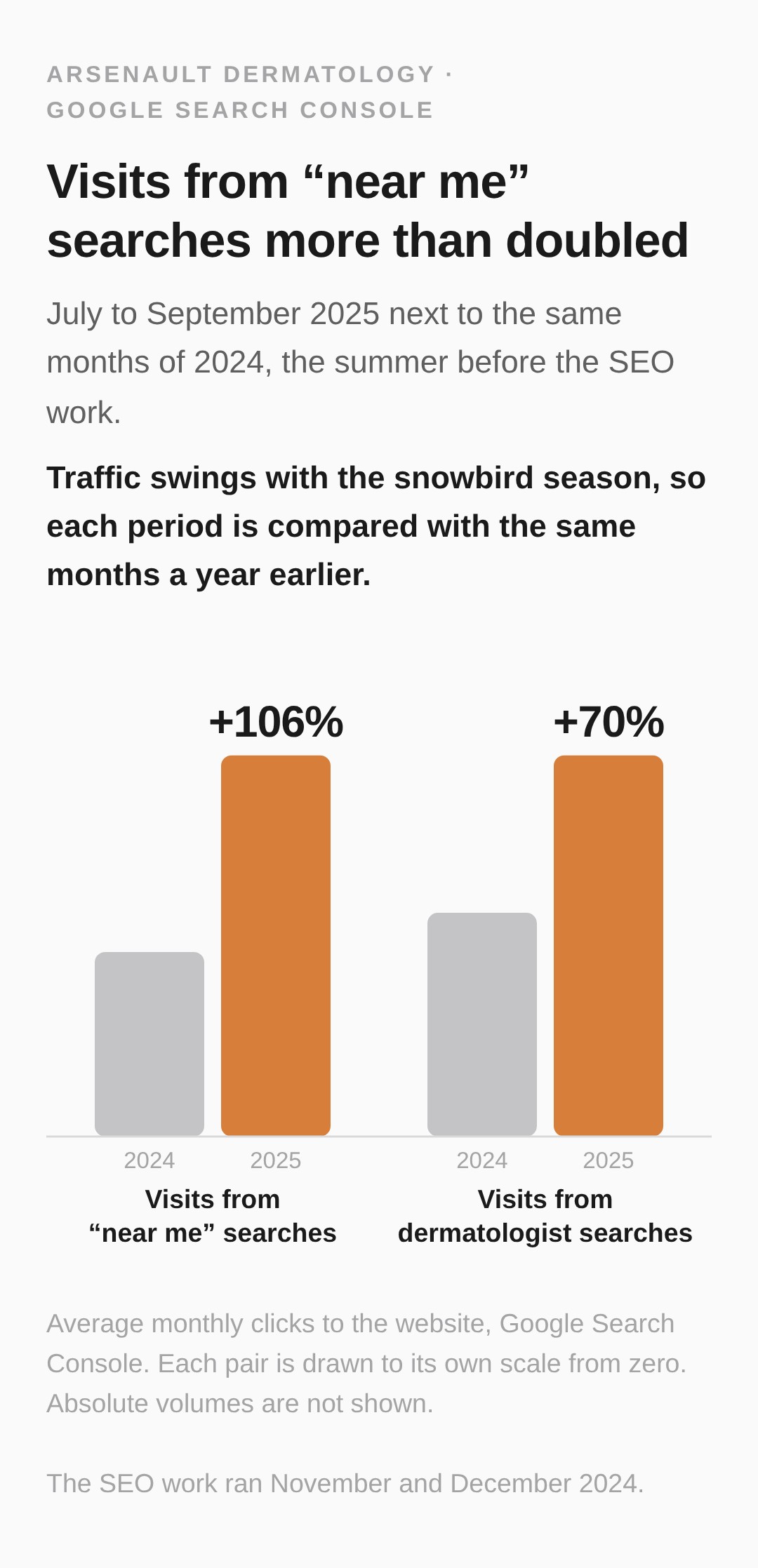
Arsenault Dermatology. See the case study →
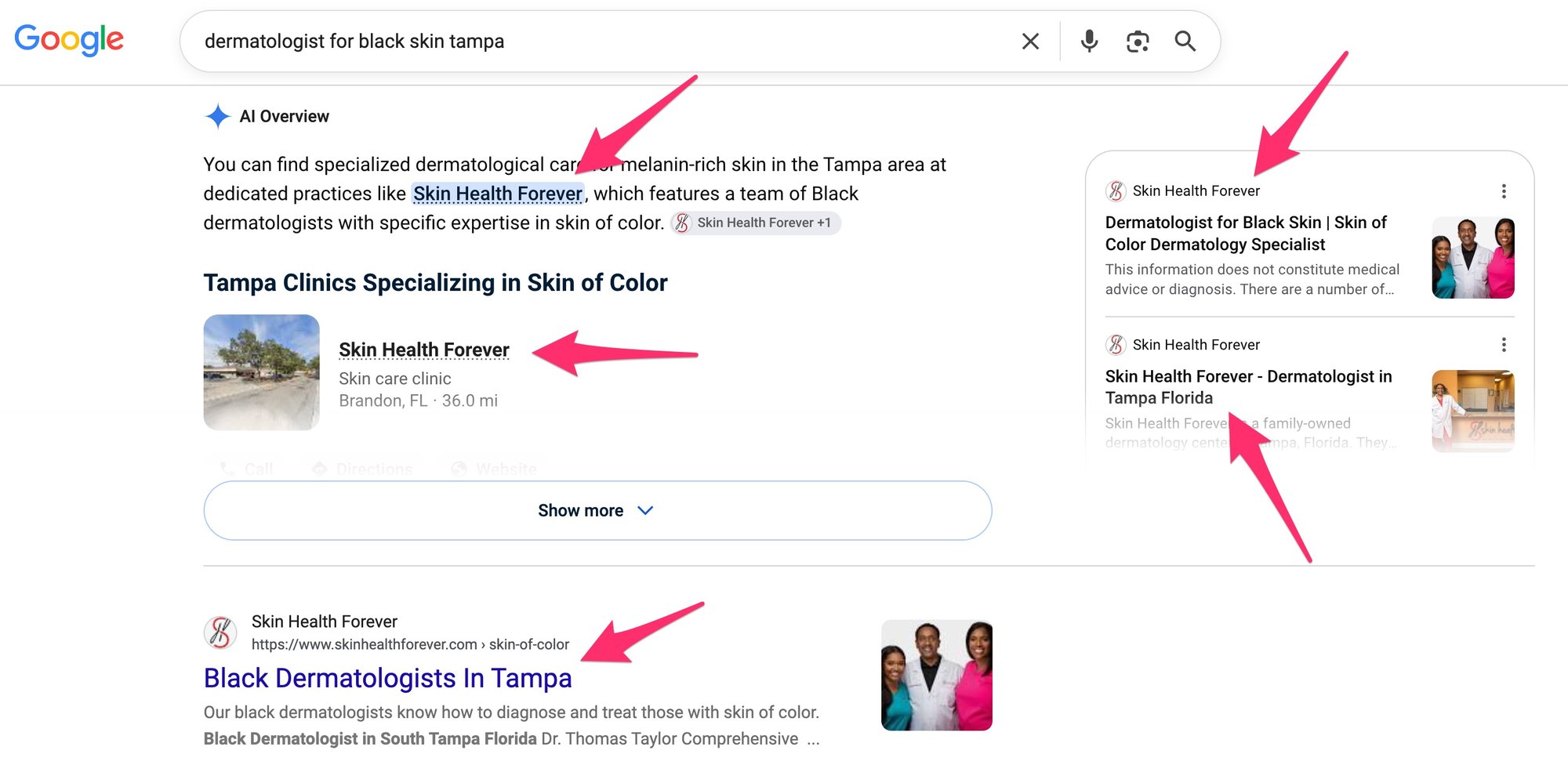
Skin Health Forever in Google’s results for “dermatologist for black skin tampa.” See the case study →
SHOWING UP NEARBY
Local SEO for Medical Practices
When someone searches “dermatologist near me” or a specialist with the name of their town, Google shows a map and a short list of practices, and most patients choose from that list. Local SEO is the part of SEO that gets your practice onto that map and keeps it there.
It starts with your Google Business Profile, the listing Google shows on the map: whether it’s complete, accurate and set up the way Google expects. It extends to the listings for each of your providers, your pages on sites like Healthgrades and Facebook, and how your website backs all of it up, so everything Google sees about your practice tells the same story. Venice Retina, a client of mine, comes up first on the map for “retina specialist” at every point I check around Venice.
I set up and look after all of it for you, from each office’s Google Business Profile to the listing for each of your providers, and I keep it accurate as the practice grows.
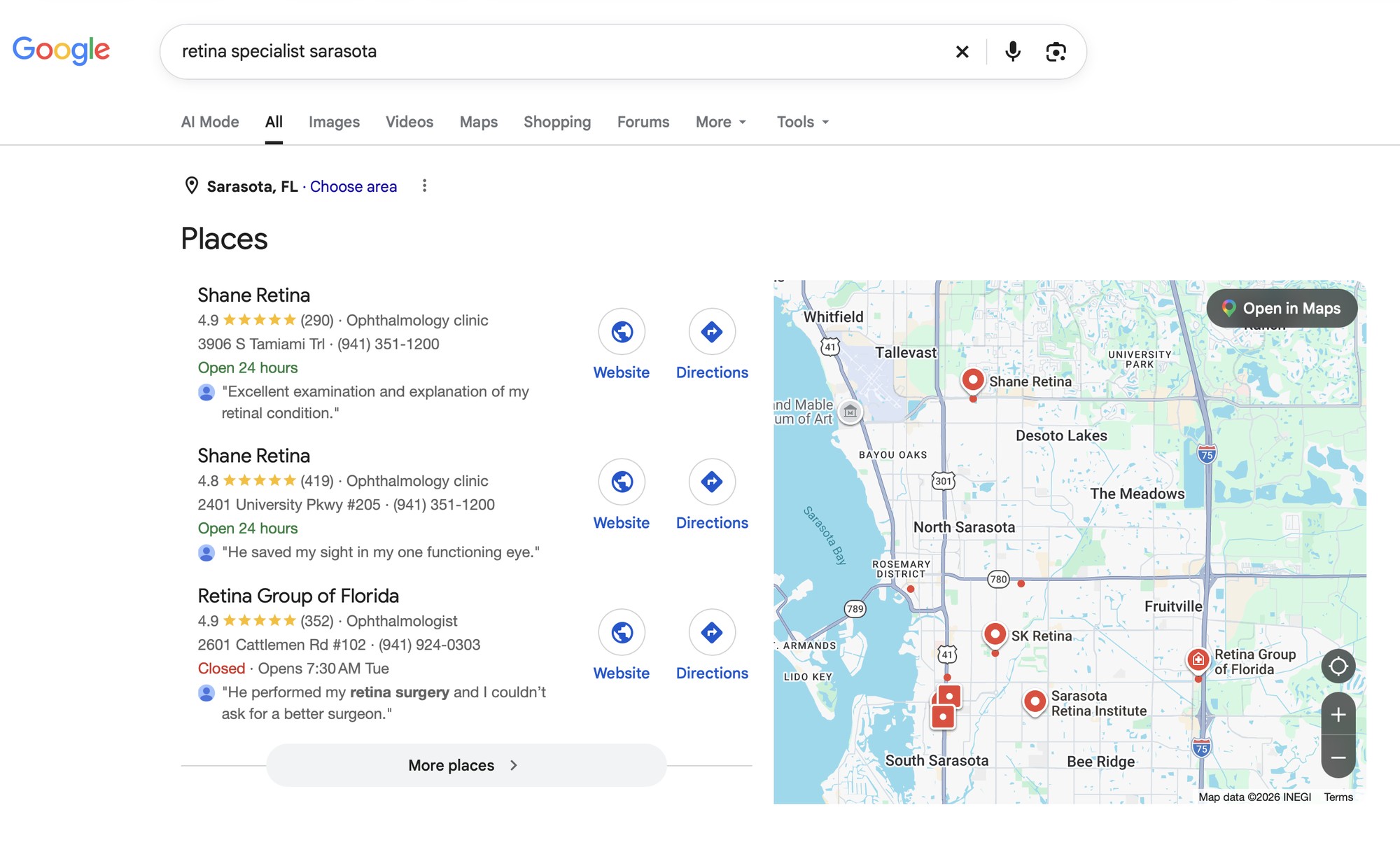
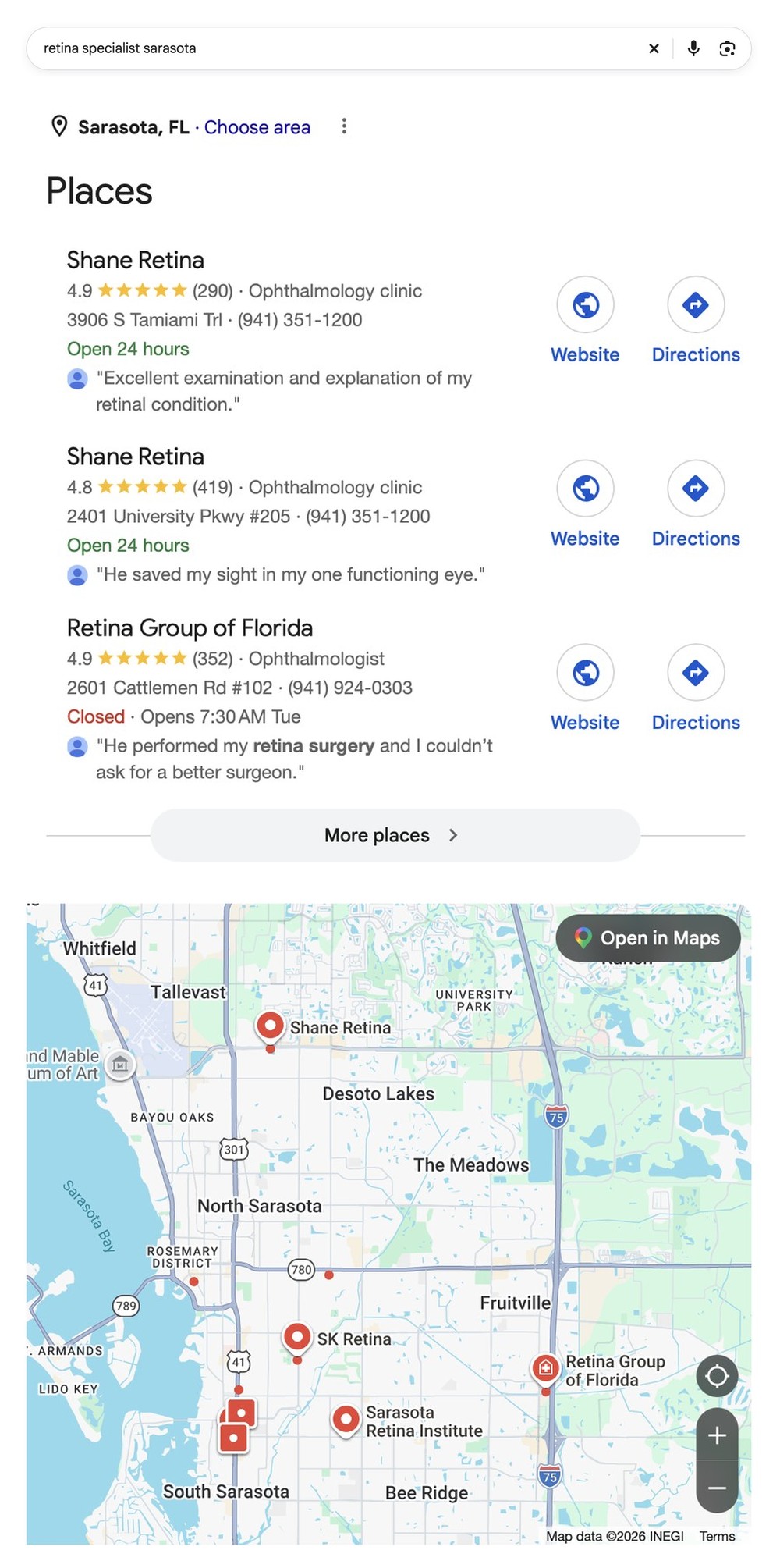
Google’s map results for “retina specialist sarasota.” Shane Retina holds the first two places. See the case study →
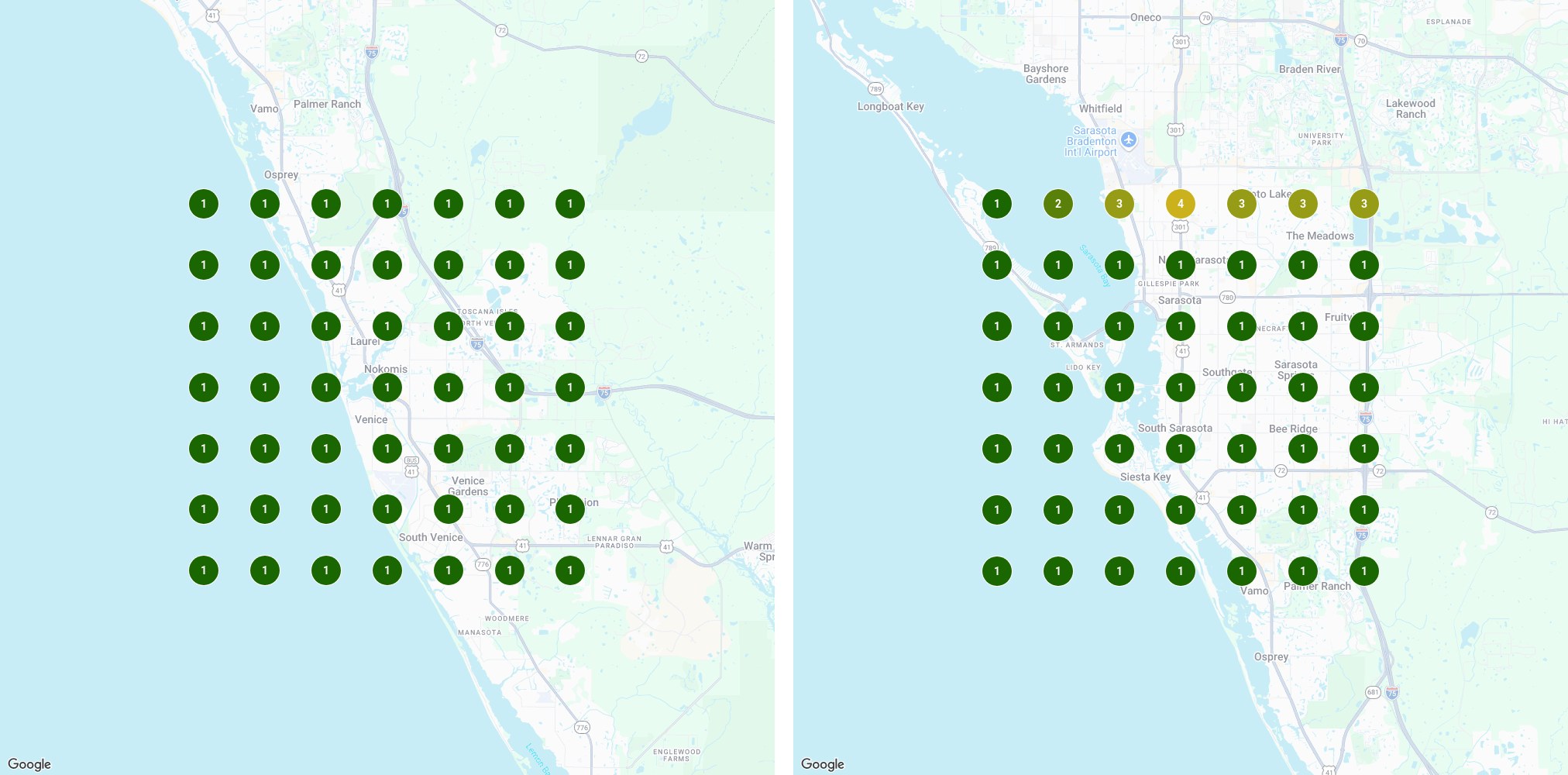
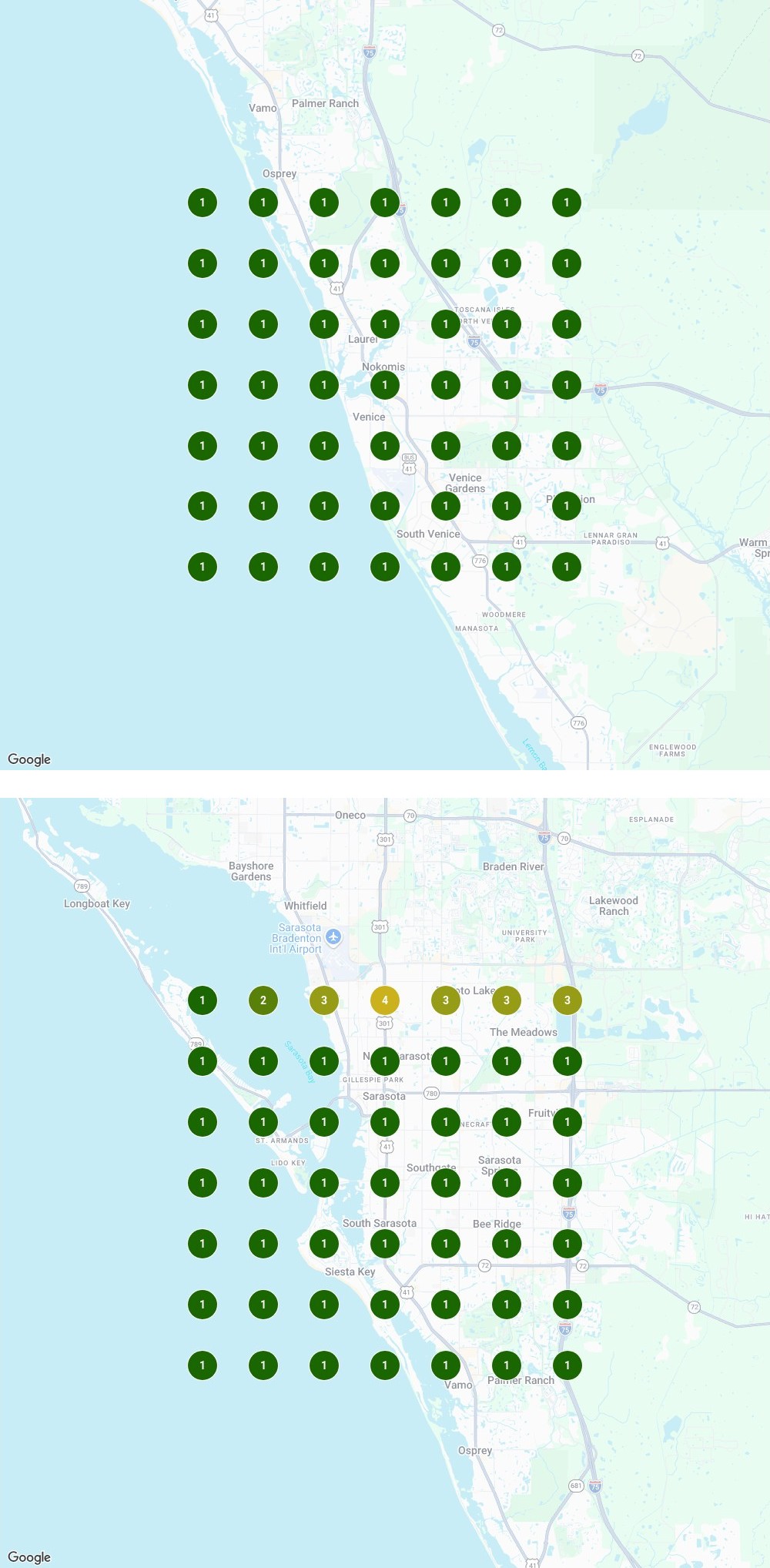
Venice Retina and Shane Retina on the Google map, checked from 49 points around each office. See the case study →
BEING UNDERSTOOD
Structured Data for Medical Practices
Structured data is code that states the key facts on your website in a way that’s made for search engines and AI tools to understand. It spells out who your providers are, what you treat and where, so they get those facts right. It is written in a shared language called Schema.org, which Google and Microsoft both read, and AI tools can read too.
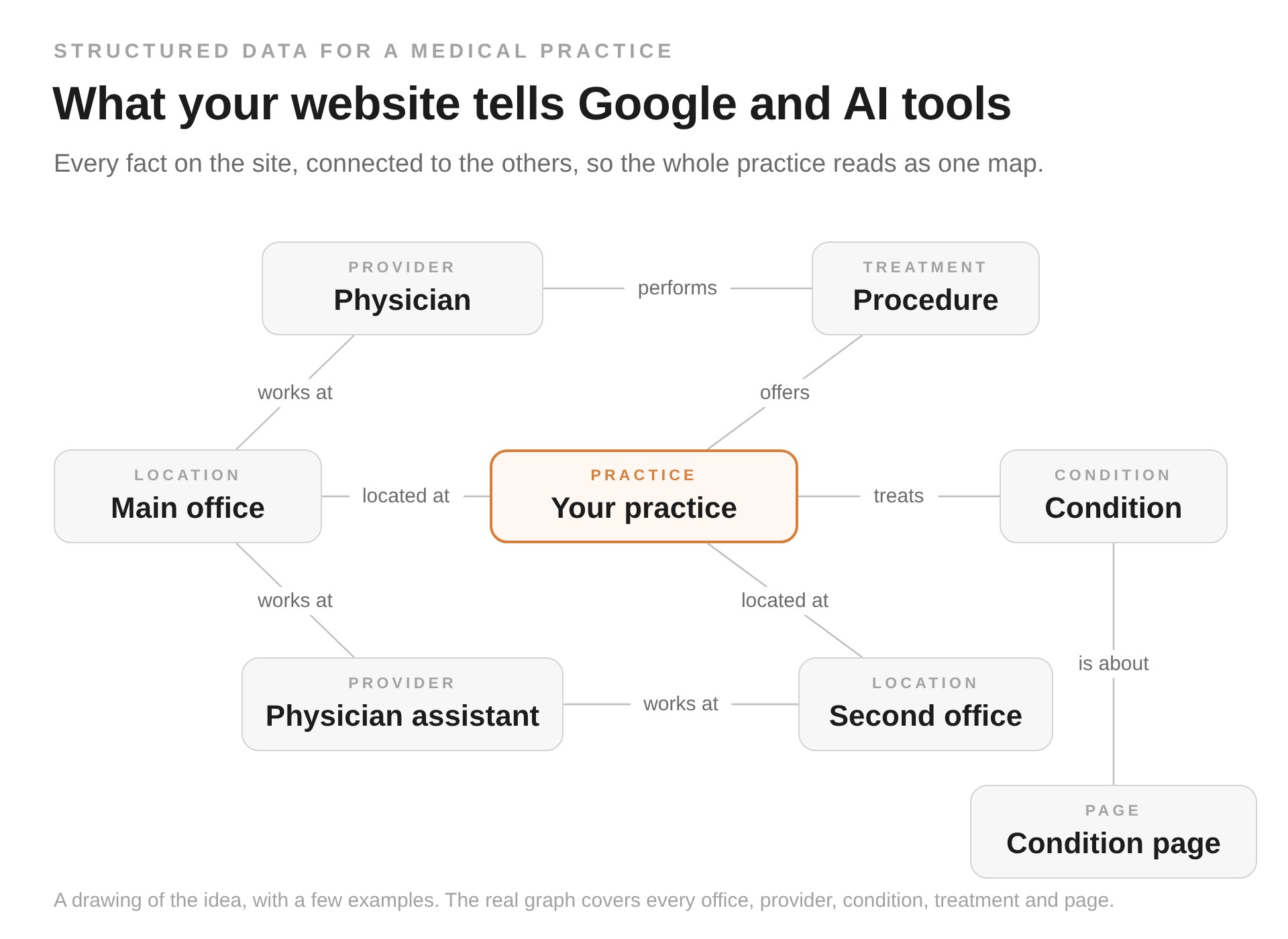
For a medical practice, structured data adds up to a map of the whole practice. The map connects each provider to the offices where they see patients and the conditions and treatments they handle. People understand a map by looking at it. Search engines and AI tools read this one in code, and it is called a knowledge graph.
Most medical practices have only basic structured data on their websites, usually little more than the practice’s name, address and hours, or none at all. As AI systems get more capable, they will rely more and more on the code behind a website.
Every website I build comes with a full knowledge graph, and I keep it current as the practice grows. If you already have a website, I have options for adding one.

BEING RECOMMENDED
AI Visibility for Medical Practices
More patients now take their health questions to AI tools like ChatGPT, Claude and Perplexity, and ask them to recommend a doctor nearby. The practices named are the ones whose pages, profiles and structured data say clearly what they do.
My clients already show up in AI answers. Ask Google for the best retina specialist in Sarasota, and its AI Overview names Dr. Thomas Shane first. AI assistants have sent Arsenault Aesthetics nearly nine hundred visits, from almost none in 2024 to dozens a month in 2026.
Starting early on AI search optimization is an advantage. AI search optimization means working on what these tools draw on: the practice’s pages, reviews, listings and knowledge graph. These tools favor practices that are well established online, and that takes time. Reviews have to add up, other sites have to mention the practice, and search engines and AI tools have to come to trust it. A practice that waits can build the same pages later, but it can’t make up that time.
I do this work for you as part of your SEO, and I regularly check how ChatGPT, Google’s AI and other tools answer when patients ask about a practice like yours. It starts with an AI Visibility Audit.
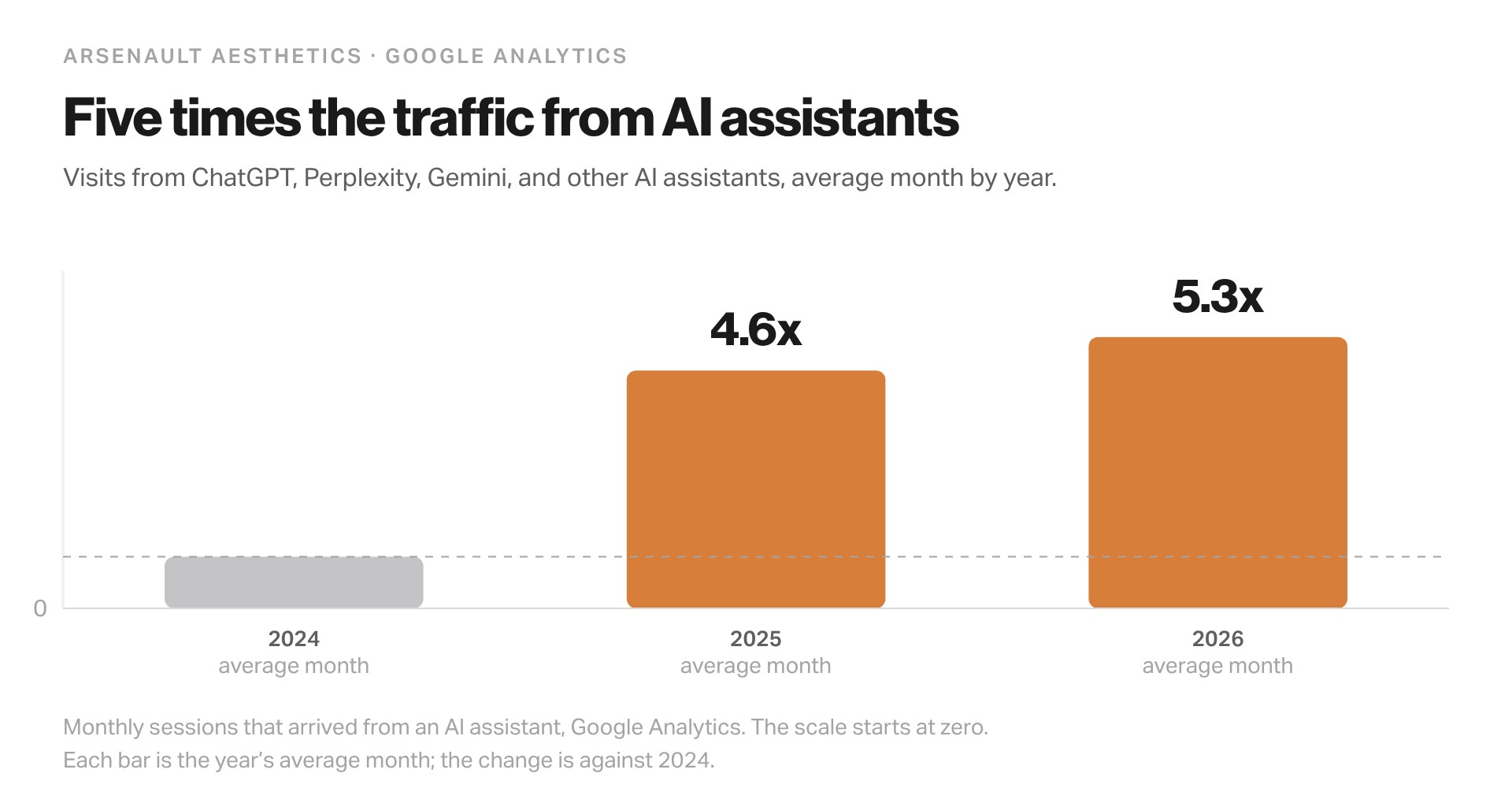
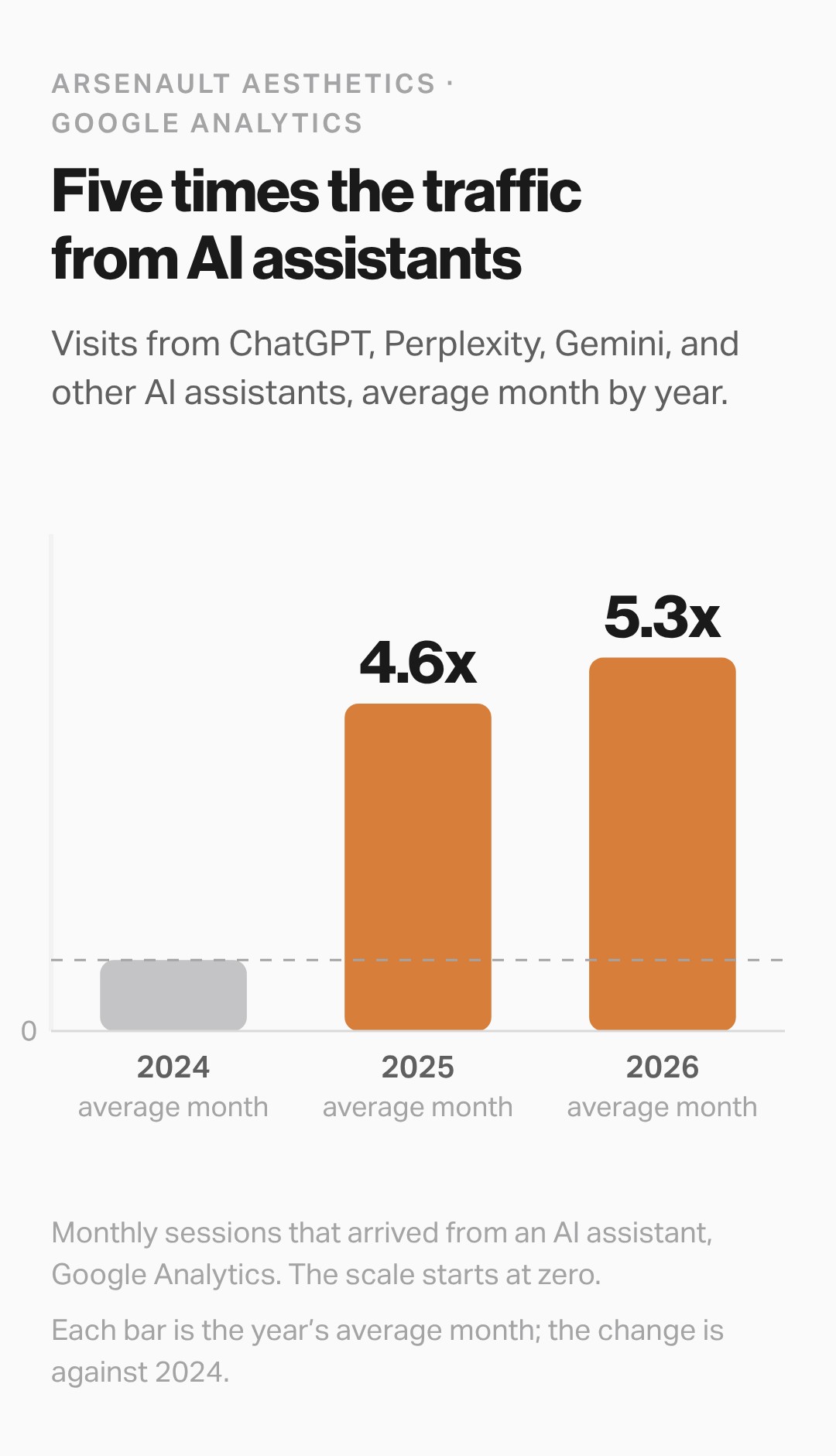
Arsenault Aesthetics. See the case study →
STAYING CURRENT
Ongoing Website Support and Maintenance
Practices change all the time. Providers join and leave, offices open, and services are added. You send me a request, and the person who reads it is the person who makes the change.
The care plan keeps the site hosted, updated, backed up and secure, the same way your phone needs its updates. New pages and other changes are covered by a retainer or billed hourly as they come up.
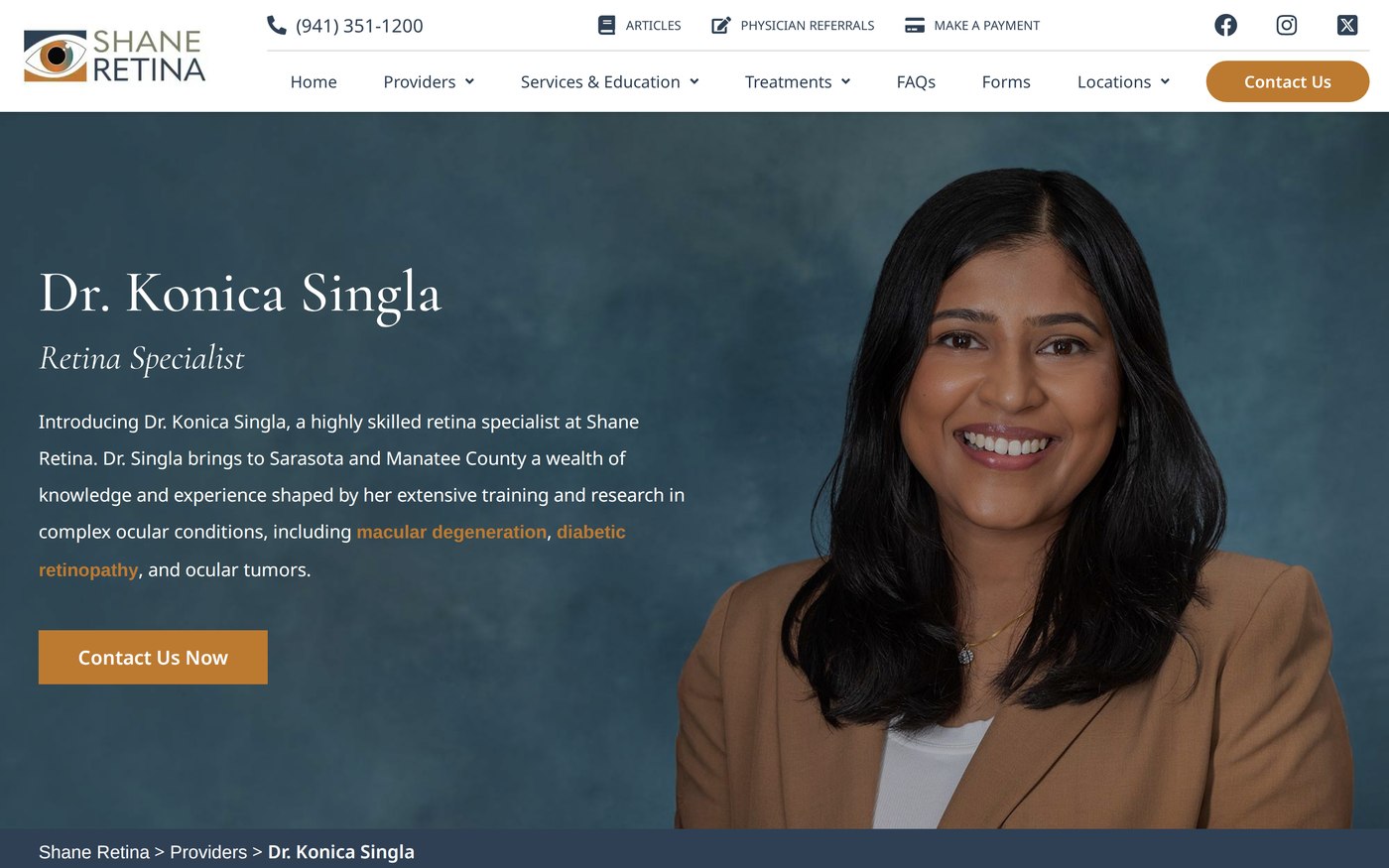
Shane Retina. A new retina specialist’s page, added when she joined the practice. See the case study →
One person, everything connected
There's one person to call.
Healthcare marketing usually gets split among several vendors. One firm builds the website, another does the SEO, and someone else looks after the Google Business Profile. You end up explaining your practice to each of them, and the details stop matching. A new provider shows up on the website but not on the Google listing, or an office changes its hours in one place and not the other.
Having one person handle all of it is a big advantage, because everything stays consistent. I design the site, write the pages, do the SEO and look after the listings, so every decision is made with the rest in mind.
It also gets better over time. I come to know your practice, your providers and how you like things done, so a short note is enough. Arsenault Dermatology’s staff have sent me more than a thousand requests since 2020, and the person who reads each one is the person who makes the change.
Independent practices have a story to tell, and it’s a strength. You may be competing with hospital systems and corporate groups that have marketing departments and large budgets. But you have your own advantage: your character, your place in the community and the care you give. Nobody wants to feel like just a number. I help show patients who you really are.
“Seven years later, Josh continues to be just as responsive, reliable, and attentive to our evolving needs as he was at the beginning. I’ve since referred him to at least three other large medical practices, all of whom have been equally thrilled with his work and have developed the same long-standing relationship with him that we have enjoyed. That, to me, is the strongest testament to the quality of his work and the trust he earns from his clients. I recommend him without hesitation.”
Dr. Anita Shane · Ophthalmologist & Founder, Venice Retina
Healthcare experience
I’ve worked with healthcare practices since 2014, from dermatology and retina to radiology, functional medicine and pharmacy.
Each of these practices still works with me.

Dermatology · Lakewood Ranch
Arsenault Dermatology
How a website keeps pace with a practice that keeps growing.
Read the case study →Med spa · Lakewood Ranch
Arsenault Aesthetics
How a brand-new practice gets found, and keeps its place through a rename.
Read the case study →Dermatology · Tampa
Skin Health Forever
How a website can reach the patients looking for a specialty without turning anyone else away.
Read the case study →Compounding pharmacy
Medrock Pharmacy
A website built for a business to grow on, and in time, to run itself.
Read the case study →Retina · Sarasota and Venice
Shane Retina and Venice Retina
What steady SEO, month after month, does for a practice over the years.
Read the case study →Radiology · Fort Myers
Florida Radiology Consultants
A website built to recruit doctors and win partners as well as bring in patients.
Read the case study →Functional medicine · Ohio
Optimal Health Institute of Ohio
How long a website lasts when it is built well the first time.
Read the case study →All Eight Case Studies
Including Love and Beauty Maui, a wedding hair and makeup studio.
See my work →





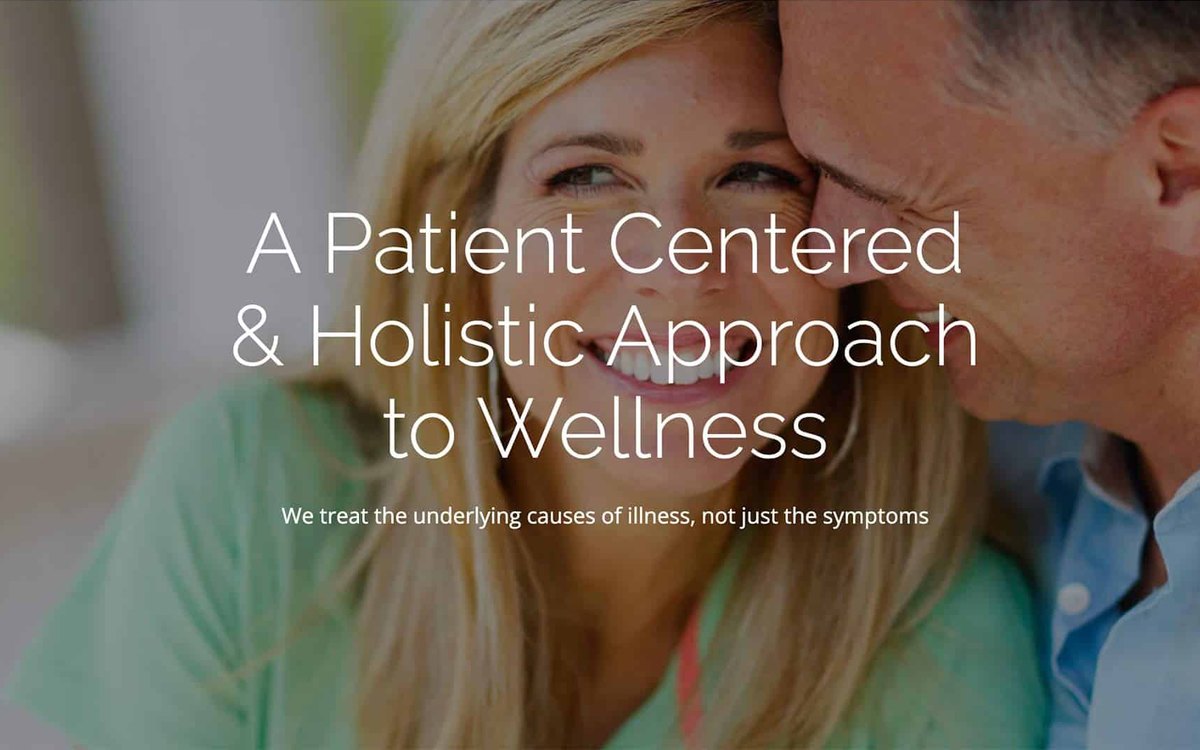
“Josh Miller is a true talent with website development, design, and knowledge on maximizing SEO content. My new website design and content was delivered on schedule and with the latest style. Over 50% of my new patient visits were referred from the web. I can not say that was the case with my previous website designed by a ‘plug and post’ company.”
Nancy Fazekas Grubb, MD · Optimal Health Institute of Ohio
A few common questions
What practice owners ask before we start.
The questions I hear most from practice owners and office managers. If yours isn’t here, ask it on the contact page.
What is healthcare marketing?
Healthcare marketing is how a medical practice reaches the patients it wants and earns their trust. For most independent practices, new patients come through search, so the website, the Google listing and the reviews come first. Ads and social media can help on top of that, especially for cosmetic care.
Do you work with medical practices?
Yes, healthcare is where I focus. My clients include dermatology, ophthalmology and retina, med spa, radiology, functional medicine and compounding pharmacy practices, and I have also built websites in spine care, home care and veterinary medicine. If you run an independent practice and want to grow, it’s worth a conversation.
What makes a good medical practice website?
A good medical practice website makes patients confident enough to book. The first screen says what the practice does, who it is for and what to do next. There is a page for each condition, treatment, provider and office, written the way patients describe things. A way to book or reach the practice is one step from every page, and the site works well on a phone. Underneath, structured data tells Google and AI tools exactly what the practice is.
Do you do website design for doctors, or only SEO?
Both, and usually together. When the same person does both, the structure that helps a patient find the right provider is the same structure that helps Google understand the practice. If you only need one of the two, that works too. The web design and healthcare SEO pages cover each one.
What’s the difference between SEO and local SEO for a medical practice?
Local SEO is part of SEO. SEO is the whole job of helping your practice show up in search, and local SEO is the part that deals with nearby searches and the Google map.
The rest of SEO helps patients find you while they research a condition or a treatment. Local SEO decides whether your practice appears on the map when someone searches “dermatologist near me” or a specialist with the name of their town. It adds a few things of its own: your Google Business Profile, your reviews, and how consistently your details appear across the web.
Google checks your Business Profile against your website, so it is one job, done on the same website. I handle both together.
How do you measure results in healthcare marketing?
By what matters to the practice. Usually that is more of the right patients, and for a group that is hiring it also means candidates finding the careers pages.
I watch the searches that bring people to the site, especially the ones that don’t name the practice, because that is where new patients come from. I also watch the calls and website clicks from your Google listings, where you show up on the map around each office, and the visits AI tools send you. I compare the same months a year apart, so a busy season doesn’t look like a result. With ongoing SEO, you get a short update every month in plain language.
How long does healthcare SEO take to work?
It depends on where you start. Local SEO usually moves first, often within three to four months once the Google Business Profile and listings are in order. Organic rankings for competitive searches usually take six to twelve months, and searches for a specific condition or treatment often move sooner.
The gains keep building after that. For Shane Retina, the South Sarasota office went from Google’s top three at 54 percent of the map around it in 2023 to 92 percent in 2026.
Do you work on existing sites or only build new ones?
Both. Some clients come to me for a new site. Others have a site they’re happy with and want help with SEO, local search or ongoing support. Arsenault Dermatology came to me in 2020 with a website that needed its code cleaned up, and it has grown in place since. Sometimes the right answer is to improve what is there, and sometimes it is a redesign. I’ll tell you which.
Will you write the content, or do we have to?
I’ll write it. I can write every page from scratch, and I like to start from what your providers know, because no one knows your patients better. A few notes, a bulleted list or a list of topics is enough. Early in the project I develop the voice of the practice, and every page is written in it. You can be as involved as you want to be.
Where do you work with medical practices?
Anywhere in the United States. I live in the Denver area, and my healthcare clients are in other states, from Florida to Ohio. Discovery happens in writing and we meet by video on a regular schedule, so where your practice is doesn’t change how the work goes.
What happens if you're unavailable?
I travel with my laptop, so if something urgent comes up, I can handle it from wherever I am. Your website runs on managed hosting with daily backups and a support team available around the clock, so the technical safety net doesn’t rest on one person. You own your domain, your website and your logins, and if you ever needed someone else to step in, I’d give you everything they need. I typically respond to requests quickly, and some of my clients have been with me for more than ten years. At an agency, the person who knows your practice can leave. With me, it’s always the same person.
Do you work with my competitors?
No. I won’t work with a practice that competes with one of my clients for the same patients in the same area. If you’re my client, I’m on your side, and I want you to win. I do work with practices in the same specialty in other areas, but never two competing in the same market.

Get in touch
If your practice is better than its website shows, I can help.
Tell me what your practice does best and who you want to reach, and we’ll both get a sense of whether we’re the right match.