


Services · SEO and Content Strategy
SEO & Content Strategy
Built so the right people find you.
In short
- SEO is mostly about doing things the right way.
- It's not something separate that gets added at the end.
- The goal is more of the right traffic.
What SEO Actually Is
Most people think SEO means keywords, rankings, and tricks. That framing is outdated.
Search engines and AI systems aren’t just matching keywords. They’re trying to understand what your business is, what you do, and how your content fits together. Once that’s clear, they’re more likely to connect you with the people looking for what you offer.
SEO is mostly about doing things the right way. That means accuracy, clarity, and credibility, the same things that make a website good for people. That is what I sell as an SEO expert: search engine optimization done properly, by the same person who builds the site.
It’s not something separate that gets added at the end. It’s part of how the site is structured, how the content is written, and how everything works together.
And it doesn’t stop at the edge of the website. Your site is one part of a larger online presence: your Google Business Profile, your directory listings, your social accounts, and everywhere else your business is described. Search engines and AI systems read all of it together. So I build a website with that in mind, and the SEO work takes in how the site relates to everything else that carries your name.
SEO starts with meaning
SEO doesn’t start with optimization. It starts with whether the site makes sense.
What does each page actually say? What question does it answer? How does it connect to everything else on the site?
When those things are clear, search engines don’t have to guess. They can understand what the business does, what each page represents, and how it all fits together. That gives the site its best chance of showing up in the right places.
When meaning is clear, everything else has something solid to build on. That’s where the work starts.
How I Approach SEO
Most SEO work is done in isolation. Someone builds the site. Someone else writes the content. An SEO specialist comes in afterward and tries to make it work.
That’s the wrong order. By the time SEO is considered, many of the decisions that matter most have already been made.
I approach it differently.
Because I handle web design and SEO together, along with the development and the content, SEO is part of those decisions from the start, instead of being added on after the site is built.
I pay attention to the details. Every page title, heading, internal link, and piece of structured data is handled deliberately.
The result is a site where everything points in the same direction. It’s easier to understand, easier to find, ranks higher, and is easier to build on over time.
SEO Results in Practice
I practice what I sell. For years, my own site held the #1 ranking for “freelance web designer” in Ohio, and then in Florida after I moved, earned through exactly the kind of work described on this page. That site is now Freelance Web Designer, my brand for businesses outside healthcare.
The case studies show what that work looks like for clients, at three different scales: a site built with SEO in it and no campaign after, a focused campaign, and the long haul of continuous SEO. Each one below links to the full case study, where the evidence is laid out in detail.
One Build, With SEO in It
Love and Beauty Maui is the cleanest test a website gets. It is a Maui wedding hair and makeup studio with a new site that had search built in from the start and its Google Business Profile optimized alongside it, with no campaign or retainer after launch. Inquiries through the site were up 28 percent in 2025, a year Maui destination weddings rose 8 percent, and are up 51 percent in 2026, both against the old site’s last full year.
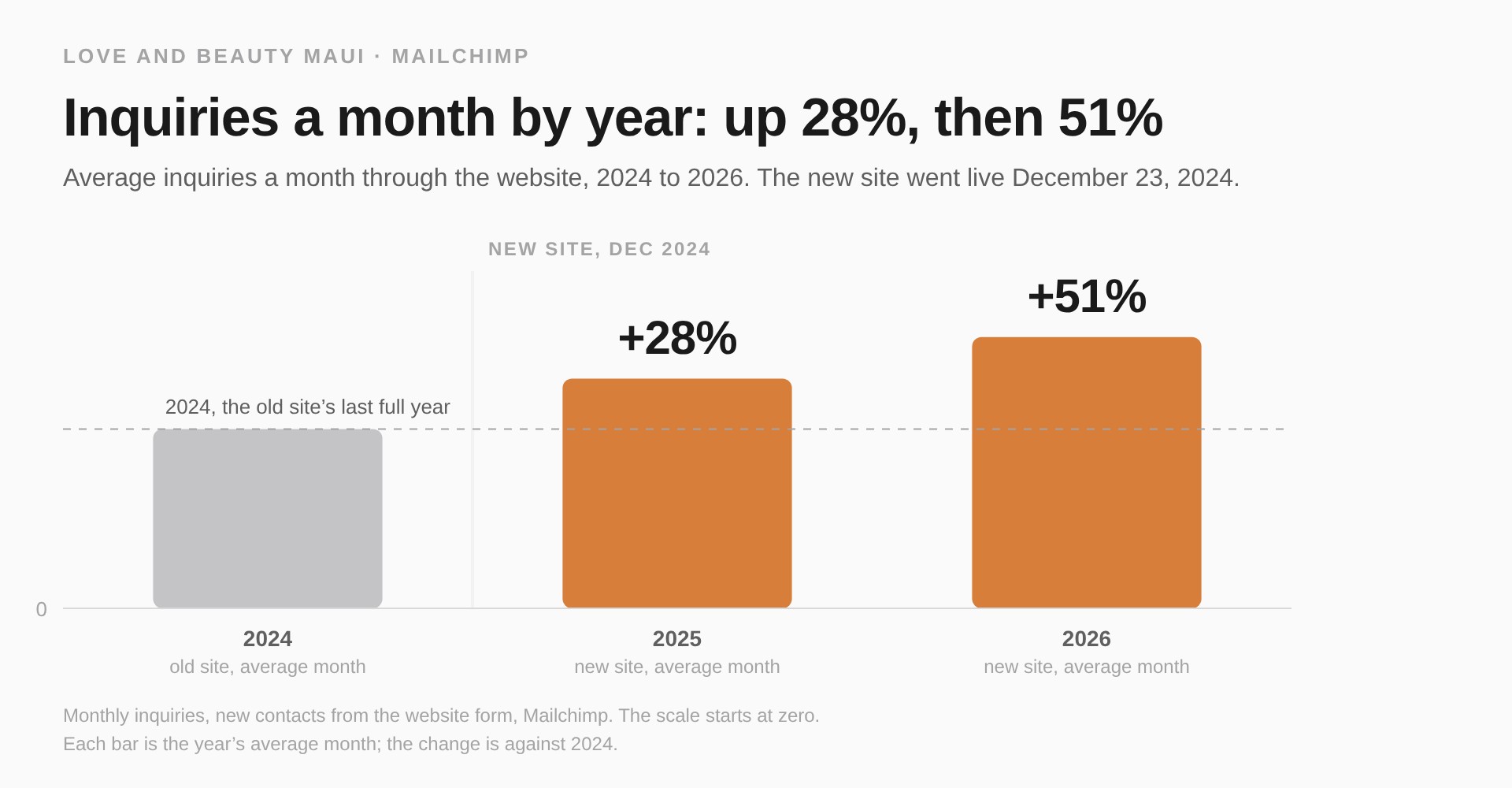
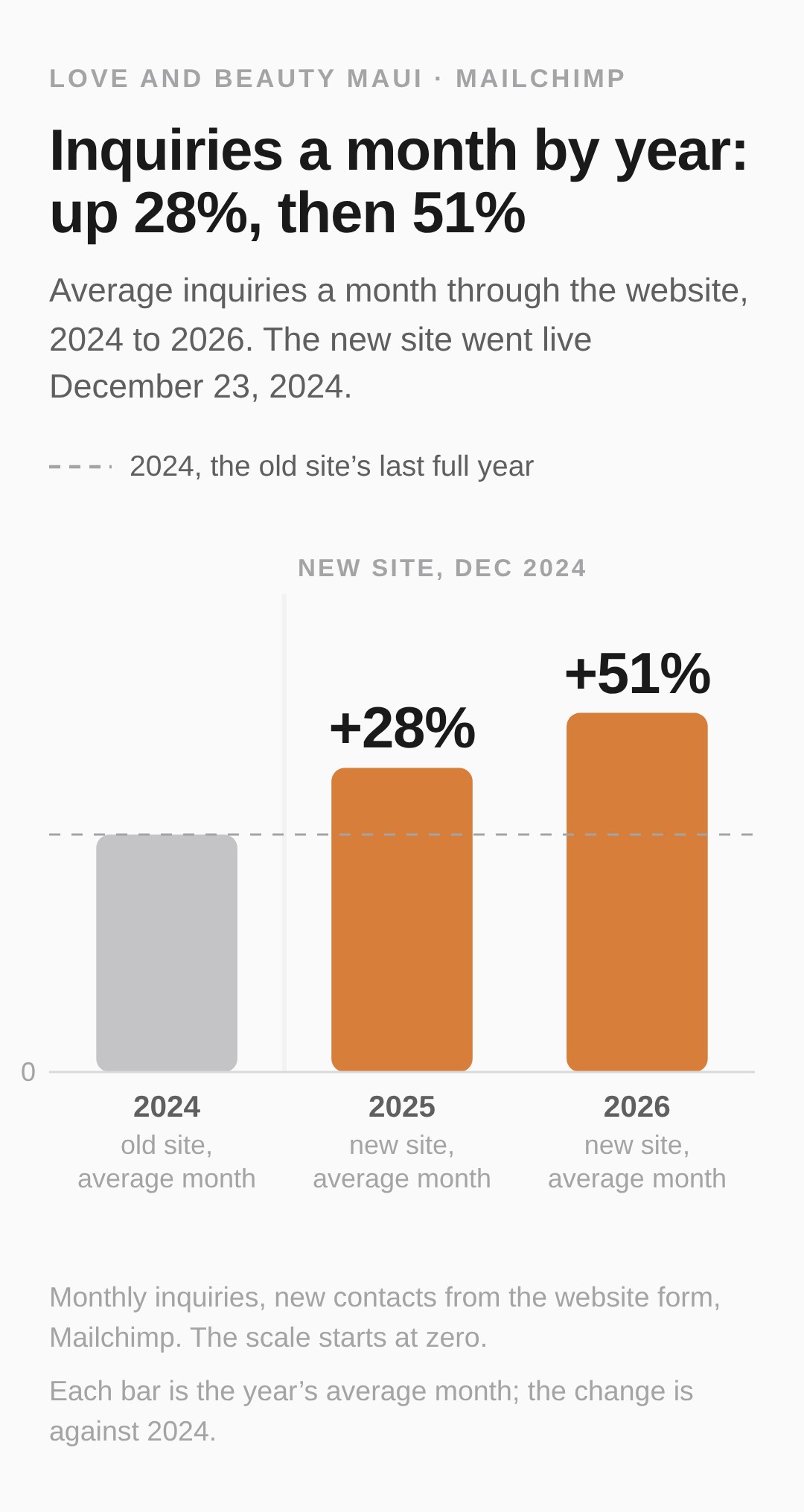
Average inquiries a month through the website: 2024 on the old site, then 2025 and 2026 on the new one.
Optimal Health Institute of Ohio shows the same thing over a longer span. I built Dr. Grubb’s functional medicine site in 2016 and wrote most of the copy. She says more than half of her new patient visits come from the web. The site shows up on Google for more than 1,000 different searches, and it has needed very little since it launched.

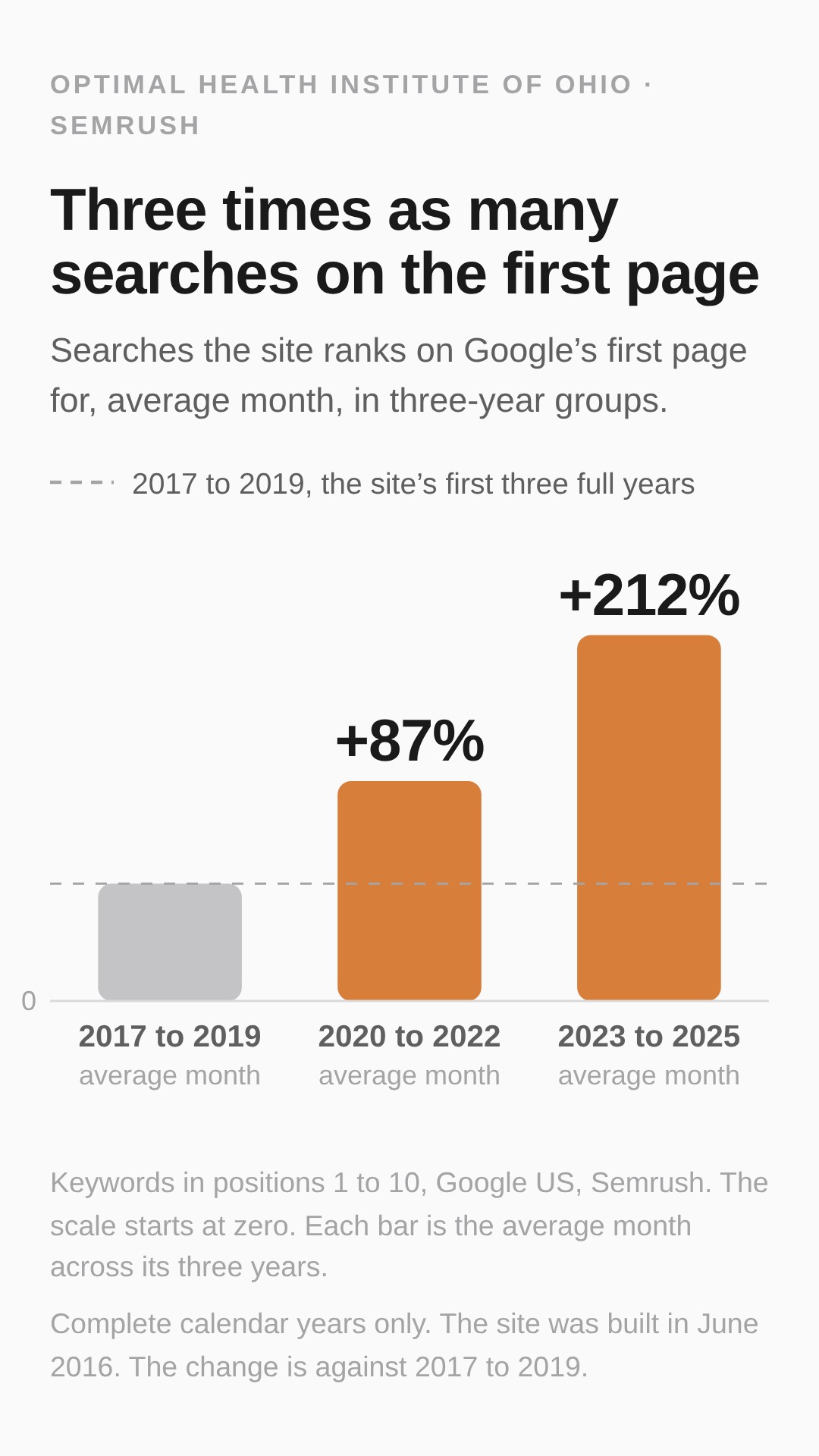
Searches the site ranks on Google’s first page for, average month in three-year groups, 2017 to 2025. Semrush.
A Focused Campaign
Arsenault Aesthetics opened as a new med spa in one of the most saturated markets in Florida. Nearly every competitor there has “med spa” in its business name, and that gives them a head start: when someone searches “med spa near me,” Google gives weight to business names that match the words in the search. Arsenault Aesthetics had no such match, so it had to be found through what was on its website. A content-driven SEO campaign took it from 25 non-branded clicks a month to 1,297, and the growth reached the appointment book: bookings up 43 percent.
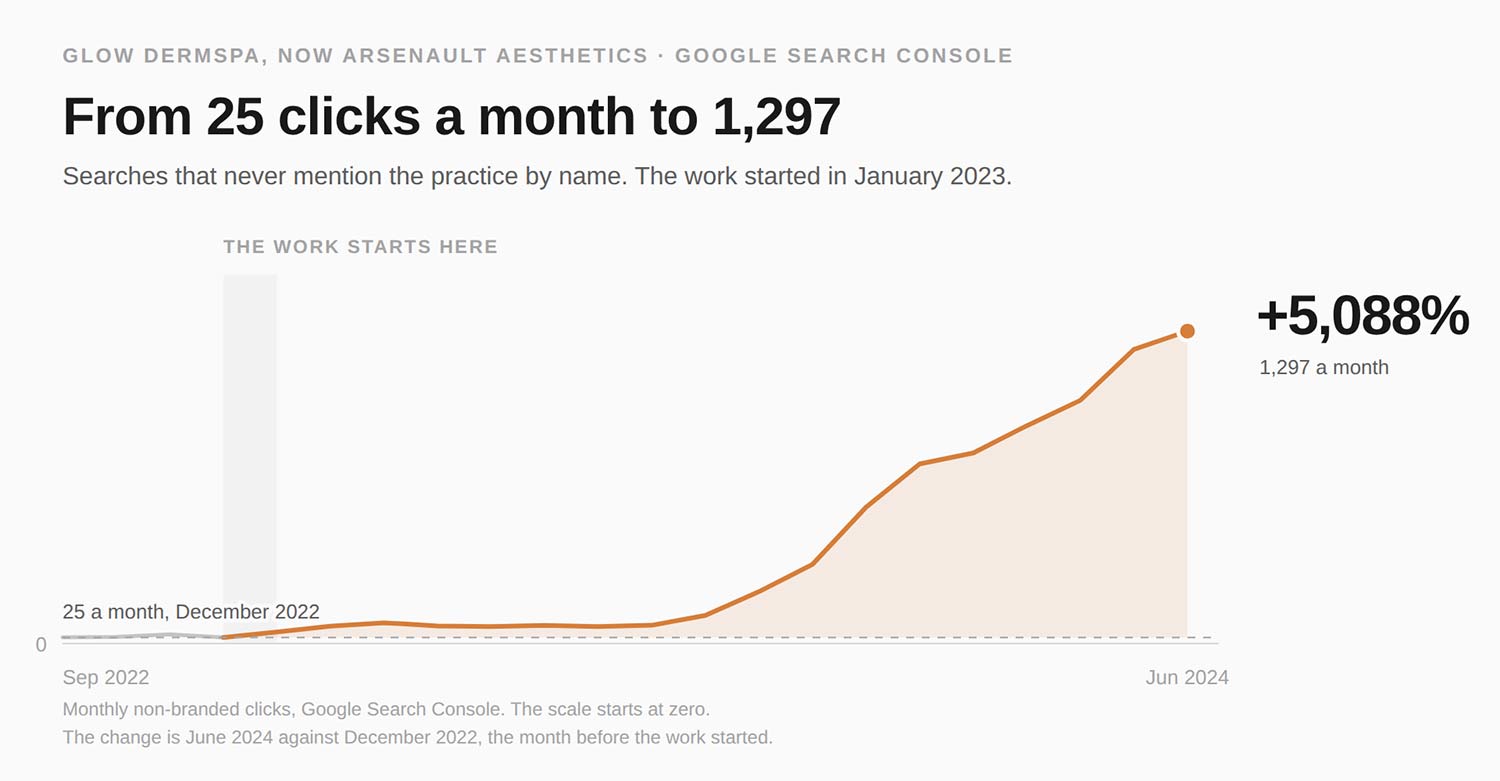
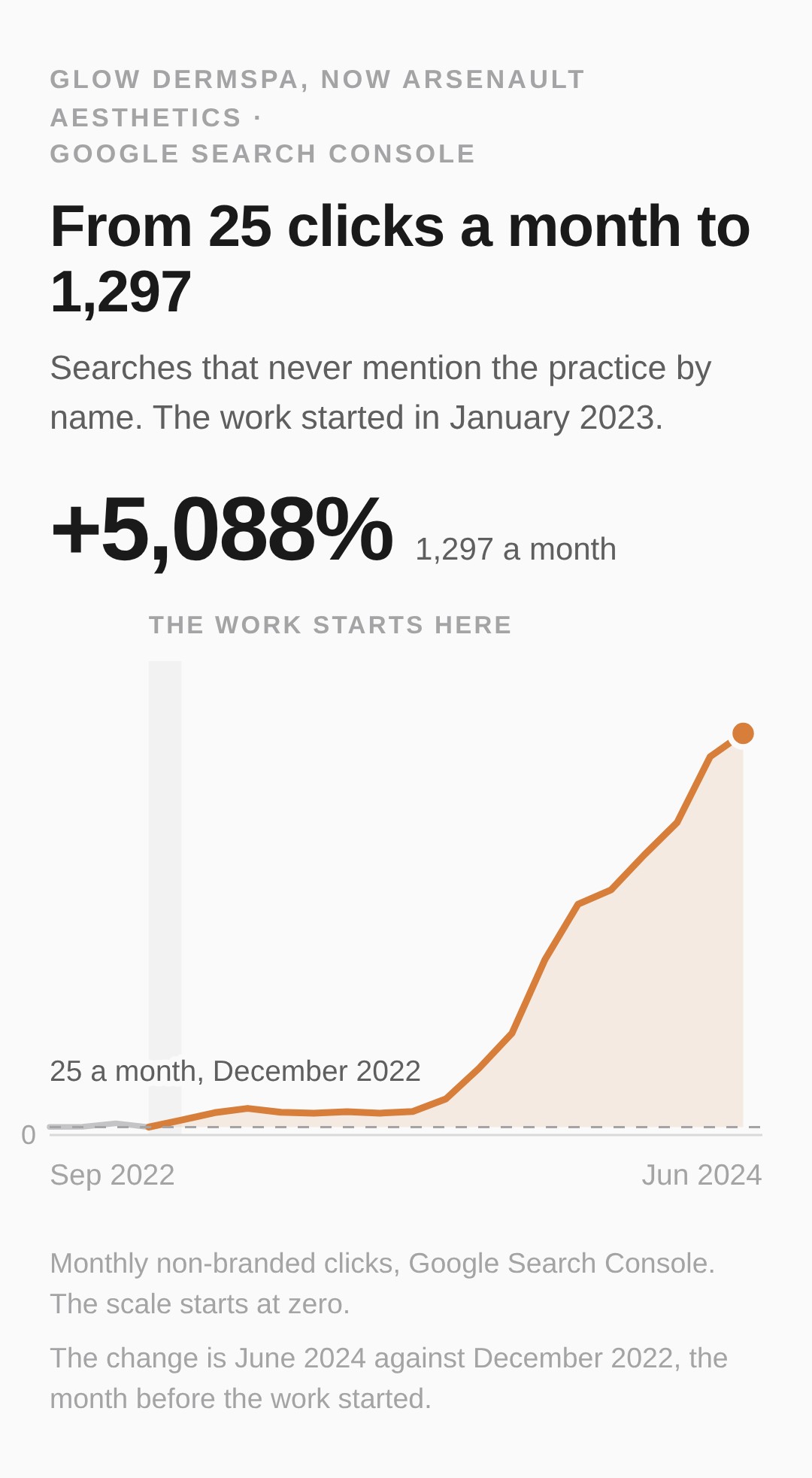
Monthly clicks from searches that never name the practice, September 2022 to June 2024. Google Search Console. The work started in January 2023.
The Long Haul
Shane Retina and Venice Retina are two retina practices, a husband’s and a wife’s, with sister sites built to one standard and continuous SEO: content, doctor and location pages, and a knowledge graph. Venice Retina comes up first on the map for “retina specialist” at every point checked around Venice. Clicks to the practices’ websites from their Google listings, on searches that don’t name them, were up 145 percent in summer 2026 against summer 2024.

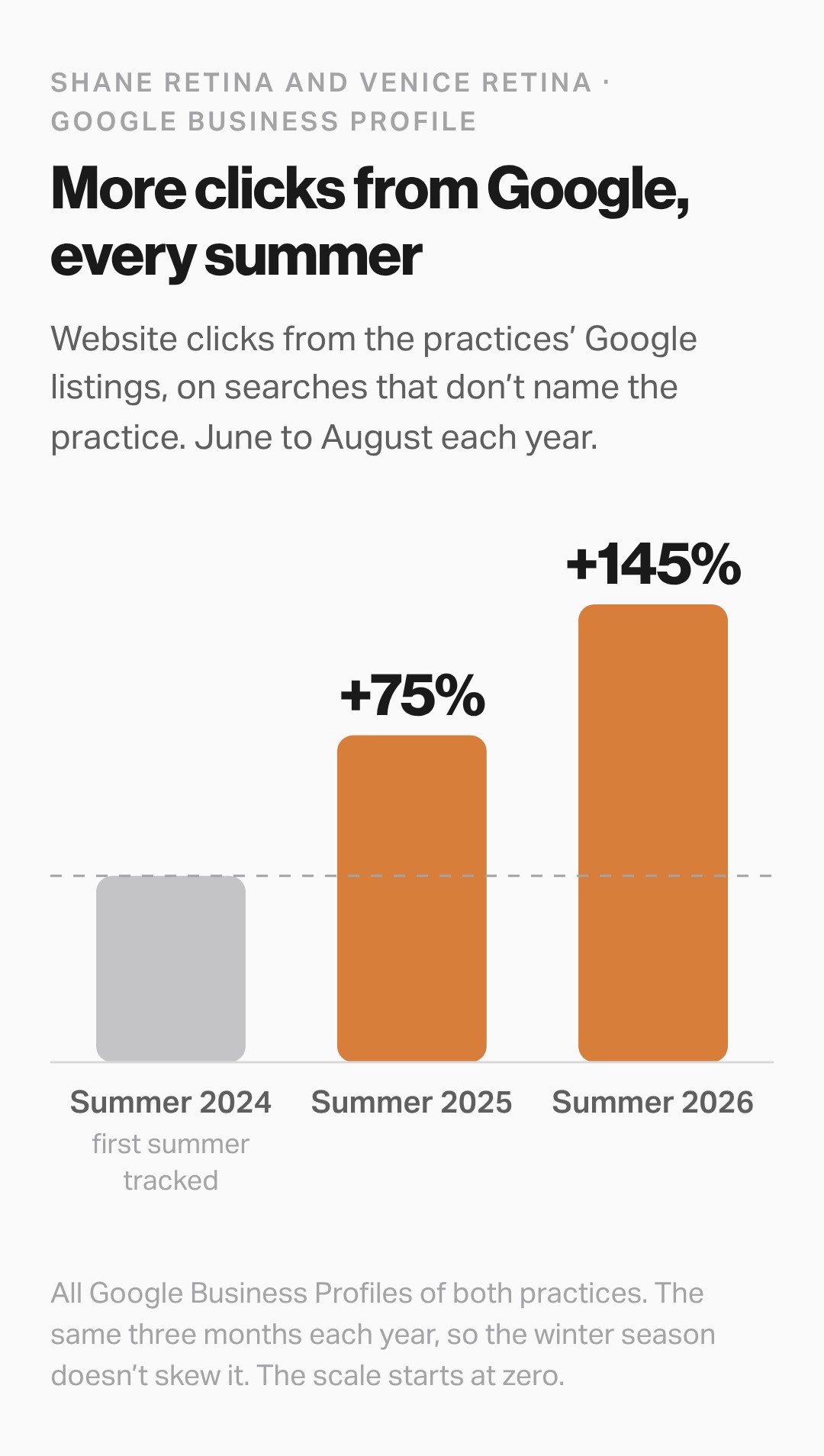
Website clicks from the practices’ Google Business Profiles on searches that don’t name them, June to August of each year.
There are more. Skin Health Forever, a Tampa dermatology practice with special expertise in skin of color, is number one in Tampa for “black dermatologist”, and its site welcomes every patient. Florida Radiology Consultants needed a site that recruits radiologists and wins partners. More than 30 radiologists have joined since 2024, and its procedure pages bring patients in from Google. Medrock Pharmacy went from serving patients only in Florida to more than 30 states, and the same website took all of it on. Arsenault Dermatology has grown from three offices to seven, and I’ve had a front-row seat since 2020. Two of these practices also changed their names along the way, Retina Care Consultants to Shane Retina and Glow Dermspa to Arsenault Aesthetics, and both kept their place on the Google map. How I handle a rename is on the website redesign page.
Local SEO
Local SEO is a core part of this work. Your Google Business Profile, local listings, and how your business appears in map-based searches all require ongoing attention to stay accurate and competitive. The local SEO page explains the whole subject in plain language, including how the profile and the website feed each other.
Most local decisions happen on the map. When somebody searches for a service with a town or “near me” in it, Google answers with a map and a short list of businesses, and that short list is where most of the choosing happens. Those searches have also changed the least as AI answers spread through the rest of Google, which is part of why, for most businesses that serve an area, the map is the first thing worth getting right.
This is especially true for medical practices. Showing up when someone is looking for a specific service or specialist in your area, and continuing to show up, takes consistent effort. Your competitors aren’t standing still.
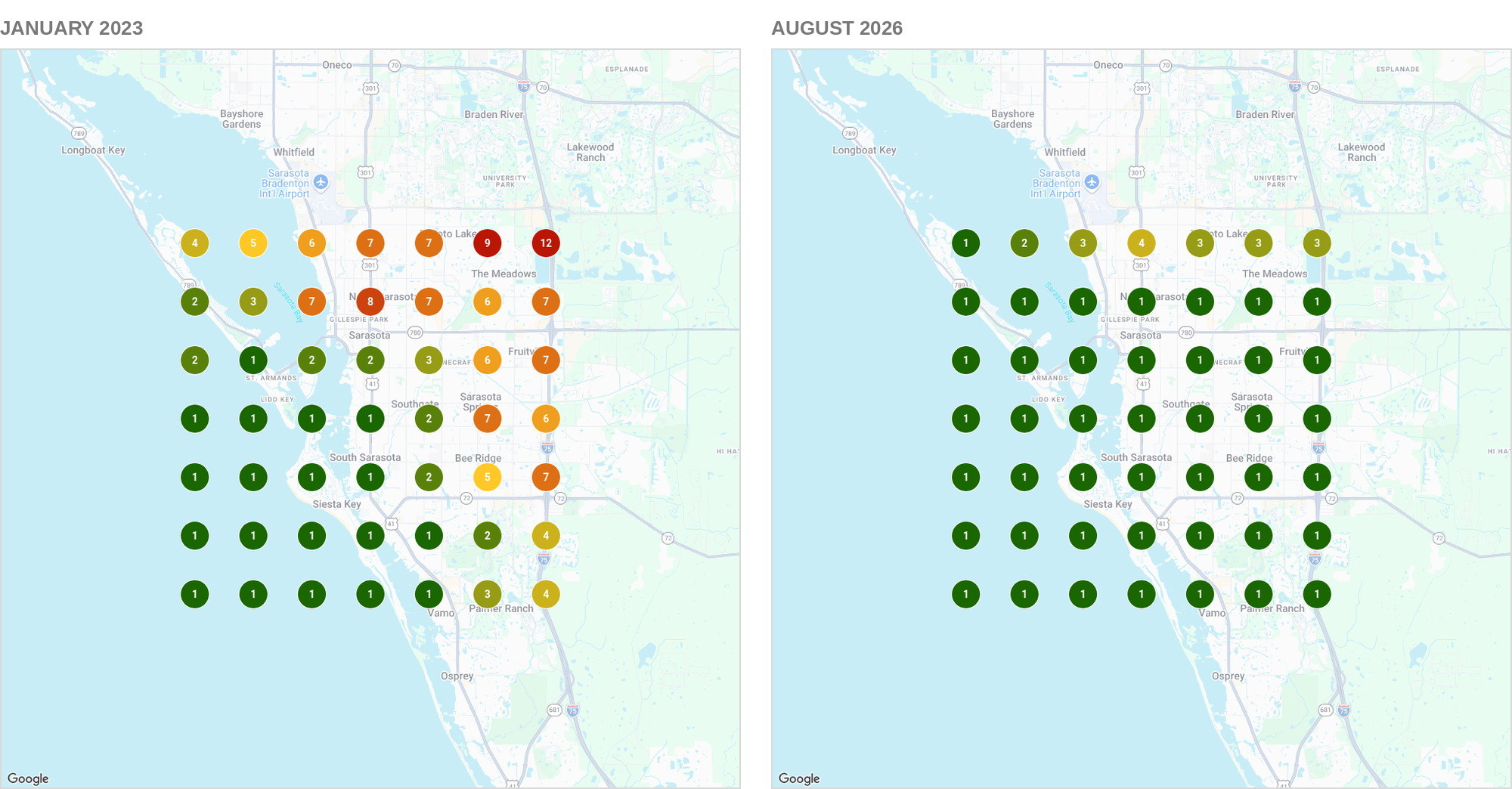

One office of a retina practice and one search, “macular degeneration specialist,” January 2023 and August 2026. Each dot is a point around the office, and the number is where the practice ranked for someone searching there: top three at about six in ten points at the start, and at all but one at the end. Source: Local Falcon.
SEO for Medical Practices
A large part of my SEO work is for independent medical practices: dermatology, retina, radiology, med spas, functional medicine, and a compounding pharmacy. Medical search works differently from most. Patients often search for a symptom or a condition before they search for a doctor, a practice usually has more than one audience to reach, and every provider and every office can carry a listing of its own.
SEO for a medical practice starts from the patient’s point of view. I write pages for the conditions and treatments patients look up, in the words they use to describe them. I build provider and location pages that give each doctor and each office a place of its own in search. And I add structured data that describes the practice exactly. For some practices, search has to serve recruiting and referrals as much as new patients. The medical SEO page covers the whole approach, with results from the practices I work with.
SEO Built for Search Engines and AI
Google is one way people find businesses. It’s no longer the only way.
AI systems are now part of how people search. They’re interpreting your content, forming an understanding of what your business does, and deciding what to surface.
That understanding comes from how the site is built. Clear structure, accurate content, and the way information is structured and labeled all shape how these systems interpret it.
This includes things like structured data and how your content is connected, not just what it says.
A site built this way is easier to understand across the board. Not just for Google, but for any system trying to connect people with the right result.
It’s about building something durable. Something that communicates clearly enough to hold up however people are searching, now and in the future.
Schema & Knowledge Graphs
Schema is structured data: code added to your site that tells search engines and AI systems, in their own language, exactly what your business is. Who you are. What services you offer. Where you’re located. Who your providers are and what they specialize in. How all of it connects.
A knowledge graph is what that builds toward: the organized web of facts and relationships that machines hold about your business. When it’s complete and accurate, Google and AI systems stop guessing. They know which “Dr. Smith” you are, which services belong to which location, and why you’re the right answer for a specific search.
No visitor will ever read this code. That’s the point. It’s becoming more important as AI answers more of the questions people used to type into Google.
Schema is infrastructure. I build it into the sites I make from the start, and I build it out over time for businesses that want to stay ahead of how search is changing. As search engines and AI systems lean harder on the code underneath a website to understand it, a site that has it built well is better placed.
If you want to see what the code looks like and how a knowledge graph is put together, the schema and knowledge graphs page walks through it, with a section for medical practices.
Ongoing SEO on a Monthly Retainer
Every site I build has SEO built in. That’s the first step.
Visibility in search is something you earn over time. A well-built site gives you a strong foundation, but the businesses that consistently show up in organic search are the ones that keep working at it after launch. That means an SEO strategy that builds over time: new content, refined targeting, local presence, and steady attention to how the site is performing.
SEO results come from work on the website and work off it. On the site: the content, the structure, the page titles and internal links, the structured data, and the technical health of the whole thing. Off the site: your Google Business Profile, your listings in the directories that matter for your field, the accuracy of your name, address and phone number everywhere they appear, your reviews, and links to your site from other sites that are worth having.
Designing or rebuilding a website well is a large part of good SEO. It is where the foundation gets laid. What should happen after that is the off-site work, so that the site, the profile, the listings, and everything else that carries your name work as one connected system instead of a collection of separate pieces.
Most ongoing SEO clients work with me on a simple monthly retainer: a set amount of focused monthly SEO work, applied wherever it will make the biggest difference.
The results compound. The same retainer covers SEO maintenance, keeping what already ranks healthy, and growth, so over time the site becomes more complete, more specific, and more visible for the things that matter most. It’s slower than chasing quick results with tricks and gimmicks, and it lasts much longer.
How Good SEO Grows Your Business
The goal is more of the right traffic.
Over time, the site starts to show up in the places it should, because it makes sense for it to be there.
People find you when they’re already looking for what you offer. The right pages connect with the right searches, and that connection becomes more consistent as the site develops.
For the business, it creates stability. A steady flow of new opportunities, with less reliance on paid ads to stay visible.
Paid ads are like buying fruit. You pay for every piece, and when you stop paying, the fruit stops. SEO is like planting a fruit tree. It takes time to grow, but once it does, it keeps producing, and you no longer pay for each piece.
It doesn’t happen all at once. It builds gradually, then starts to reinforce itself. The site becomes more complete, more specific, and more effective over time.
Over time, more of your new business comes from people who found you on their own.
Related
Local SEO
Maps, profiles, and “near me” searches, explained.
Healthcare SEO
SEO for independent practices.
Schema and knowledge graphs
The code that tells machines who you are.
AI search optimization
Showing up in AI answers.
Selected work
Every case study, with the evidence.
Related
Local SEO
Maps, profiles, and “near me” searches, explained.
Healthcare SEO
SEO for independent practices.
Schema and knowledge graphs
The code that tells machines who you are.
AI search optimization
Showing up in AI answers.
Selected work
Every case study, with the evidence.
A quick conversation
Not sure where your site stands in search? Start with a conversation.
“The results speak for themselves. Since we began working together, our new patient volume has doubled, and approximately half of our patients now come through online marketing. Josh has played a major role in that growth, helping us consistently outperform local competitors in online patient acquisition, including practices much larger than ours. The return on our investment in his services has been exceptional. He doesn’t simply wait for us to identify problems or request improvements. He continuously monitors our online presence, identifies opportunities, and implements strategies to improve website performance, search engine visibility, patient engagement, and conversions.”
Dr. Thomas Shane · Ophthalmologist & Founder, Shane Retina
How the work happens
Understanding comes first.
SEO starts with understanding your business, your customers, and how people are actually searching for what you offer. From there, I look at the full picture. The site itself, the content, how you show up locally, and how it compares to others in your space. That determines where the work starts and what matters most.
Then I move forward deliberately. I add content where it’s needed, refine pages that are underperforming, address technical issues, and strengthen your overall presence in the areas that make the biggest impact.
The work is steady and focused, and it builds over time.
Whether you are looking for an SEO consultant for one project or an ongoing partner, an SEO project begins like every project I take on, with a conversation and some form of discovery. The process page lays out the steps.
Common questions
What people ask about SEO.
How long does SEO take?
It takes time. Most sites start to show movement within a few months, but meaningful results build gradually. The goal is steady visibility that holds.
Is SEO included in a website build?
Yes. Every site is built with a strong SEO foundation. Ongoing work is optional for businesses that want to actively grow their visibility over time.
Is SEO just work on the website?
No. The website is where the foundation is built, and it is the part I control most directly. But a good share of what decides whether you show up happens off the site: your Google Business Profile, your listings, your reviews, and the links pointing to you. Ongoing SEO covers both, so the site and everything around it work as one system.
What is local SEO?
Local SEO is about showing up when someone searches for a service in your area. It includes how your site is structured, how your business is listed across the web, and how clearly your location and services are defined. The local SEO page covers the whole subject.
Do you do local SEO?
Yes. For most medical practices, it’s one of the most important parts of the work.
Local SEO determines whether your practice shows up when someone nearby is looking for what you offer. It includes how your business appears on the map, how your location and services are defined, and how consistently you’re represented across the web.
When it’s done well, your practice shows up where it should, for the people who are already looking. For businesses that depend on a specific area, that visibility matters.
Do you work with structured data and schema?
Yes. This is part of how your site communicates clearly to search engines and AI systems. It helps define what your business is, what you offer, and how everything connects, not just what’s written on the page. See the schema and knowledge graph section above for what that means in practice, or the full page on schema and knowledge graphs.
Do you guarantee rankings?
No. No one can guarantee rankings, and it’s not how I approach the work. The focus is on building a site that deserves to show up, based on clarity, accuracy, and structure.
Can this work without paid ads?
Yes. SEO is what allows your site to be found without relying entirely on ads. Many businesses use both, but strong organic visibility reduces how much you need to spend over time. Ads buy the fruit. SEO plants the tree.
Do I need to create content myself?
Not necessarily. I’ll guide what’s needed and can help develop it. You provide the expertise about your business, and I shape that into content that works.
What does an SEO content strategy include?
A map of what the site should say and for whom: the searches that matter for the business, the pages that answer them, how those pages connect, and what gets written next. It covers the structure of the site as much as the blog, and it is revisited as the results come in, so the content keeps building toward the searches that bring the right people.
What's the difference between this and typical SEO services?
Most SEO is treated as a separate service added after a site is built. As an SEO expert who also designs and builds the sites I optimize, I approach it as part of the system from the beginning, so structure, content, and search all work together instead of being patched together later. That changes the outcome. The site doesn’t have to be reworked to fit SEO later, because it was built to make sense from the start.
Do you specialize in SEO for medical practices and healthcare businesses?
Yes. A significant part of my work is medical SEO for independent practices: dermatologists, ophthalmologists, radiologists, and other specialists. I understand how patients search for care, how local search works in healthcare, and what it takes to show up ahead of larger competing practices in your area. That industry familiarity makes the work more targeted and more effective.
Can you do SEO for a site you didn't build?
Yes. I’ll start by assessing the structure, content, and technical setup to see what’s working and what isn’t. From there, we can improve it in a way that makes sense. If the structure itself is what holds the site back, a redesign may need to come first, and a careful one keeps the rankings the site already has.

Ready to get started?
If you want your site to work harder and show up in the right places, let’s talk.
Tell me what your business does best and who you want to reach, and we’ll both get a sense of whether we’re the right match.