


Industries · Healthcare · Ophthalmology
Ophthalmology SEO and Website Design
I design websites and handle SEO and local search for independent ophthalmology practices. Each site is built to bring in new patients, and I keep it growing after launch.

1 to 7
Providers at Shane Retina since the search work began
#1
Venice Retina on the Google map for “retina specialist,” all around Venice
1st
Dr. Thomas Shane, named first in Google’s AI Overview for “best retina specialist sarasota”
+145%
Non-branded website clicks from Google profiles, summer 2026 against 2024
How patients choose
Ophthalmology patients don't all arrive in the same state of mind.
Most patients find an ophthalmologist on Google. They search for a symptom, a condition or a specialist, look at the map, read a few reviews, and then open one or two practice websites. Often the person searching is a spouse or an adult child, and sometimes it is a doctor deciding where to send a patient.
Clear, readable pages matter more here than in most specialties. Many ophthalmology patients are older, and some have the very vision problems the practice treats. A website that is hard to read loses them before they find the phone number.
Referring doctors read the website too. Optometrists and primary care doctors send patients to ophthalmologists every day. A doctor who has never worked with your practice will often look at your website before sending anyone.
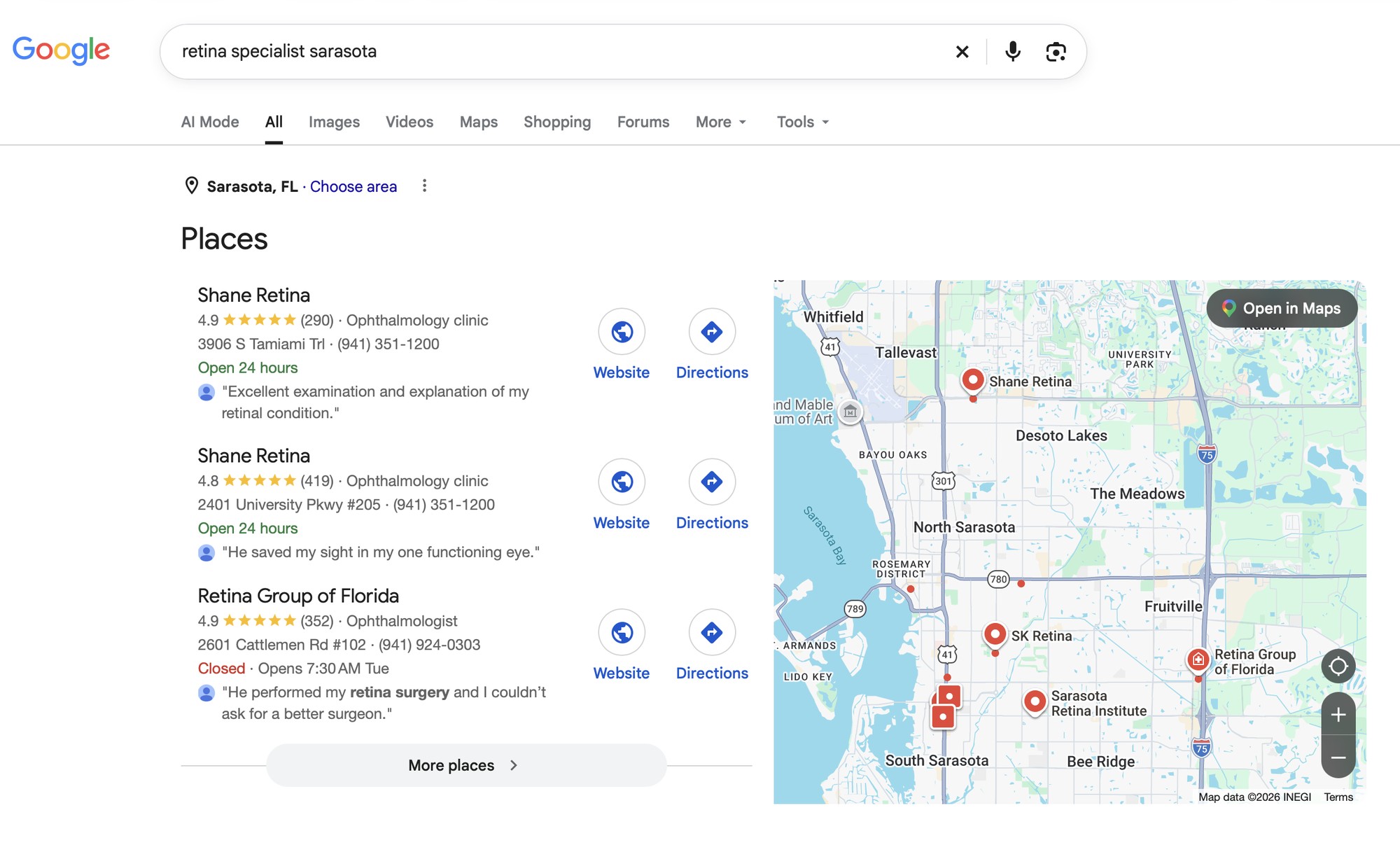
Google’s map results for “retina specialist sarasota.” Shane Retina, a client of mine, holds the first two places. See the case study →
Who lands on the site
Four kinds of visitors land on an ophthalmology website. The site has to work for all of them.
Researching a Diagnosis
Patients researching a new diagnosis, taking their time and comparing practices before they decide.
In a Vision Emergency
Patients in the middle of a vision emergency who need to know immediately whether this is the right place to call.
Searching for Someone Else
A spouse, an adult child, or a caregiver who is trying to find good care for someone in their family.
Referring Physicians
Optometrists and primary care doctors who check the practice’s website before they send a patient.
What an ophthalmology practice needs to get right online.
- 01
A website that is easy to read and easy to move through.
- 02
Pages for the symptoms and conditions patients search for.
- 03
A strong place on the Google map, where patients choose.
Ophthalmology Website Design and Patient Clarity
An ophthalmology website has to work for very different visitors. The patient managing a chronic condition, the one with a sudden change in vision, the daughter searching for her father, and the doctor sending a patient should each find the right page in a click or two. Large, readable type and simple menus come first.
The site also has to be clear about what the practice does. Someone looking for glasses or a routine eye exam should see quickly whether this is the right place. A referring doctor should find the referral form without hunting for it.
The design should feel like the practice. The look of the site, the photography and the words should give patients an accurate sense of the practice before they walk in, including what it values.
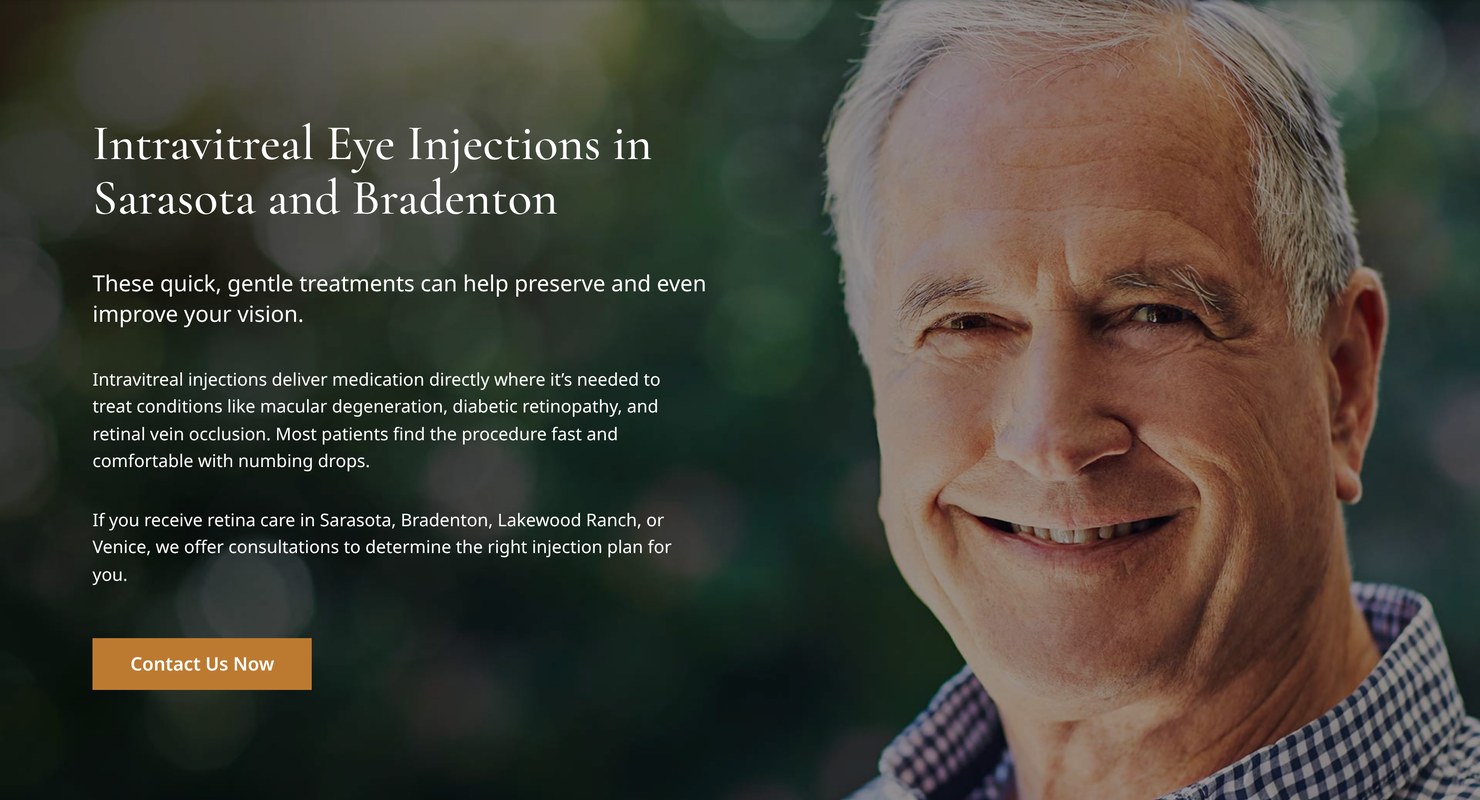
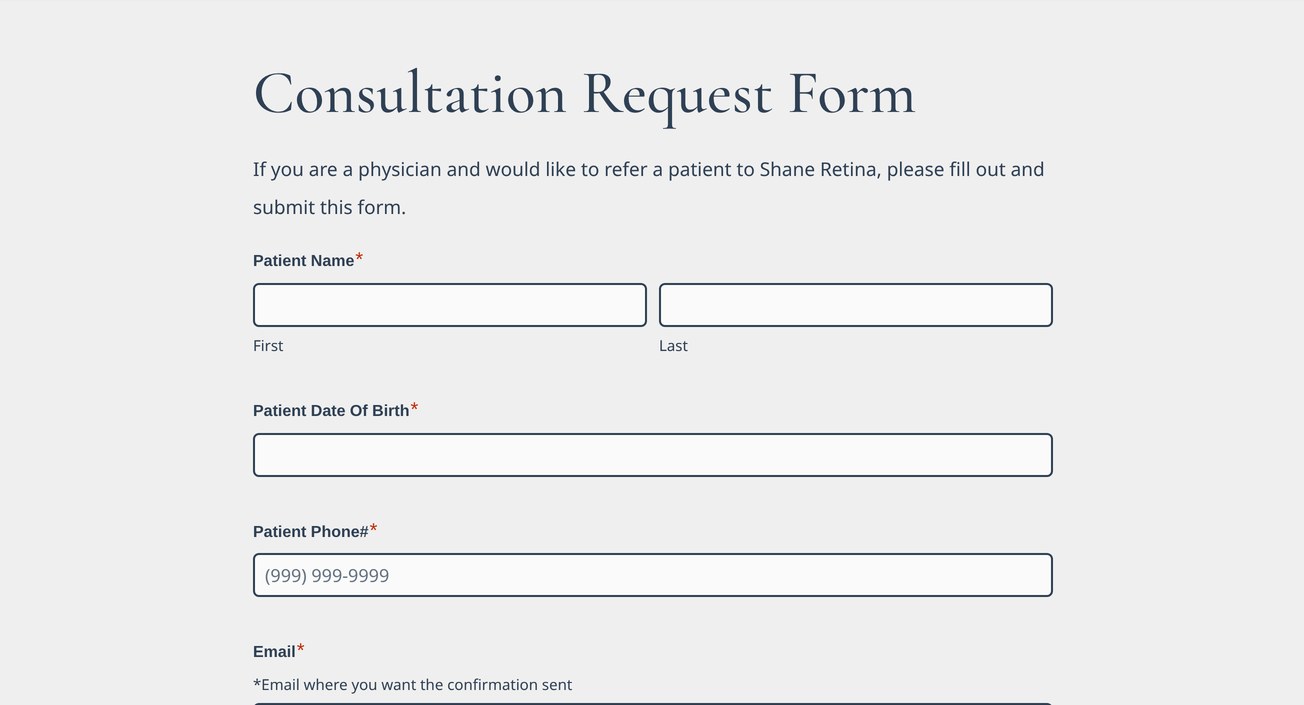
Shane Retina’s eye injections page, and the form doctors use to refer a patient. See the case study →
For practices that offer cataract surgery, premium lenses or LASIK, the website also has to earn the consultation. Patients are making a big decision about their vision, and often paying part of it themselves, so they read carefully before they book. For every ophthalmology practice, the annual exam is one of the most important messages the site can carry, because early detection is how most serious eye conditions stay manageable.
Most ophthalmology practices already have a website, so this work often starts as a website redesign, and a careful one keeps the Google rankings the old site has earned. When I started with Dr. Thomas Shane’s practice, it needed to be found more than it needed a new look, so the work began with search. The redesign came later, a few pages at a time, and most of the content was kept because it was already doing its job.
Some of the most useful pages on an ophthalmology site never show up in Google. A patient might get a link to new patient forms before a first visit, or to instructions before an eye injection or after cataract surgery. A referring office might get a link to the referral form. Pages like these are part of every website I build. I plan the site and write its pages myself, so it fits how your patients look for care and how your practice runs.
Ophthalmology SEO
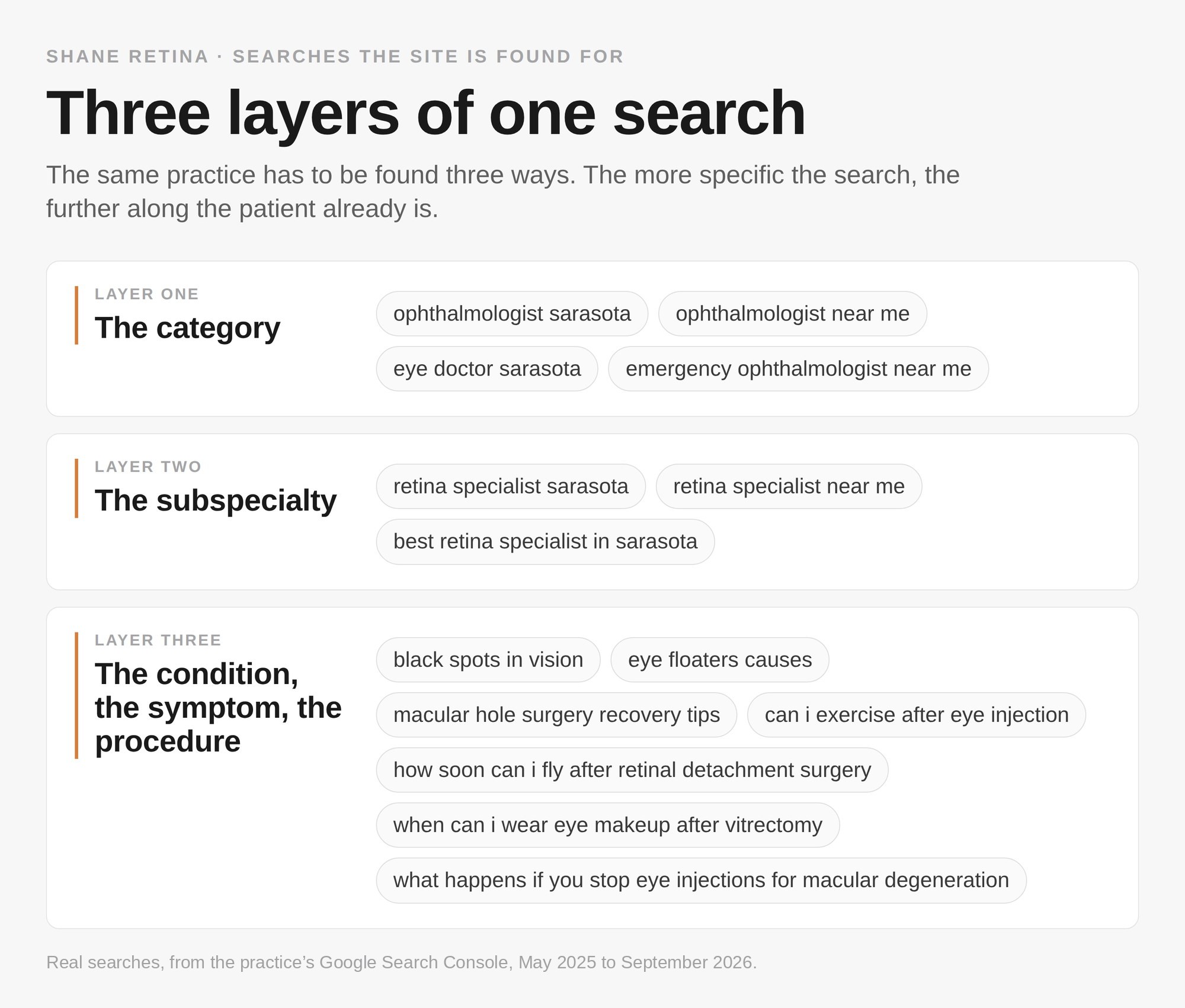
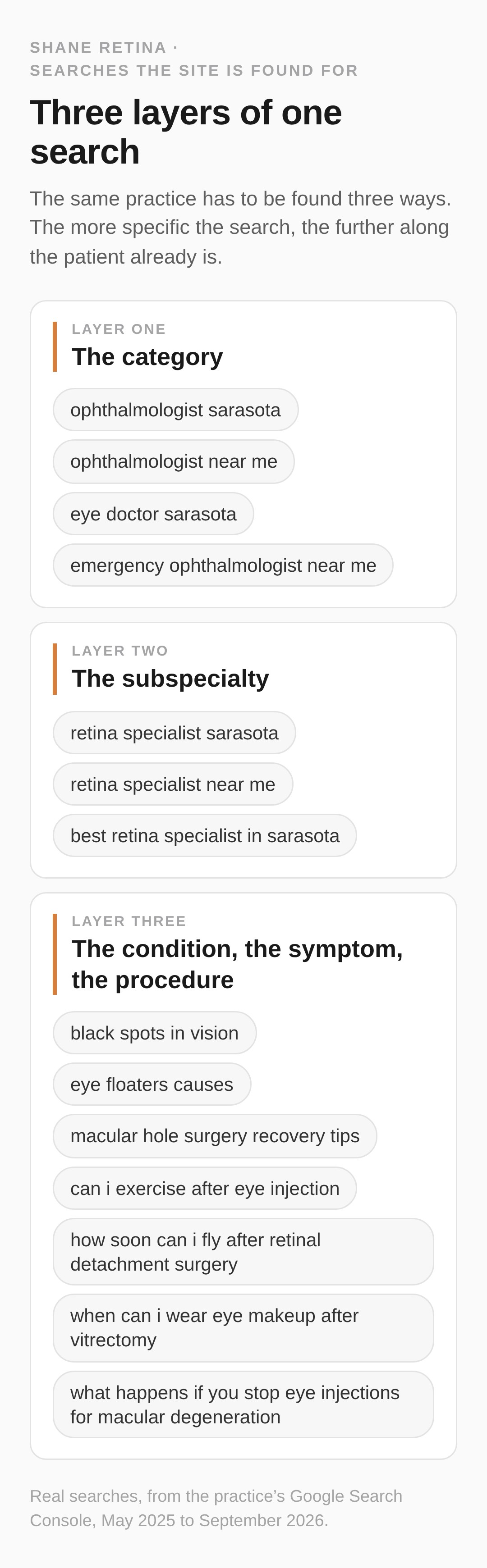
Most ophthalmology patients search for a symptom, a condition or a specialist before they search for a practice name. “Flashes and floaters.” “Macular degeneration treatment.” “Retina specialist near me.” The more specific the search, the closer the patient is to booking.
Ophthalmology SEO, or eye care SEO for practices that brand themselves that way, is what puts your practice in front of those patients and gives you a real chance of winning them. It covers each layer of what your practice treats: the broad category of ophthalmology, the subspecialty, and the individual conditions and procedures patients search for. When all three are covered well, your practice shows up for the searches that matter most, and patients can see what it does and who it serves before they ever reach the site.
The method is the same healthcare SEO work I do for every specialty: build the pages patients are searching for, then keep building.
Retina is where I have done my longest-running SEO work. For Shane Retina and Venice Retina, the content has been rewritten several times over, condition by condition, and a page went up for each new doctor and each new office as the practice grew. Most new patients search for what they need, like “retina specialist near me.” Non-branded website clicks from the practices’ Google profiles were up 145 percent from summer 2024 to summer 2026.
I can do the same for your practice. I research what your patients search for and write a page for each condition and procedure they look up, with new pages as the practice grows.
Local SEO for Ophthalmologists
When someone needs an ophthalmologist locally, the Google map becomes the decision point. For routine care, it’s about convenience. For urgent issues, it’s about finding a credible provider nearby as quickly as possible. In both cases, patients and caregivers are choosing from a short list of options that show up in the map and look trustworthy at a glance. Local SEO for ophthalmologists is what puts your practice in that group and keeps it there.
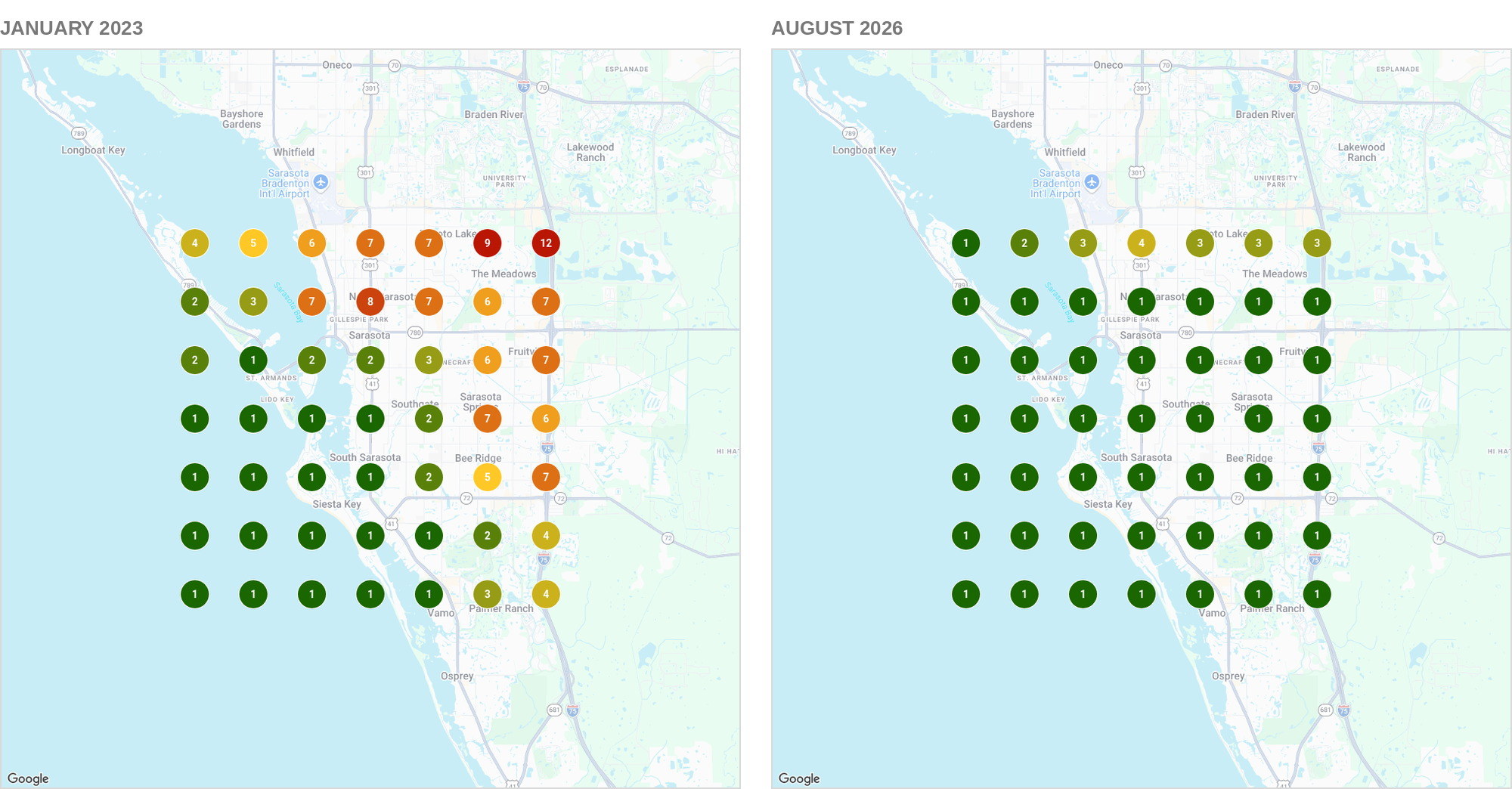

Shane Retina’s South Sarasota office for “macular degeneration specialist”: in Google’s top three at about six in ten points around the office in 2023, and at all but one in 2026. See the case study →
Your Google Business Profile is the foundation. It needs to be complete and accurate, with your subspecialties and the conditions you treat. From there the work takes in the listings for each of your doctors, your pages on sites like Healthgrades, Zocdoc and Facebook, your reviews, and your website, which Google reads to check what the profile says. When all of it agrees, Google feels more confident putting your practice in front of patients and caregivers.
My retina clients show what this looks like. Venice Retina comes up first on the map for “retina specialist” at every point I check around Venice. Around the South Sarasota office, Shane Retina is in Google’s top three at 92 percent of the points I check, up from 54 percent in 2023.
Name your treatments. Shane Retina comes up first at every point I check around one of its offices for “Izervay injections near me,” a treatment it names on its listing and its website. Few practices list treatments by their brand names, so few compete for those searches.
Every ophthalmologist can have a Google listing of their own, as well as each office. A practice with more than one office needs a listing and a page for each one, and they have to agree with each other.
I set up and look after all of it for you, from each office’s Google Business Profile to the listing for each of your doctors, and I keep it accurate as the practice grows. For Shane Retina, that means a complete profile for every office and every physician. The local SEO page covers how this is handled for practices with several locations.
Structured Data for Ophthalmology Practices
Structured data is code that states the key facts on your website in a way that’s made for search engines and AI tools to understand. It spells out who your doctors are, which conditions you treat and where you see patients, so they get those facts right. It is written in a shared language called Schema.org, which Google and Microsoft both read, and AI tools can read too.
For an ophthalmology practice, structured data adds up to a map of the whole practice. The map connects each doctor to their subspecialty, each condition to the treatments for it, and each treatment to the doctors who provide it and the offices where they see patients. People understand a map by looking at it. Search engines and AI tools read this one in code, and it is called a knowledge graph.
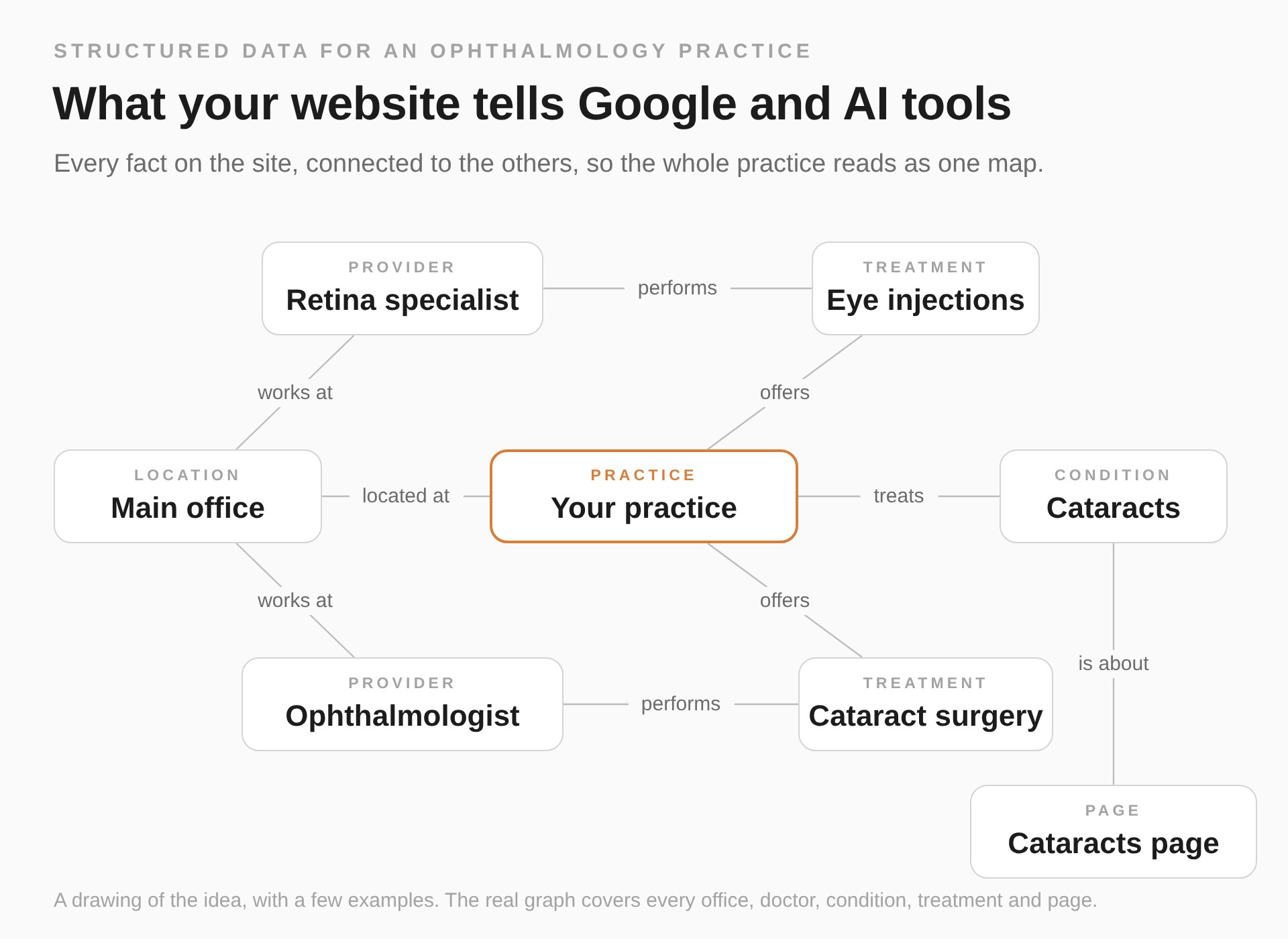
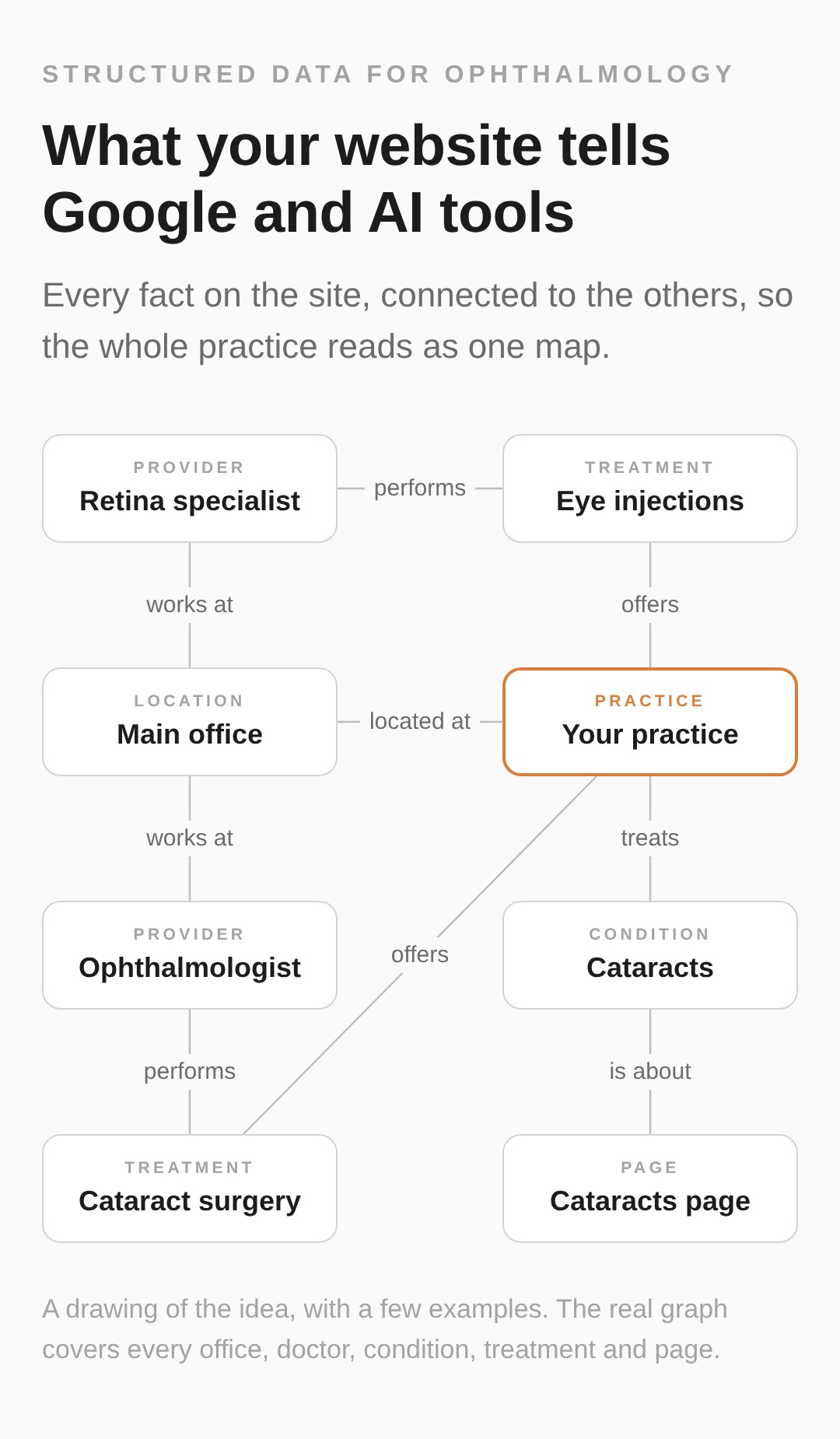
That detail matters in ophthalmology. Retina, cataract, glaucoma and general ophthalmology each mean something different to a patient searching, and the knowledge graph makes those differences clear.
Most ophthalmology practices have only basic structured data on their websites, usually little more than the practice’s name, address and hours, or none at all. A practice that describes itself fully stands out from the others. As AI systems get more capable, they will rely more and more on the code behind a website. Every website I build comes with a full knowledge graph, and I keep it current as the practice grows. If you already have a website, I have options for adding one.
The schema and knowledge graphs page shows how a graph like this is built for a medical practice.
AI Visibility for Ophthalmology Practices
More patients and caregivers now take their questions to AI tools like ChatGPT, Claude and Perplexity. In ophthalmology those questions often carry real urgency: “Flashes in vision, what should I do?” “Do I need to see a retina specialist?” “Is this an emergency or can it wait?” Someone weighing lens options before cataract surgery asks them too.

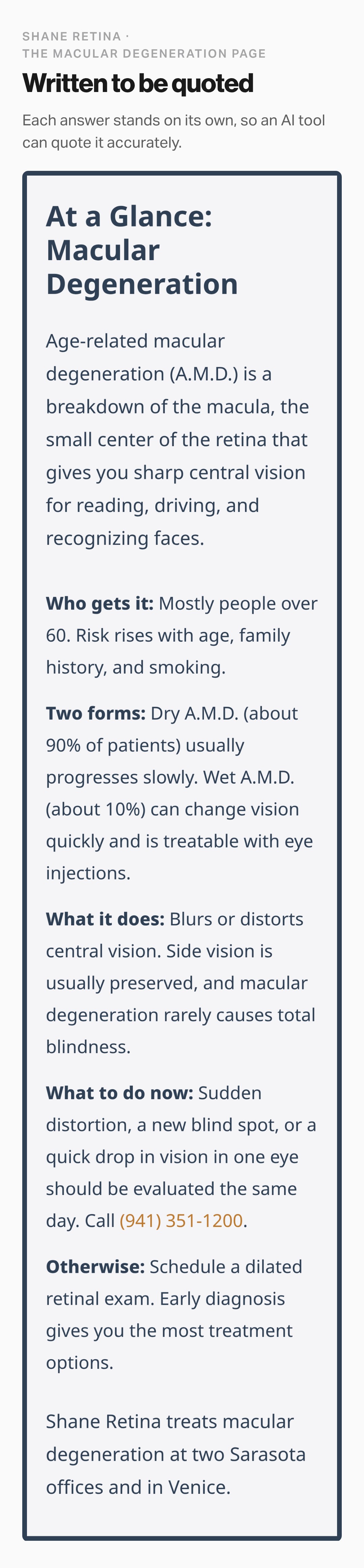
My retina clients already show up in AI answers. Ask Google for the best retina specialist in Sarasota, and its AI Overview names Dr. Thomas Shane first, with the practice’s two Sarasota offices as the first two places on the map below it.
Increasingly, patients are also asking AI tools to recommend local practices directly: “find me a retina specialist near me” or “best ophthalmologist in [city].” The practices that appear in those results are the ones whose content is specific, well-structured, and clear enough to be cited, and whose local presence is consistent enough to be trusted.
Starting early on AI search optimization is an advantage. AI search optimization means working on what these tools draw on: the practice’s pages, reviews, listings and knowledge graph. These tools favor practices that are well established online, and that takes more than the right pages. It takes time for reviews to add up, for other sites to mention the practice, and for search engines and AI tools to come to trust it. A practice that waits can build the same pages later, but it can’t make up that time. A practice that starts now will also be in a much better position as more patients move from Google to AI.
A patient asking what floaters mean may get an answer and never click, while a patient searching for a retina specialist nearby still gets a map and a list of practices. I work on both for you as part of your SEO, and I regularly check how ChatGPT, Google’s AI and other tools answer when patients ask about an eye doctor near you. The AI search optimization page covers how, starting with an AI Visibility Audit.
One Person, Everything Connected
Ophthalmology practice marketing usually gets split among several vendors. One firm builds the website, another does the SEO, and someone else handles the listings. You end up explaining your practice to each of them separately. Because no one sees the whole picture, the details stop matching. A new doctor shows up on the website but not on the Google listing, or the listings still show the old hours after an office changes them.
Having one person handle all of it is a big advantage, because everything stays consistent. When a doctor joins or an office changes its hours, one person updates the website, the Google listings and the knowledge graph together. For ophthalmology, that one person is me. I design the site, write the pages, do the SEO and look after the Google Business Profiles, so every decision is made with patients and referring doctors in mind. It also gets better over time. I come to know your practice, your doctors and how you like things done. You don’t have to explain the background again each time, because I already know it. A short note is enough, and the work gets done.
That is how I work with Shane Retina and Venice Retina. I handle both websites, the content, the Google Business Profiles and the listings, and Shane Retina’s knowledge graph. Every month I send Dr. Thomas Shane a plain-language update on how the practices are doing, what I worked on, and what comes next.
Independent practices have a story to tell, and it’s a strength. In ophthalmology, corporate groups are buying up practices, and they have marketing departments and large budgets. But you have your own advantage: your character, your place in the community and the strength of your care. Patients want a doctor they trust with their eyesight. Nobody wants to feel like just a number. I help show patients who you really are.
Related
Web design and development
How a site gets structured before it gets designed.
Healthcare SEO
How patients search for care, and the work that answers it.
Local SEO
Getting on the Google map, and staying there.
Shane Retina and Venice Retina
First on the map all around Venice.
See my work
Every case study, with the evidence.
Ophthalmology experience
Two retina practices, his and hers.
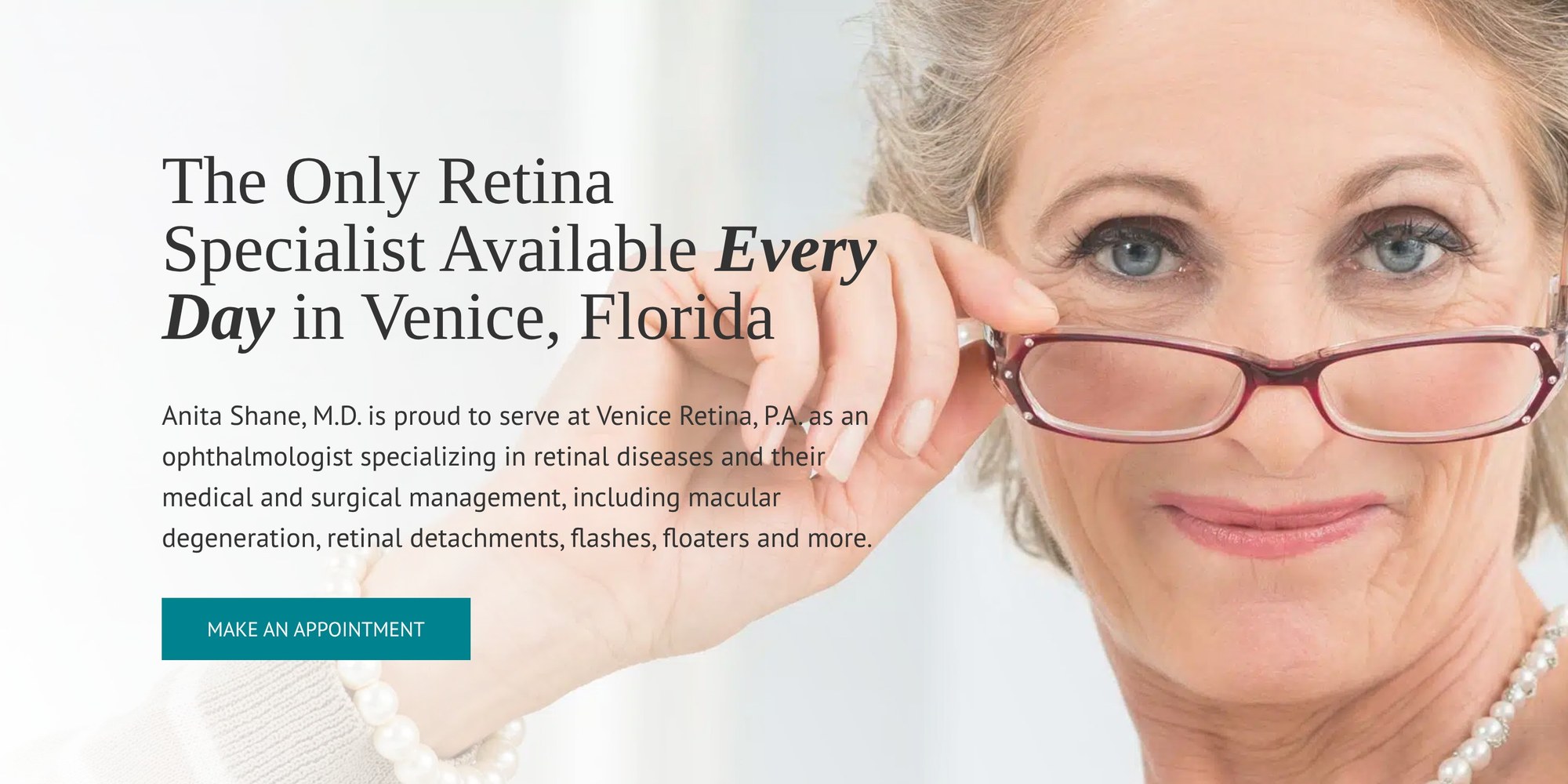
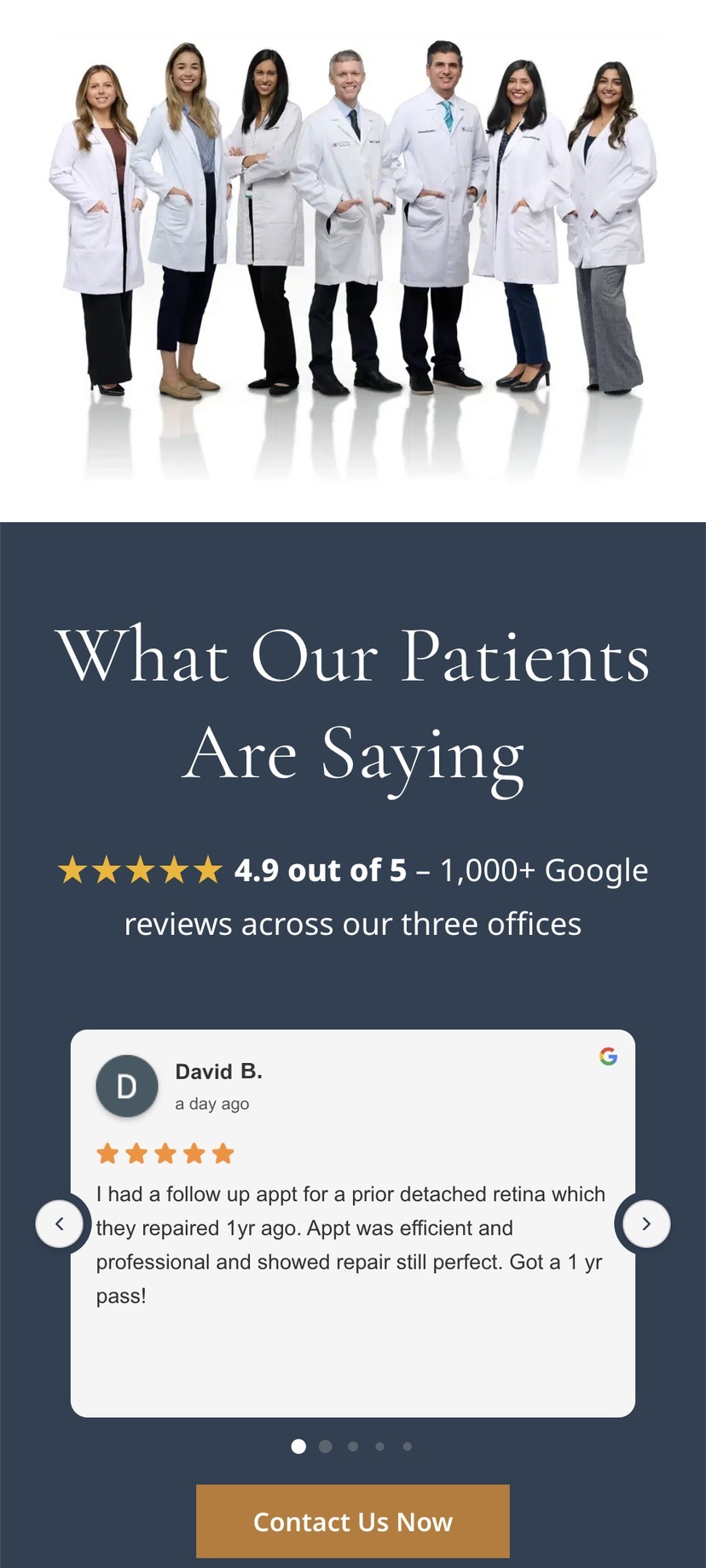
Dr. Thomas Shane and Dr. Anita Shane trained together at the Bascom Palmer Eye Institute, and each runs an independent practice. I designed their two websites to complement each other. The homepages match on purpose, so the two practices read as one family while each keeps its own look. Their offices hold 4.9 stars across more than a thousand Google reviews. Dr. Thomas Shane was the only doctor at his practice when the search work began, and seven providers now see patients across the three offices.
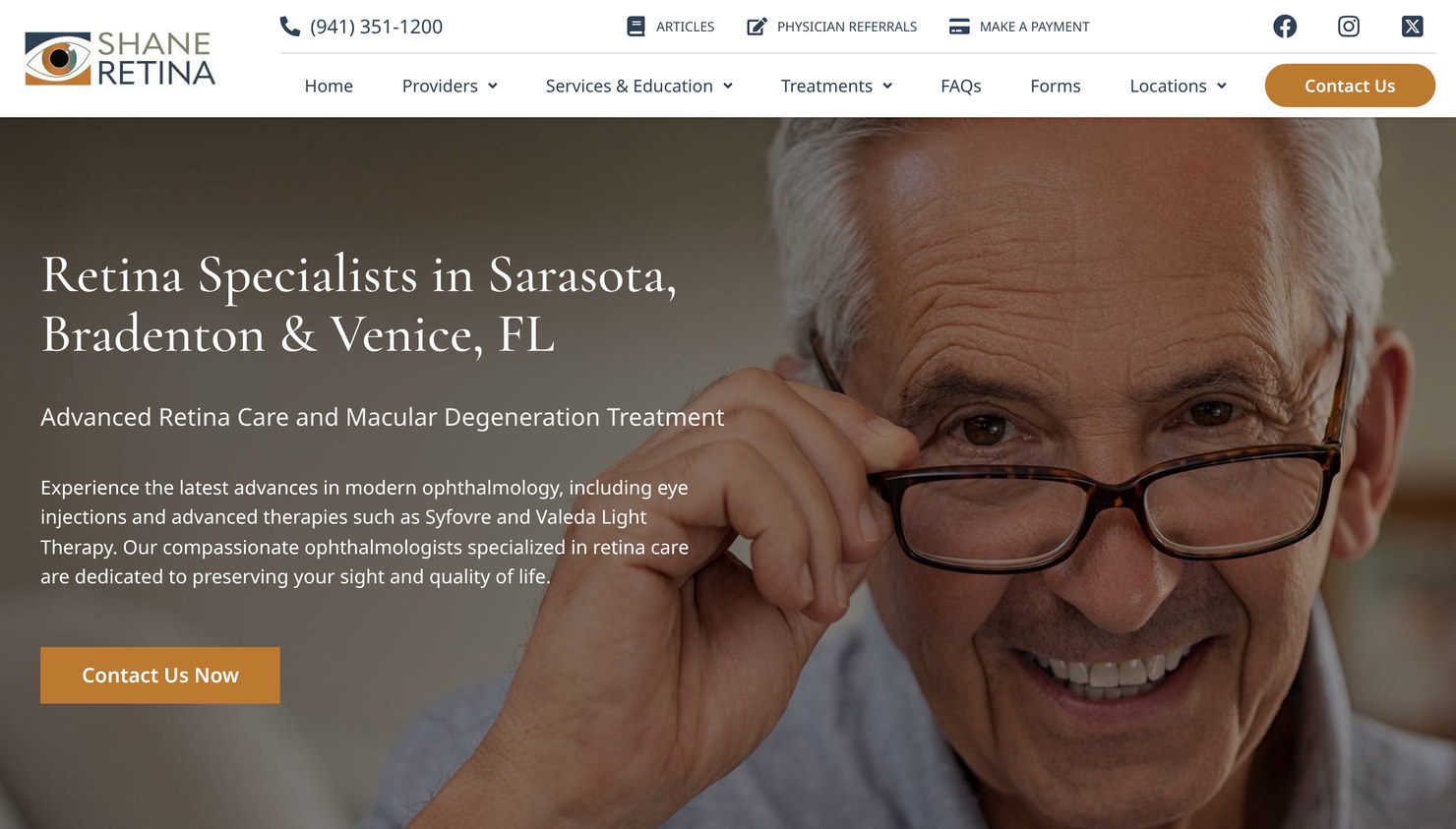
Shane Retina, Sarasota, FL
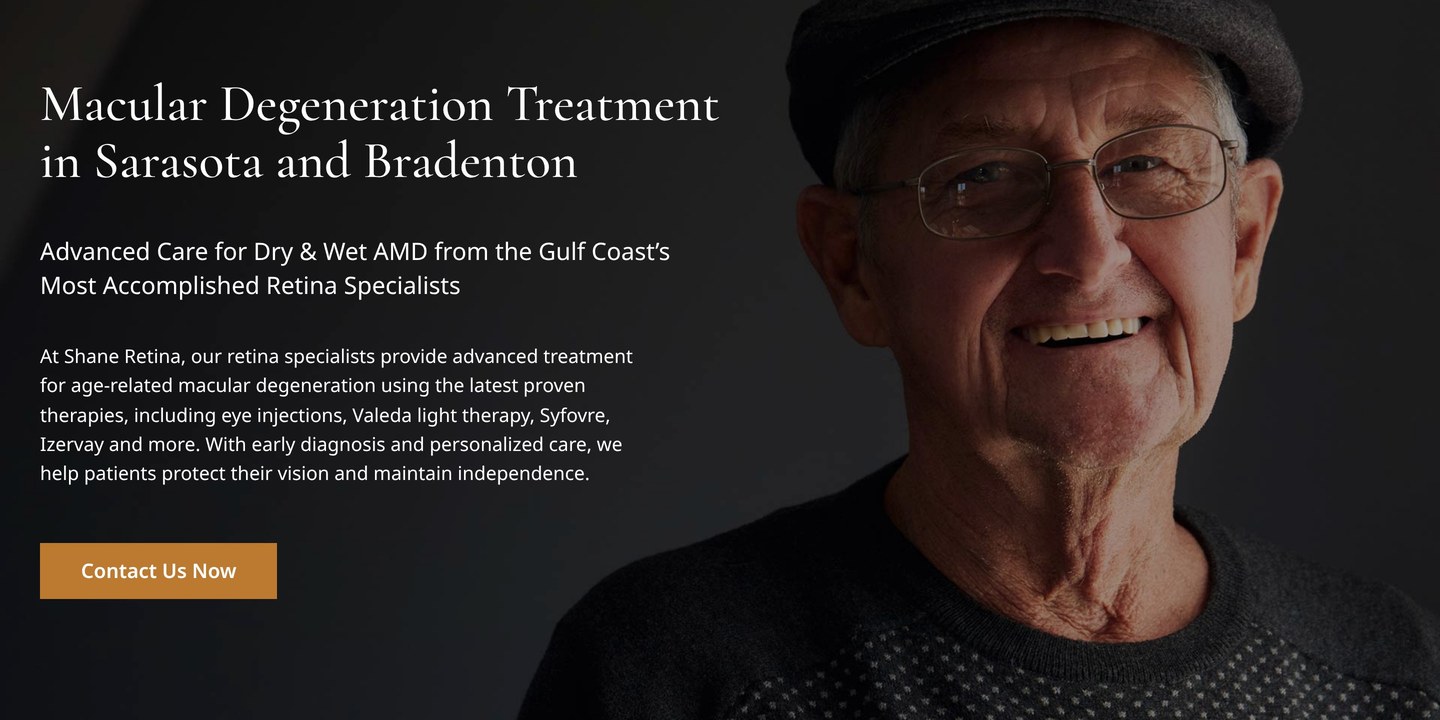
Dr. Thomas Shane’s practice, with two offices in Sarasota. After seeing his wife’s new site, he hired me for his search work. I later redesigned the site and carried it through its name change from Retina Care Consultants.
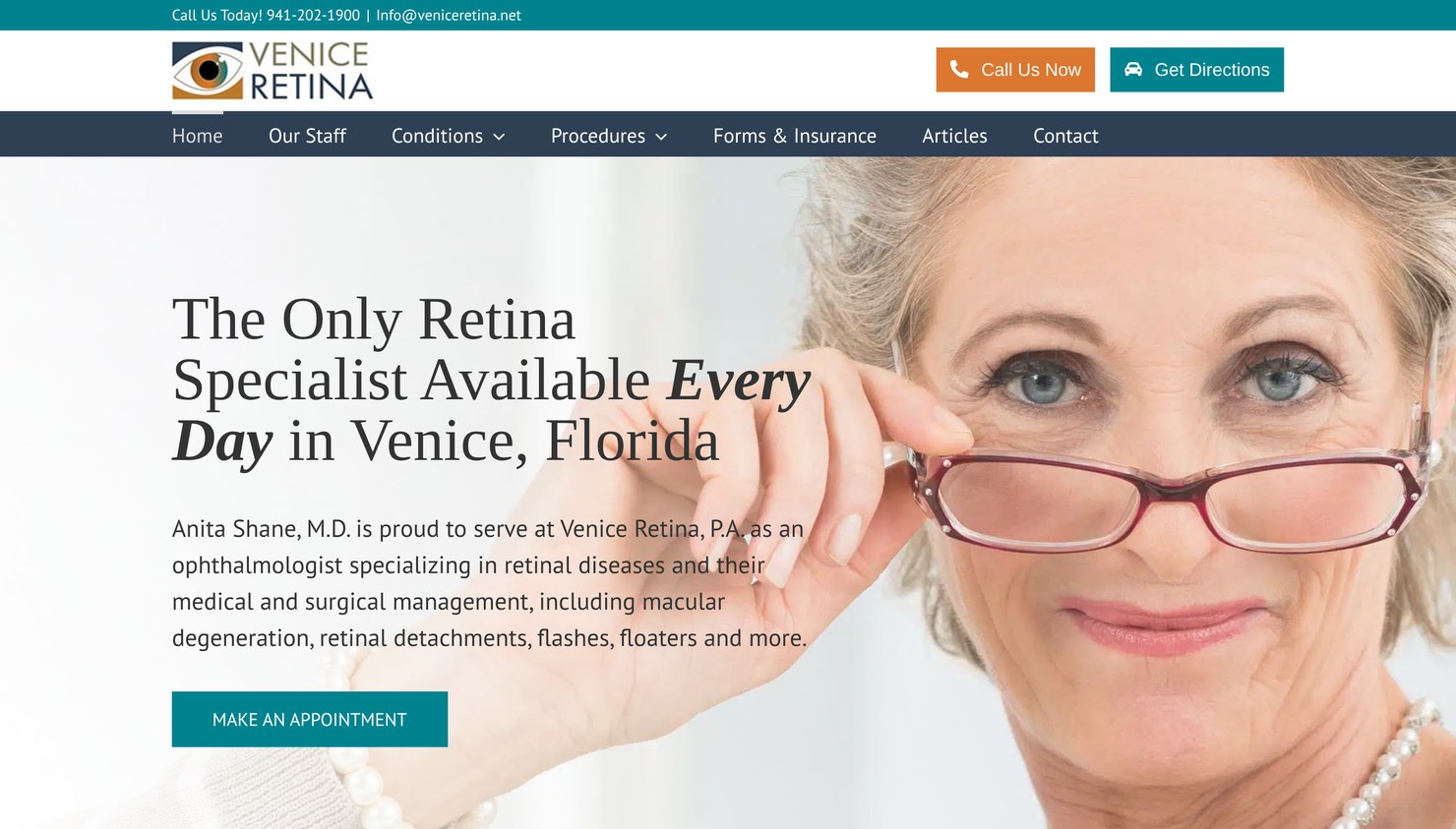
Venice Retina, Venice, FL
Dr. Anita Shane’s practice in Venice, where the work began. I built its website before the practice opened its doors. Today it comes up first on the map for “retina specialist” all around Venice.
In their words
Two retina practices, his and hers, on working with me.
“The results speak for themselves. Since we began working together, our new patient volume has doubled, and approximately half of our patients now come through online marketing. Josh has played a major role in that growth, helping us consistently outperform local competitors in online patient acquisition, including practices much larger than ours. The return on our investment in his services has been exceptional.”
Dr. Thomas Shane · Ophthalmologist & Founder, Shane Retina
“When I was looking for someone to develop our practice’s website, I researched many different developers before finding Josh. His approach to website design stood out to me for both its aesthetics and functionality. From our very first conversation, he was responsive, easy to communicate with, and genuinely interested in understanding our practice and its needs. He immediately demonstrated an ability to appreciate our business from multiple perspectives and translate that understanding into a beautiful, highly functional website.
Seven years later, Josh continues to be just as responsive, reliable, and attentive to our evolving needs as he was at the beginning. I’ve since referred him to at least three other large medical practices, all of whom have been equally thrilled with his work and have developed the same long-standing relationship with him that we have enjoyed. That, to me, is the strongest testament to the quality of his work and the trust he earns from his clients. I recommend him without hesitation.”
Dr. Anita Shane · Ophthalmologist & Founder, Venice Retina
A few common questions
What ophthalmology practices ask before we start.
The questions I hear most from practice owners and administrators. If yours isn’t here, ask it on the contact page.
What should a good ophthalmology website include?
A good ophthalmology website does several things well at once. It makes clear immediately what the practice does and who it serves, whether that’s general ophthalmology, a subspecialty, or both. It provides clear paths for different types of visitors: the patient scheduling a routine exam, the one dealing with an urgent condition, and the caregiver searching on behalf of a family member. It includes a straightforward referral process for physicians who need to send a patient quickly.
Beyond structure, the site needs to meet a higher standard of legibility than most healthcare websites. Many ophthalmology patients are older or dealing with conditions that affect their ability to read a complex page, so large, readable text, simple navigation, and plain language are practical requirements.
Every ophthalmology website also needs to earn trust. That means clear information about what the practice treats, provider credentials that are easy to find, and a visual standard that reflects the quality of the care.
How should an ophthalmology website handle physician referrals?
Referring physicians are busy. When an optometrist or primary care doctor decides to send a patient to an ophthalmologist, they need to be able to act on that decision quickly. A website that buries the referral process, or doesn’t address it at all, creates friction at exactly the wrong moment.
A well-built ophthalmology website makes the referral process visible and simple. That means a dedicated referral form or a clear set of instructions that tells a referring physician exactly what to do and what information to include. It also means presenting the practice’s subspecialties, credentials, and scope of care clearly enough that a physician who has never worked with the practice before can evaluate it quickly and feel confident sending a patient.
On the Shane Retina site, physician referrals sit in the top menu of every page, and the form opens with a line written for the referring doctor.
How do ophthalmology patients find a practice online?
Most ophthalmology searches fall into three categories.
- Symptom-based:
- Patients who notice something wrong often search with what they’re experiencing. “Flashes and floaters,” “blurry vision in one eye,” “sudden vision loss.” These searches carry urgency. Often the person searching is a spouse or caregiver trying to understand what to do next.
- Condition or treatment-based:
- Patients who already have a diagnosis search for the specific care they need. “Retina specialist,” “macular degeneration treatment,” “detached retina surgeon,” “cataract surgery.” The more specific the search, the further along in the decision they are.
- Location-based:
- The highest-intent searches combine a specialty or condition with proximity. “Ophthalmologist near me,” “retina specialist near me,” “ophthalmologist in [city].” These come from patients who are ready to act and comparing nearby options.
Symptom and condition searches capture patients earlier, when they’re still trying to understand what’s happening. Local searches capture them later, when they’re ready to choose. Showing up across all three requires different things from the website and the local presence, and is how a practice stays visible across the full length of the decision.
What's the difference between SEO and local SEO for an ophthalmology practice?
Local SEO is one part of SEO. SEO is the whole job of helping your practice show up in search. Local SEO is the part that deals with nearby searches and the Google map.
The rest of SEO helps patients and caregivers find you while they research symptoms, conditions and treatments: “macular degeneration specialist,” “retina surgeon,” “what causes floaters.” It works through the structure of your pages, the quality of your condition and treatment content, and the answers you give to the questions patients have before they book.
Local SEO helps you show up when patients are ready to choose. It decides whether your practice appears in the Google map when someone searches “ophthalmologist near me” or a condition with the name of their town. It adds a few things of its own: your Google Business Profile, your reviews, and how consistently your practice details appear across the web.
The two depend on each other. Your website is a big part of local SEO: Google checks your Business Profile against it, and your condition and treatment pages help you show up for searches near you. For most ophthalmology practices, the map is the best place to start, because patients choose a practice nearby. But it is one job, done on the same website, and it works best done together.
What is local SEO for ophthalmology practices?
Local SEO is the work that determines whether your practice shows up when someone nearby searches for an ophthalmologist. When a patient types “ophthalmologist near me” or “retina specialist in [city],” a map appears at the top of Google showing a short list of nearby practices. Local SEO is what gets your practice into that group and keeps it there.
Venice Retina, a client of mine, comes up first on the map for “retina specialist” at every point I check around Venice. That is what local SEO is working toward.
How do I get my ophthalmology practice to show up in the Google map?
Showing up in the Google map comes down to four things: your Google Business Profile, your reviews, your website, and consistent listings across the web.
Your Google Business Profile is where it starts. It needs to be fully built out. That means the right categories, your subspecialties listed, photos that reflect the practice, hours that are accurate, and information that matches what’s on your website. Gaps between your profile and your site create confusion for Google and cost you position in the map results.
Reviews matter more in local search than almost anywhere else. The map is where patients compare practices at a glance, and Google weighs how many reviews you have, how good they are and how recent they are. A steady flow of recent reviews signals that the practice is active and trusted. That has to be maintained over time.
Your website reinforces everything. Google checks your Business Profile against what it finds on your site. When the site has clear condition and treatment pages, proper structured data and the same location details as the profile, Google is more likely to show your practice in the map.
Consistent listings are the fourth. Your name, address, and phone number need to appear the same way everywhere across the web. Inconsistencies, even small ones, create doubt for Google about which information is correct.
Do you work with ophthalmology subspecialists like retina, cornea, and glaucoma specialists?
Yes. A retina surgeon, a cornea specialist and a glaucoma specialist each treat a different set of conditions, and the website has to make those differences clear to patients, to the family members searching for them, and to the doctors sending them. My longest-running ophthalmology work is for two retina practices, Shane Retina and Venice Retina, and the same approach works for cornea, glaucoma, cataract and the other subspecialties.
How long does ophthalmology SEO take to show results?
It depends on where you’re starting from and which type of results you’re looking for.
Local SEO tends to move faster. An ophthalmology practice that has the foundational work done correctly can start seeing measurable movement in the map results within three to four months. That means a complete Google Business Profile, consistent citations, proper structured data, and a well-structured website.
Organic rankings take longer. For competitive terms, meaningful movement typically takes six to twelve months. Less competitive searches and subspecialty-specific terms often move faster.
The starting point matters significantly. An established domain with existing traffic moves faster than a brand-new site. A practice that has never touched its local presence has more ground to cover than one that has been actively maintained.
Those are the first signs of progress, and the gains continue for years. For Shane Retina, the South Sarasota office went from Google’s top three at 54 percent of the map around it in 2023 to 92 percent in 2026. The work compounds, and a practice that keeps at it keeps building on it.
What are the best marketing strategies for an ophthalmology practice?
For most independent ophthalmology practices, the best ophthalmology digital marketing strategy is local search, backed by organic SEO and a website that earns trust. The Google map is where the highest-intent patients decide, so a complete Google Business Profile, steady reviews, and consistent listings come first. From there, organic SEO built around the conditions, procedures, and subspecialties you actually offer captures patients earlier in their research, and it compounds: a practice that builds its search presence holds that position in a way paid advertising never does, because ads stop the moment the budget does. Ads are like buying fruit: you pay for every piece. SEO is like planting a fruit tree. It takes time to grow, but once it does, it keeps producing, and you no longer pay for each piece.
Social media plays a smaller role in ophthalmology than in cosmetic specialties. Patients don’t see a post and book cataract surgery. The decision happens on your website and in the map, which is why those two assets deserve the investment.
What's the difference between ophthalmology SEO and general medical SEO?
The fundamentals are the same, but ophthalmology adds layers that generic medical SEO tends to miss. Subspecialty matters: retina, cornea, glaucoma, and cataract each carry different search intent, and the site has to make those distinctions clear. Search behavior spans a wider urgency range than most specialties, from routine exam searches to “sudden vision loss,” and each needs different handling. There’s a second audience most medical SEO overlooks: referring optometrists and physicians evaluating the practice online. And there’s the terminology problem, where patients search for ophthalmologists, optometrists, and “eye doctors” interchangeably without knowing the difference. Good ophthalmology SEO accounts for all of it, so the practice shows up for the searches that matter most.
Do you work with practices that brand themselves as eye care centers?
Yes. Many ophthalmology practices brand themselves as “[City] Eye Care” or an eye care center, and that choice affects how patients find them. The work is the same discipline: eye care website design and SEO built so that Google and AI systems understand exactly what the practice is and what it offers, regardless of what the sign says. Done right, the practice shows up for both vocabularies, the formal searches and the everyday ones.
Where do you work with ophthalmology practices?
Anywhere in the United States. I’m based in the Denver area, and most of my clients are in other states. Discovery happens in writing, and we meet by video on a regular schedule, so the work runs the same way wherever your practice is. For local search, I check how your practice shows up on the Google map around each of your offices, so the work is built around where your patients are.
Will you write the content, or do we have to?
I’ll write it. I can write every page from scratch, but it works best when your doctors or staff give me a few facts first, because no one knows your patients and treatments better than they do. That doesn’t mean anyone has to write every sentence. A bulleted list, a few ideas or a list of topics is enough, and I turn it into the pages. Early on, I work out a voice for the practice, or put into words the one it already has, and every page is written in it, so the whole site sounds like your practice. Your doctors see every page before it goes live, so nothing is published until they have had the chance to check it. You can be as involved as you want to be.
What happens if our practice changes its name?
It gets planned. A new name is one of the riskiest changes a practice can make online, because the rankings, reviews and listings it has built all sit under the old one. Done carefully, the practice keeps all of that.
A name change usually means a new web address, so every old page is sent to the right page on the new site, and nobody hits a dead end. The Google Business Profile for each office and each doctor is renamed the day the new site goes live. The practice’s listings on sites like Healthgrades and Zocdoc are updated to match, and the structured data changes with them, so Google and AI tools connect the new name to the practice they already know. After launch, I watch how Google takes the change and fix anything that slipped.
When Retina Care Consultants became Shane Retina, the old web addresses were sent to the new ones and the Google profiles were renamed on launch day. Within a few months, the South Sarasota office ranked higher on Google Maps for “retina specialist” than it had before the change. The website redesign page covers how I handle it.
What happens if you're unavailable?
I travel with my laptop, so if something urgent comes up, I can handle it from wherever I am. Your website runs on managed hosting with daily backups and a support team available around the clock, so the technical safety net doesn’t rest on one person. You own your domain, your website and your logins, and if you ever needed someone else to step in, I’d give you everything they need. I typically respond to requests quickly, and some of my clients have been with me for more than ten years. At an agency, the person who knows your practice can leave. With me, it’s always the same person.
Do you work with my competitors?
No. I won’t work with a practice that competes with one of my clients for the same patients in the same area. If you’re my client, I’m on your side, and I want you to win. I do work with eye care practices in other areas, but never two competing in the same market.
Next specialty
Med Spa
More specialties

Get in touch
If your ophthalmology practice is better than its website shows, I can help.
Tell me what your practice does best and who you want to reach, and we’ll both get a sense of whether we’re the right match.