


Services · SEO · Local
Local SEO
Showing up on the Google map when somebody nearby is ready to walk through your door.
- What Local SEO Actually Is
- The Google Maps result is a shortlist
- Why "Near Me" Searches Are Worth More
- Your Google Business Profile
- What Your Website Has to Do
- Everything That Lives off Your Website
- Reviews
- More Than One Location
- Where you rank depends on where the searcher is standing
- What Goes Wrong
- How You Know It Is Working
- When Local SEO Is Not the Answer
- Local SEO for Medical Practices
- Common Questions
In short
- Local search is decided by three things: your Google Business Profile, your website, and everything written about you elsewhere.
- Where you rank changes depending on where the person searching is standing.
- Most local SEO problems are not ranking problems. They are listing problems.
What Local SEO Actually Is
Local SEO is the work of showing up when somebody nearby searches for what you do. Most of the time, that means the Google map and the short list of businesses at the top of the results. The goal is to reach the people close enough to become customers, at the moment they are looking, in the places where a local search gets answered. As a local SEO expert, I do this work myself, from the Google Business Profile to the pages behind it and the listings across the web.
The map shows up whenever a search has a location in it or implies one. Local search can also mean:
- The local results underneath the map
- Results within Google Maps itself, when somebody searches in the app
- Apple Maps and Bing
- The directories that rank for your kind of business
- AI answers, such as ChatGPT or Google’s AI Overview, when somebody asks for a recommendation nearby
Right now this service is mostly about the map, because that is where most local decisions get made. The rest follows from the same work.
Local SEO is a different job from ordinary SEO, and it is related to it. Ordinary search ranks pages. Local search ranks businesses. When Google decides what to show someone who searched for a dermatologist, it is not only asking which page best answers the question. It is asking which businesses are real, nearby, open, well regarded, and clearly in that line of work. Then it shows a map with a short list of them. Google uses how well your website does in ordinary search as part of that judgment, so the two kinds of SEO help each other.
That means a lot of what decides your local ranking is not on your website at all. Your Google Business Profile is not on your website. Your reviews are not on your website. The way your address is written on forty other sites is not on your website. All of it counts toward how often you show up in local search, but most businesses only work on their own website and leave the rest alone.
Local SEO comes down to three things:
- Your Google Business Profile. The listing itself, and everything in it.
- Your website. What it says about where you are and what you do, and whether there is a real page behind every location.
- Everything else on the internet about your business. Directories, listings, professional associations, reviews, and mentions.
The Google Maps result is a shortlist
When somebody searches for a business near them, Google usually answers with a map and a handful of listings above everything else, the group marketers call the map pack. On a phone, that map can be most of the first screen.
Being on that map or off it can make a huge difference in how many customers find you. The few businesses it shows get most of the calls and visits from the search. A business ranked fourth is rarely considered, because few people tap through to see more results.
Most people picture search as a long page of results, where being tenth is a bit worse than being first. For local search that is not the shape of it. There is a short list, and you are on it or you are not.
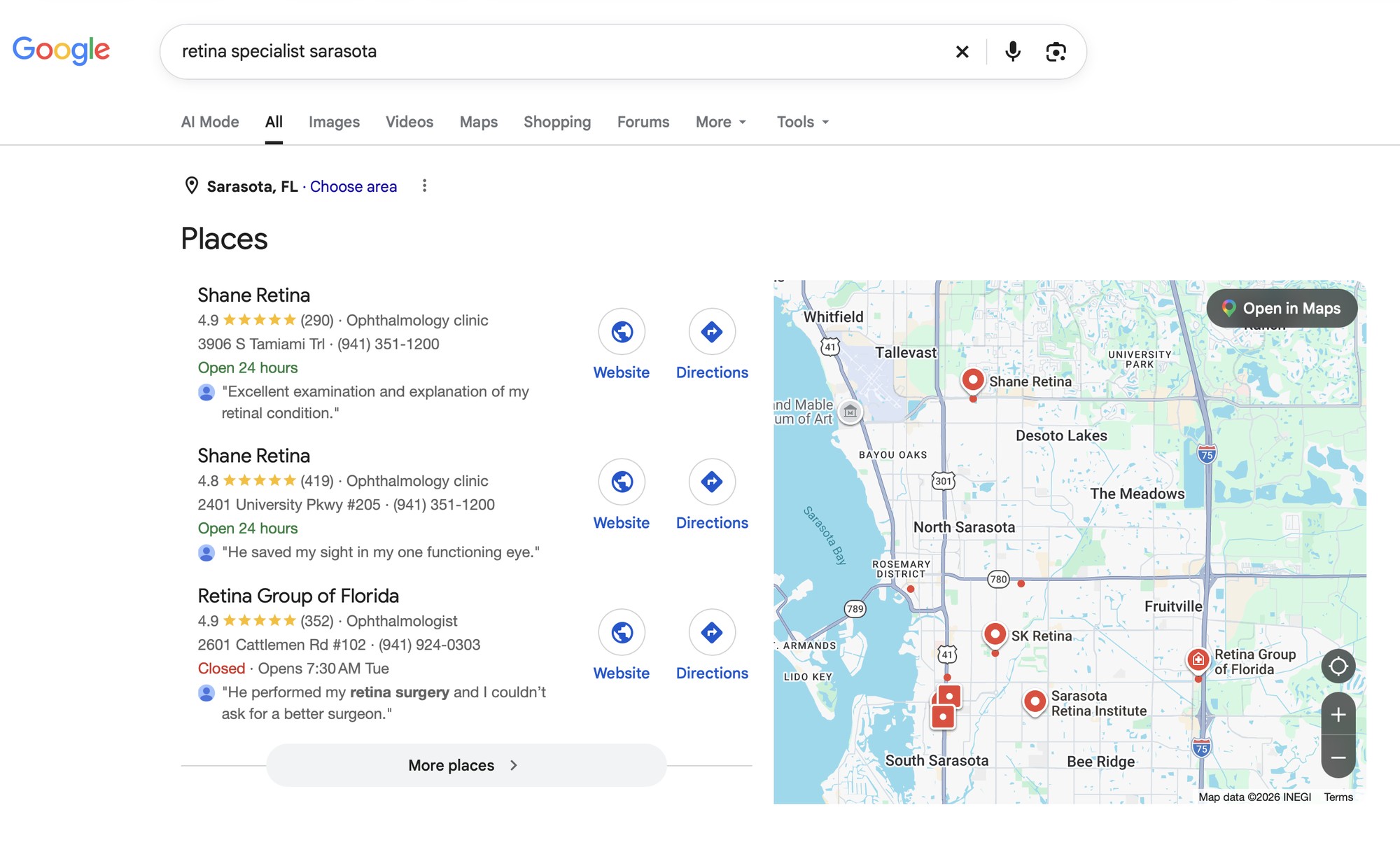
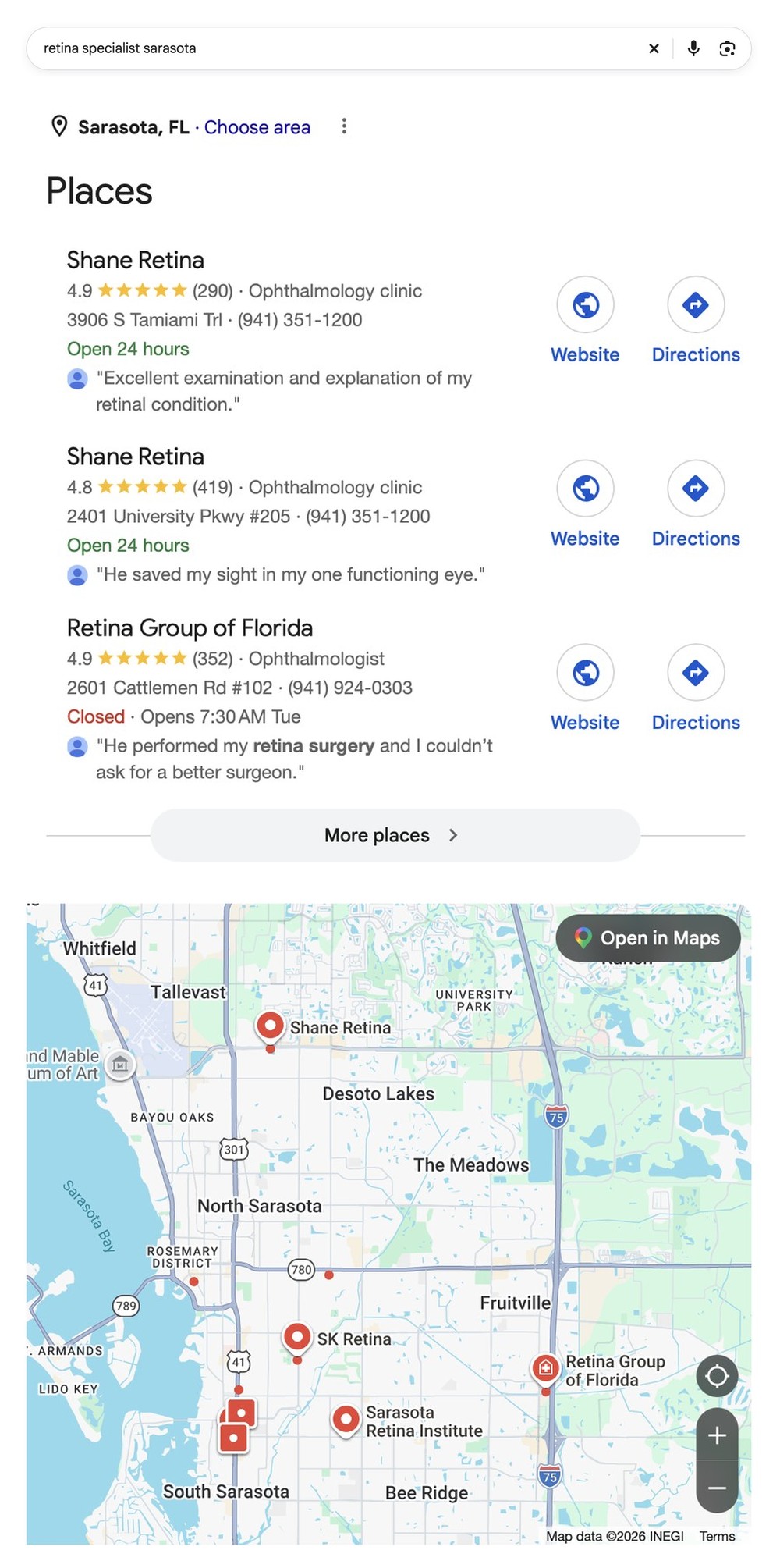
Google’s map results for “retina specialist sarasota.” Shane Retina, a client of mine, holds the first two places with its two Sarasota offices.
What gets you on it is roughly three things, the local search ranking factors Google is unusually open about:
Relevance
How well your business matches what was searched. This is where your categories, your services, and your website’s content do their work.
Distance
How far you are from the person searching, or from the area they searched in. You cannot change this one, and it is why a single ranking number for your whole city is meaningless.
Prominence
How well known and well regarded your business is. Reviews, mentions elsewhere on the web, and your ordinary search presence all feed it.
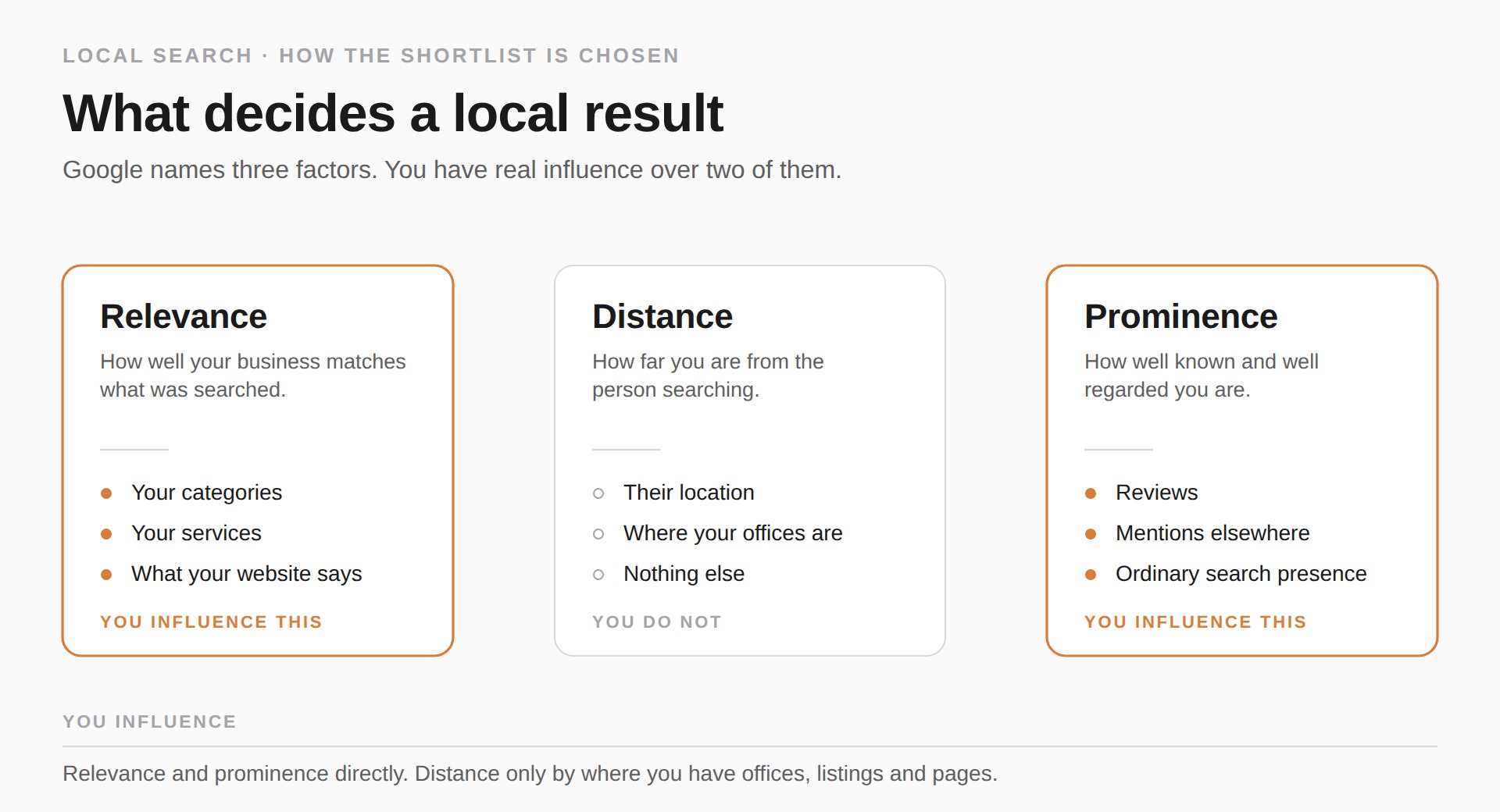
Google names three factors. You have real influence over two of them: relevance and prominence.
Why "Near Me" Searches Are Worth More
A search with “near me” in it, or the name of a nearby town, comes from somebody much closer to acting. Compare two searches: “botox” and “botox near me.” The first might be a student, a journalist, or somebody two thousand miles away reading about it. The second is a person deciding where to go.
I split my clients’ searches into ordinary searches and strong intent searches, where strong intent means the search carried “near me” or a nearby place name. It is by far the more useful number.
For Arsenault Aesthetics, a med spa, those strong intent searches rose 146 percent in a year. Total traffic rose too, but the strong intent number is the one that showed up on the appointment book.
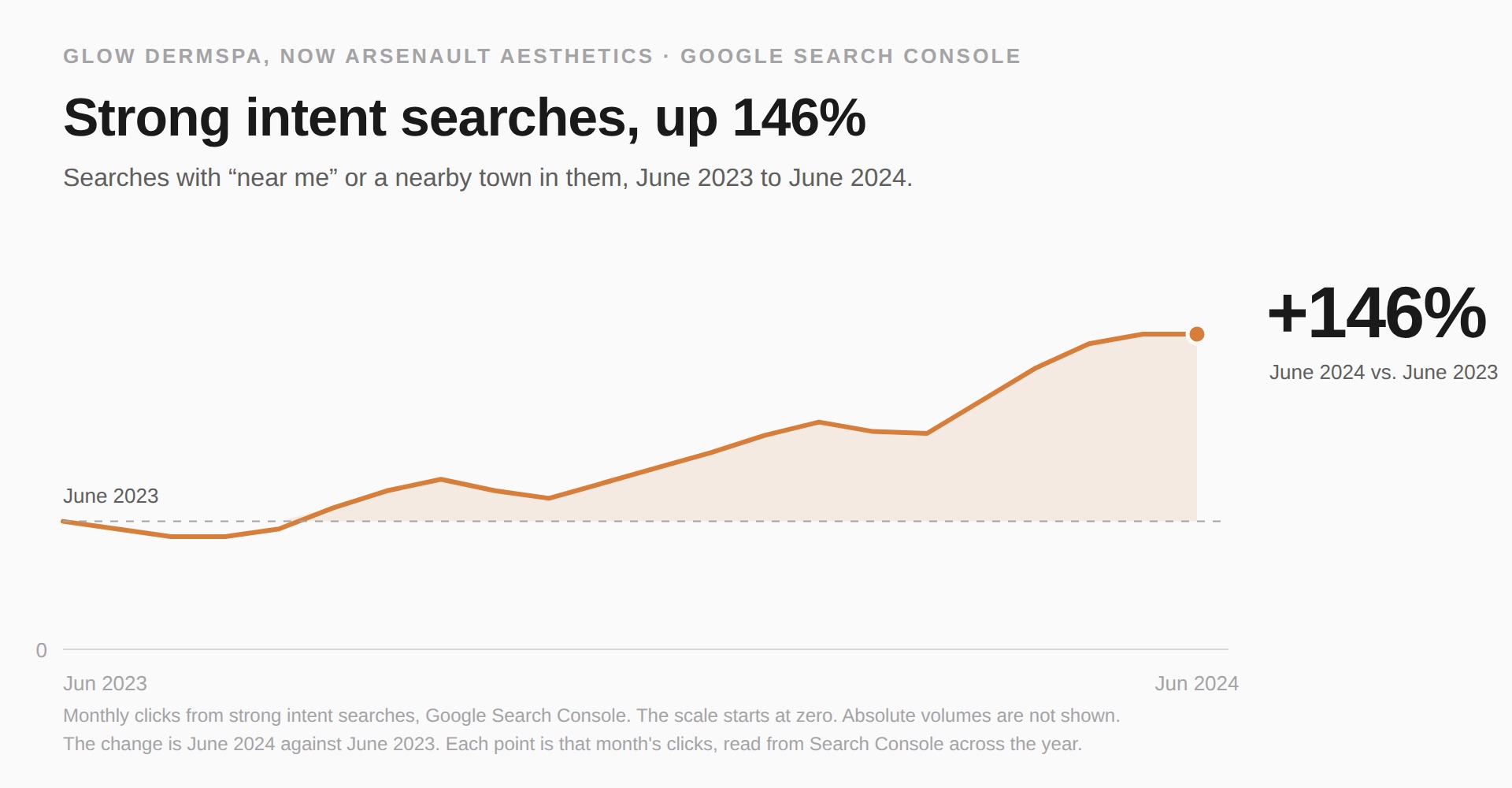
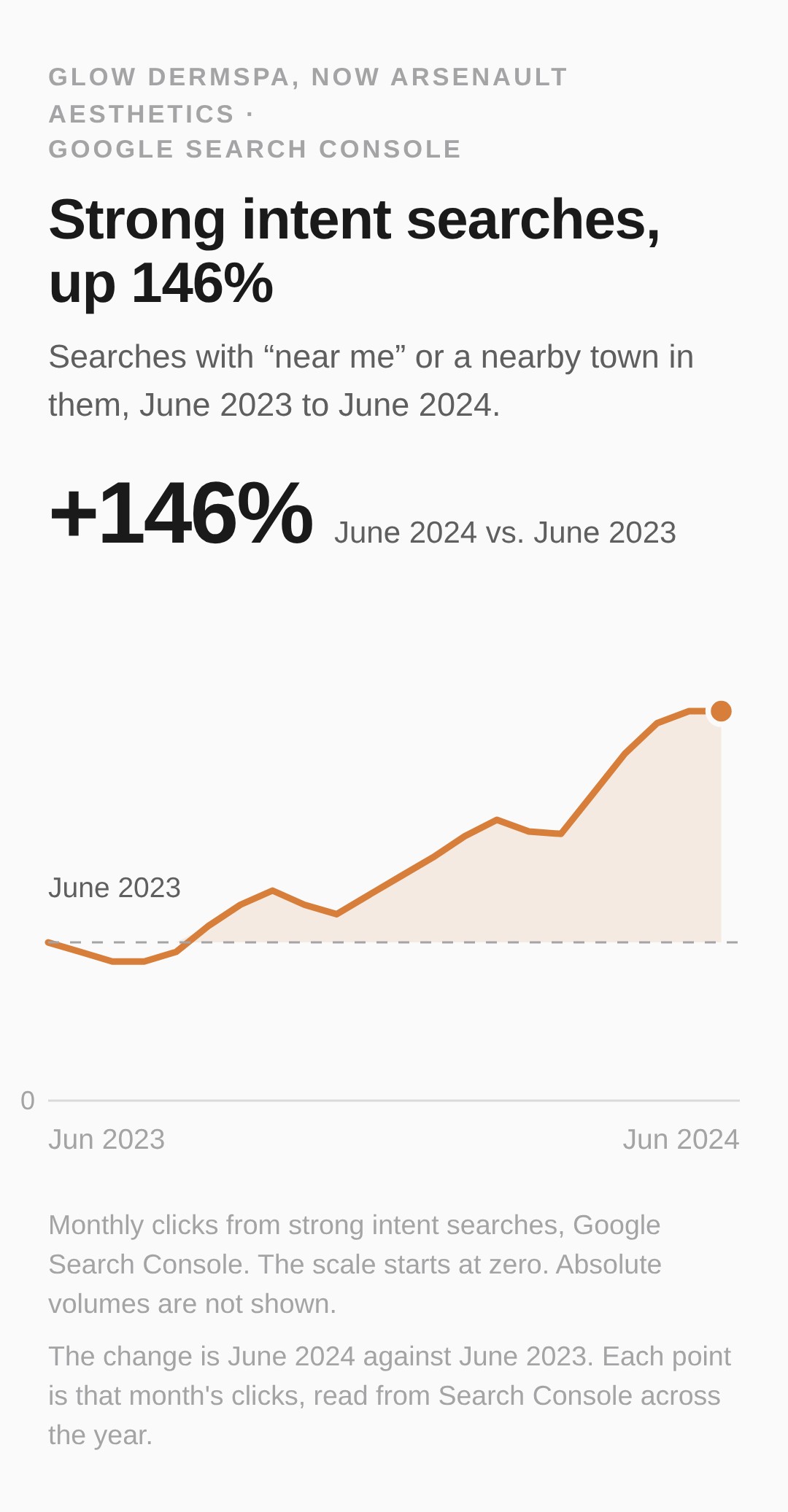
Strong intent searches a month for the med spa, June 2023 against June 2024. The searches with “near me” or a nearby town in them. From the Arsenault Aesthetics case study. Source: Google Search Console.
Total traffic is easy to grow badly. You can double a site’s visitors with content that brings in people who will never buy. Growing the searches that carry intent is harder, slower, and the only version worth paying for.
Brand-name treatments and products are a special case worth knowing about. Search a treatment’s brand name on its own and Google treats it as a question about the product: you get the manufacturer, medical references, and no map. Add “near me” and the map appears. Shane Retina is first at every point I check around one of its offices for “Izervay injections near me,” a treatment it lists by name on its profile and its website. Searches like that are usually close to empty of competition, because most businesses never list a treatment by its brand name anywhere. If you offer something people know by its brand name, that “near me” search is worth owning.
Your Google Business Profile
Nothing else in local search moves as much as Google Business Profile optimization, and the profile is the thing most businesses set up once and never touch again.
Your profile is what appears in the map, and increasingly it is a destination in its own right. People read the hours, look at the photographs, scan the reviews, and call, without ever visiting your website. For Love and Beauty Maui, more than 1,300 of the 3,500+ clicks its website has drawn from Google came through the website link on its Business Profile rather than a normal search result. I optimized that profile when the new site launched, and it has kept paying off.
It holds up across practices too. For the medical practices whose profiles I manage, about one in four Google clicks to their websites now comes through the Business Profile, and those profiles bring in more than 25,000 phone calls a year.
Here is what actually matters in it.
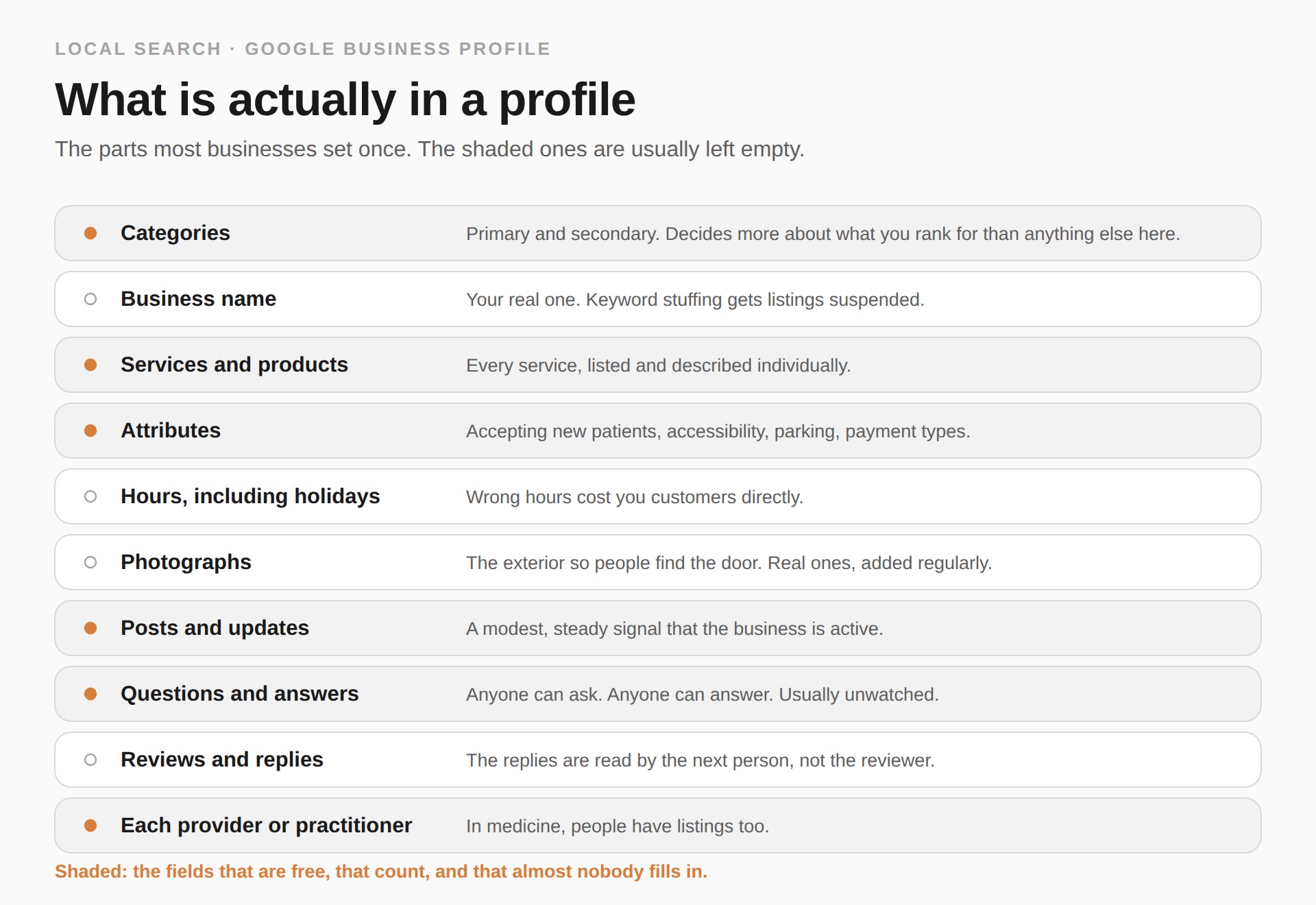

The shaded rows are free, they count, and almost nobody fills them in.
Categories
Your primary category does more to decide what you rank for than almost anything else on the profile, and there is usually a better choice available than the obvious one. Secondary categories widen what you can appear for without diluting the main one. Choosing these badly is a quiet, permanent handicap.
The Business Name
It has to be your real name. Stuffing keywords into it violates Google’s guidelines and gets listings suspended. Sometimes your real name puts you at a disadvantage. Arsenault Aesthetics, a med spa I work with, competes in a market where nearly every competitor has “med spa” in its business name. That is not a problem you can solve by cheating. You solve it everywhere else on the profile.
Services and Products
Every service you offer, listed individually, with a real description of each. This is free space that most profiles leave empty, and it feeds what the listing can be matched to. When a listing matches a search because of a service, Google often says so in a line under the listing, such as “Provides: microneedling,” and sometimes that service is the only reason the listing appears for the search at all.
Attributes
Whether you are accepting new patients, wheelchair accessible, offer a particular payment type, have parking. Small things that filter searches and that people actually read.
Hours, Including Holiday Hours
A listing with wrong hours costs you customers directly, and Google will eventually flag it if users correct it often enough.
Photographs
Real ones, added regularly. The exterior so people can find the door. The interior so they know what they are walking into. Your team. Not stock.
Posts and Updates
A steady, modest signal that the business is active.
Questions and Answers
Anyone can ask a question on your listing, and anyone can answer it. Unmonitored, this becomes a place where wrong information about your business lives permanently. It should be seeded with the real questions and watched.
Every Provider or Practitioner, Where That Applies
In medicine, individual doctors often have their own listings alongside the practice. These need the same care and they behave differently from the office listings.
The profile needs tending, not setting up. Google changes fields, adds sections, and occasionally makes changes to your listing on its own that you would not have chosen. Somebody has to be watching.
What Your Website Has to Do
Your profile and your website are not two separate projects. They feed each other.
Google reads your website to decide whether your listing deserves to rank for something. If your profile claims you offer a service that appears nowhere on your site, that claim is weak. If your site has a real page about that service, naming the area you serve, the claim is strong.
Every location needs its own page. Not a line on a contact page. A page with the address, the hours, the phone number, directions and parking, who works there, what happens there, and a way to book. Written so that somebody searching near that office finds that office rather than your head location.
This matters more than it sounds. On one practice’s site, the page behind one office’s listing is the fifth most-visited page on the website, and most of its visitors arrive from that listing.
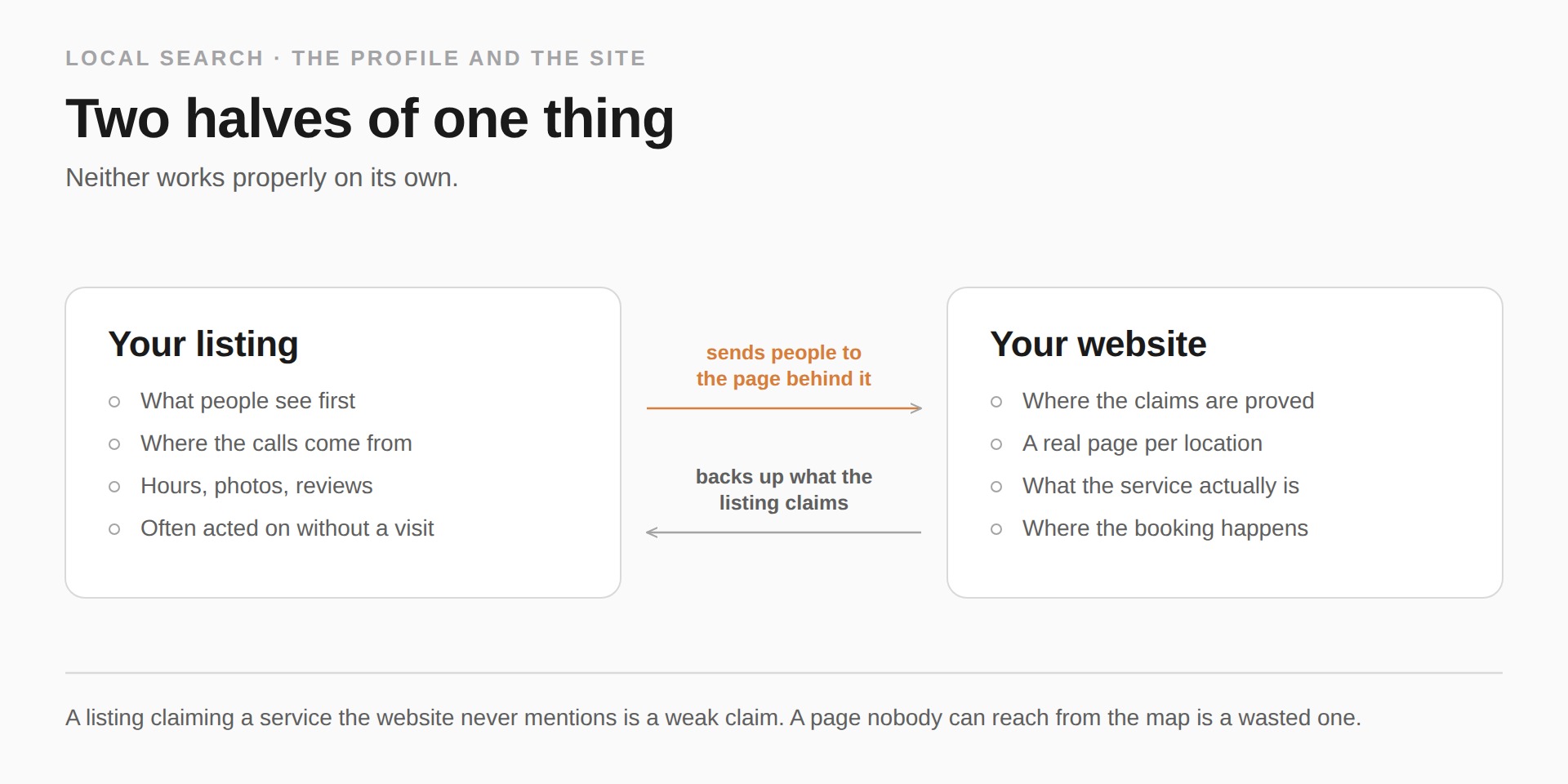
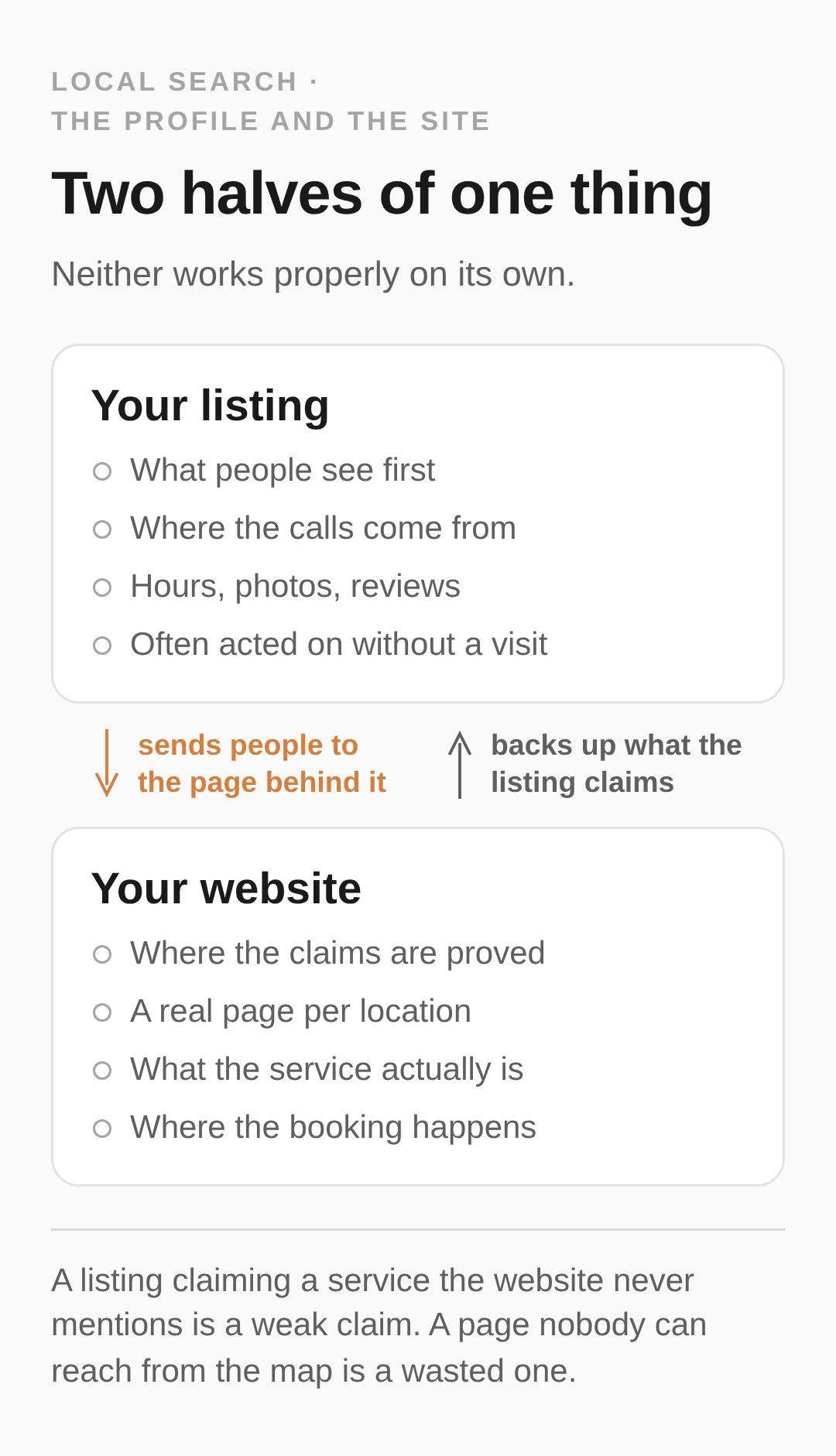
Neither half works properly on its own.
The listing has to link to its own location page. The website link on each office’s profile should point at that office’s page, not at the homepage. It is the one link that tells Google which page belongs to which listing, and most multi-location businesses point every listing at the homepage and lose the connection.
The address on your site has to match the address on your listing exactly. Same formatting, same suite number, same abbreviations. More on that below.
The technical details count. Your address should be marked up in code so it can be read without guessing. Your pages should load quickly on a phone, because most local searches happen on one. Your phone number should be tappable.
And the pages behind the listing have to be worth arriving at. Getting somebody to click through from a map listing to a page that does not answer their question wastes the hardest part of the work. When the site behind your listings cannot do this, a redesign usually comes first, and a careful one keeps the rankings the old site earned.
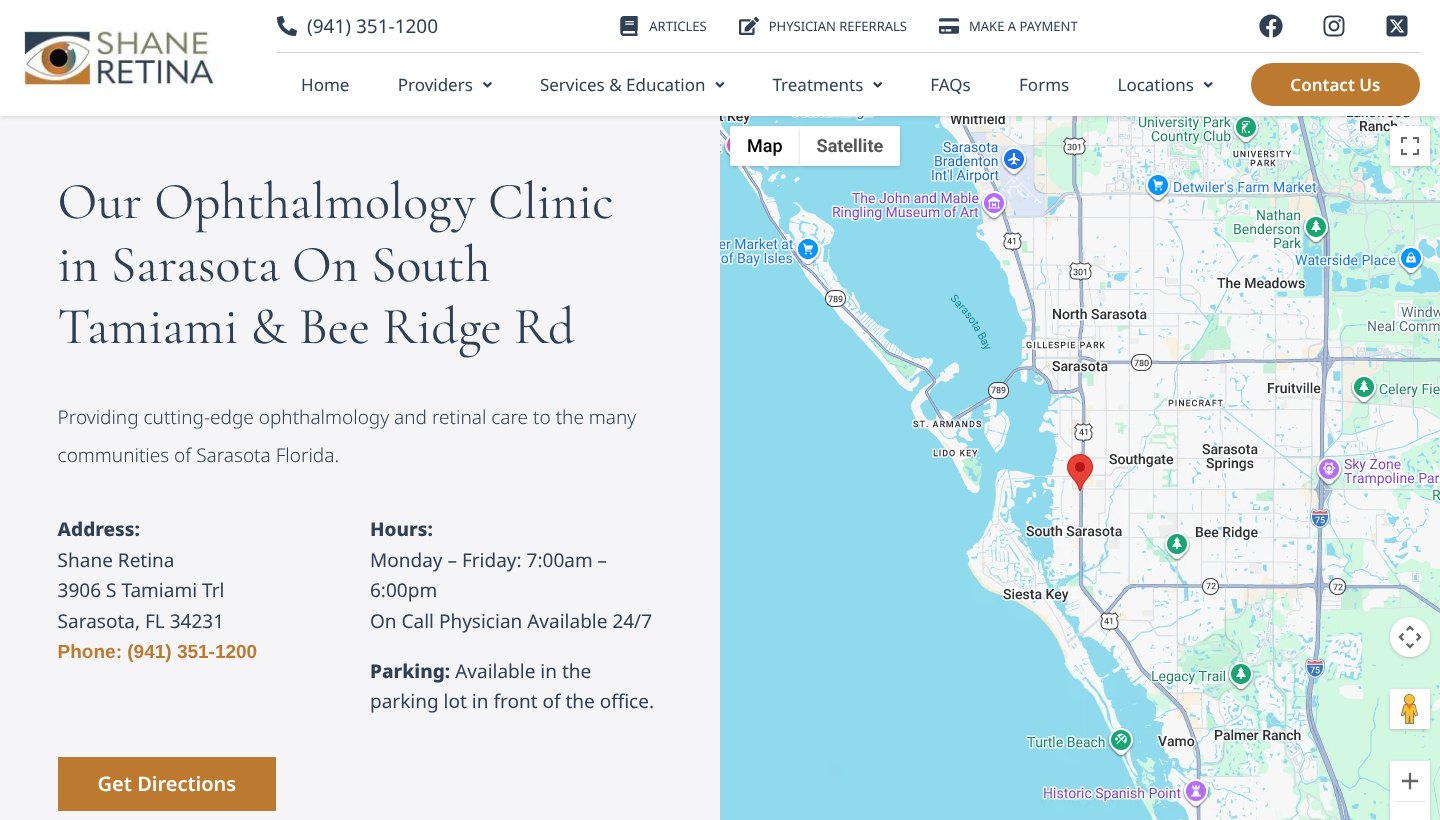

The pages behind the listings: the South Tamiami office in Sarasota and Dr. Thomas Shane, on the Shane Retina site.
Everything That Lives off Your Website
This is the half of local SEO that most businesses never touch, because it is invisible from their own site.
Name, Address, and Phone Number
Your business details are written about you in dozens of places, sometimes hundreds, and they need to agree. Directories, professional associations, insurance listings, chambers of commerce, review sites, data aggregators, and old profiles you forgot existed.
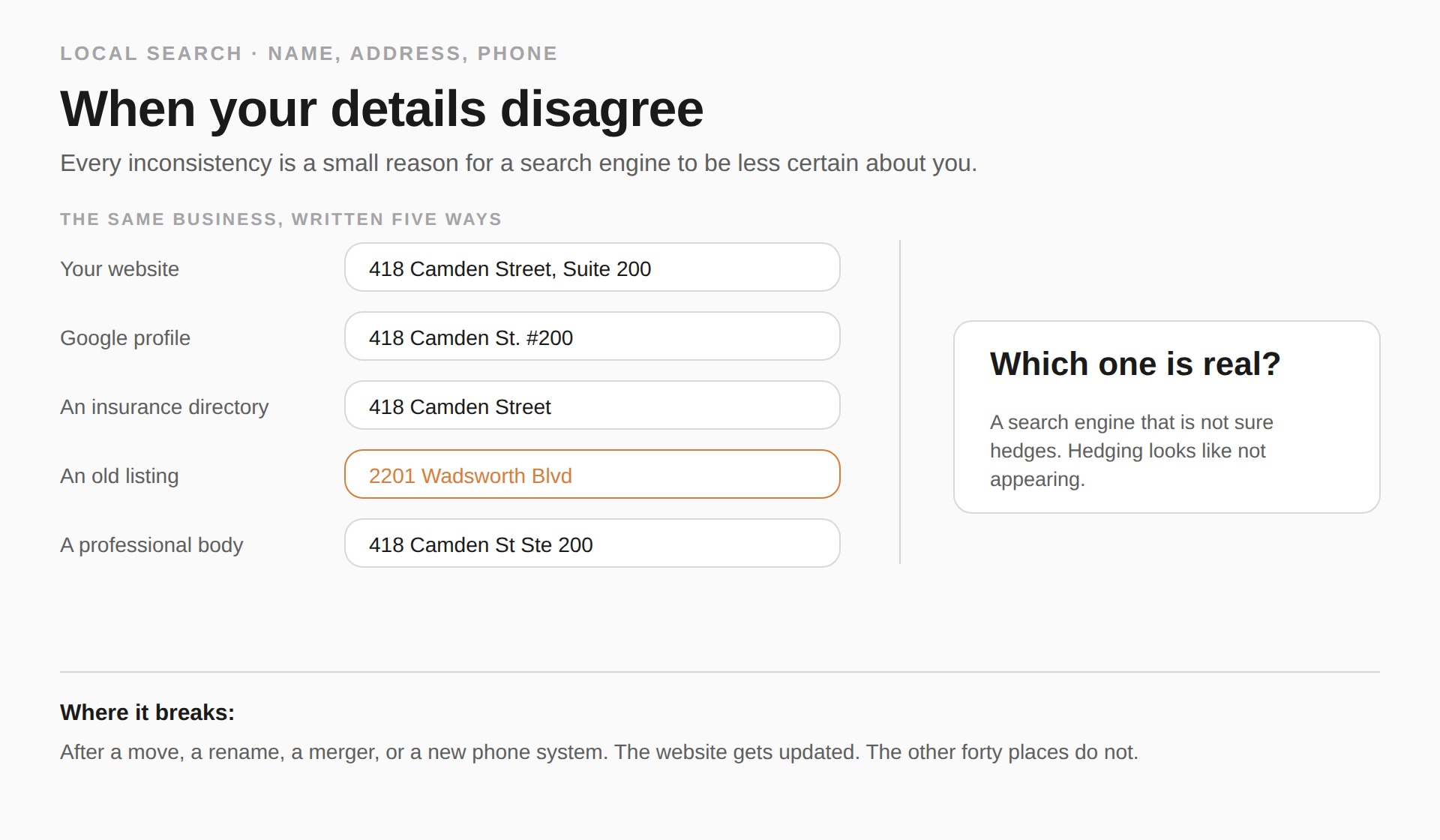
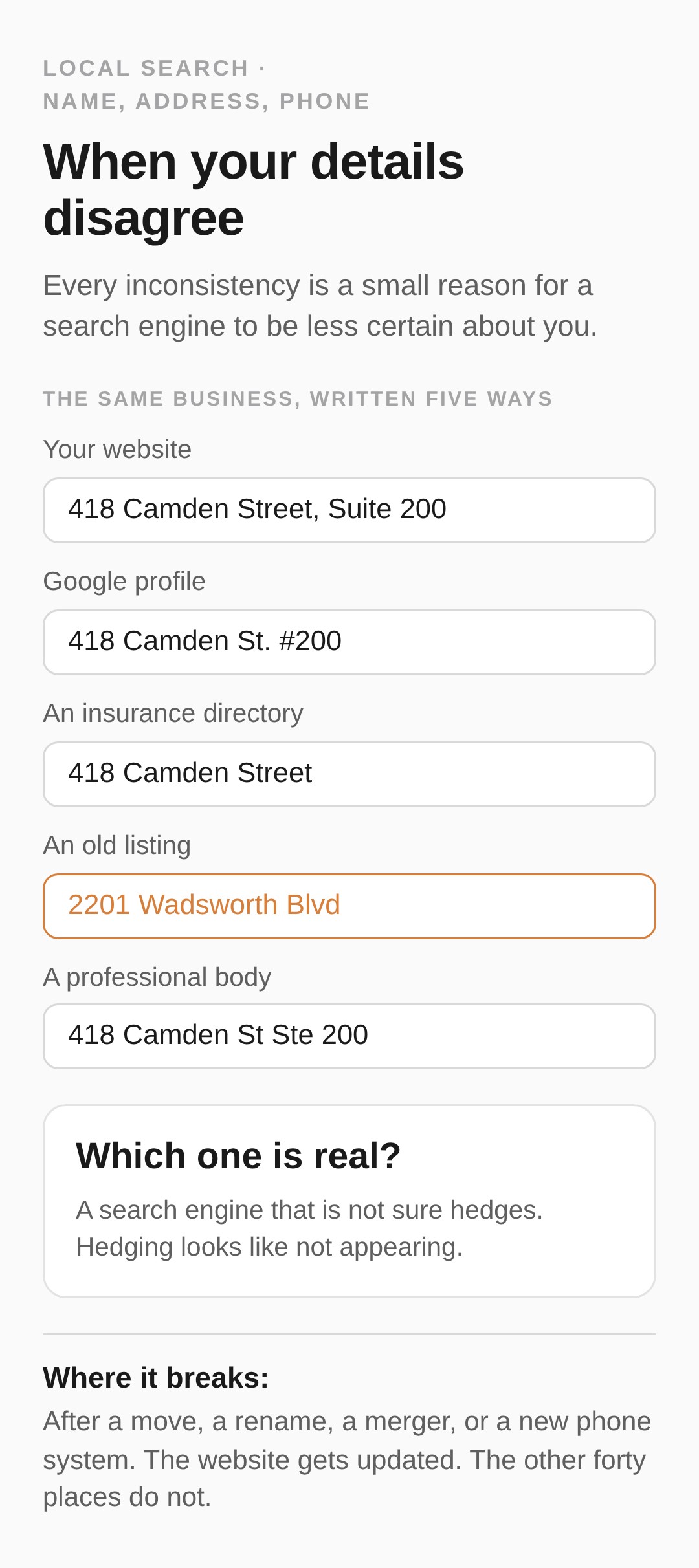
The same business address, written five different ways across the web.
When those records disagree, Google has to decide which version of you is real. A suite number on one and not on another. An old phone number that still works. A previous address. A name written three ways. Each disagreement is a small reason for a search engine to be less certain about you, and certainty is what helps you to rank.
Consistency here, what the trade calls NAP consistency, is unglamorous and it works. It is also the thing most likely to be quietly broken after a move, a rename, or a merger.
Listings and Citations
A citation is any mention of your business details on another site. The value is partly the link and partly the corroboration: a business that appears consistently across the places that matter for its industry is easier to believe in.
There are two lists. The first is the one every business needs: Google, Apple, Bing, the big review and directory sites, and the data companies that feed hundreds of smaller ones. The second is specific to what you do. A dermatology practice needs the medical directories, the insurance networks, and the hospital affiliations. A wedding vendor needs the wedding directories. A contractor needs the home services sites. Volume is not the goal, and services that blast your details to five hundred directories create more inconsistency than they fix.


The listings every business needs, and a few of the ones that depend on what you do. The second list is different for every industry.
In some industries there are listings for people as well as places. In medicine, every provider can have their own profile on the same directories, created by data companies without the practice’s involvement and often wrong. Part of this work is tracking down the listings you did not know existed, the ones set up by aggregators, by a staff member years ago, or by a directory on its own, and consolidating or merging them so there is one clean record of you.
I build these by hand rather than pushing them through a service, for exactly that reason. It is slower and the record stays clean.
Everything Else Written About You
Mentions in local press, association memberships, sponsorships, and the ordinary footprint of a business that has been in its area for a while. You do not control most of it, and it still counts.
Reviews
Reviews affect where you rank and they affect whether somebody chooses you once they see you.
The ranking side is straightforward: quantity, quality, recency, and whether you respond all feed how prominent your business looks. The choosing side is more important and less discussed. Somebody looking at three listings on a map is comparing star ratings and review counts in about four seconds.
Replying matters more than most people think. Not for the reviewer, who has moved on. For the next person reading, who is forming an impression of how the business handles itself. A calm, specific reply to a critical review does more good than ten positive reviews. Depending on the business, replies can also do a second job: naming the service and the location naturally, as in thanking somebody for trusting you with their new floors in Arvada, strengthens what the profile is understood to be about. Done clumsily it reads as clumsy, so this depends on the business and the tone of its reviews. Medical practices are the exception: a reply should never confirm that the reviewer is a patient, or what they came in for.
Reviews on more than one platform are worth having. Google dominates, but a business that exists only on Google looks thinner to everything else that reads the web.
A steady trickle beats a burst. Thirty reviews in a week after two quiet years reads as exactly what it is.
A trickle needs a system. Reviews do not arrive on their own in the numbers that matter. There has to be a way of asking every customer at the right moment, in the right words, with a link that takes them straight to the review form, and then somebody has to keep doing it, month after month. Set up once and run consistently, that system is what produces the steady flow that changes a listing. Set up and forgotten, it produces nothing.
The asking comes from your team. The practices I work with that have thousands of reviews earned them by asking patients well, consistently, over years. I can help set up that system, make sure the reviews show up where they should, and make sure nothing is broken. Be wary of anyone who offers to supply reviews. Fake reviews break Google’s rules and can get a listing suspended.
More Than One Location
Every location is a separate business as far as local search is concerned, and that is good news.
Seven offices means seven chances to be the nearest result, seven listings, seven sets of reviews, and seven pages that can rank. Arsenault Dermatology grew from three offices to seven while we worked together, and each new office needed its own page and its own listing, written and structured so a patient searching in one town finds that town’s office rather than the practice’s main address.
The discipline is consistency without sameness. All seven have to read as one business, with the same brand, the same standard of information, and the same structure. None of them should be a copy of another with the town name swapped, because that is both worse for the reader and visible to a search engine.
Locations compete with each other if you let them. Two offices in the same metro area can end up fighting for the same search. The fix is being explicit about who serves what, in the content and in the service areas on each listing.
Where you have customers but no office, a service area page can do real work, as long as it is clear about what it is. A practice that sees patients from a neighboring city from two nearby offices can say so on a page built for that, rather than pretending to an address it does not have.
Where you rank depends on where the searcher is standing
There is no such thing as your ranking for a local search. You have a different ranking at every point on the map, and the difference between them is often the whole story.
A practice can be the first result for somebody standing outside its front door and invisible three miles away. Being first in your own parking lot is not an achievement. Being in the top three across the area your customers actually live in is the thing worth measuring.
So I do not check one ranking. I check dozens of points spread across the area around each location, every month, for the searches that matter, and I look at how much of that area the business holds.
This changes what good looks like. For Shane Retina, averaged over each year’s checks, the South Sarasota office was in Google’s top three at 54 percent of the points around it in 2023 and at 92 percent in 2026, and Venice Retina went from three quarters of the points to all of them. For one dermatology office, a search for pediatric dermatology finds the practice at every point checked, in the top three at more than nine in ten of them, against forty-three competing practices in the same area.
The map also shows where the work is needed. A weak patch on one side of a location usually has a reason: a recent competitor with more reviews, a category mismatch, a town the website never mentions, or a second office of your own taking the search. Each of those has a different fix, and the map is what tells you which one you are looking at.
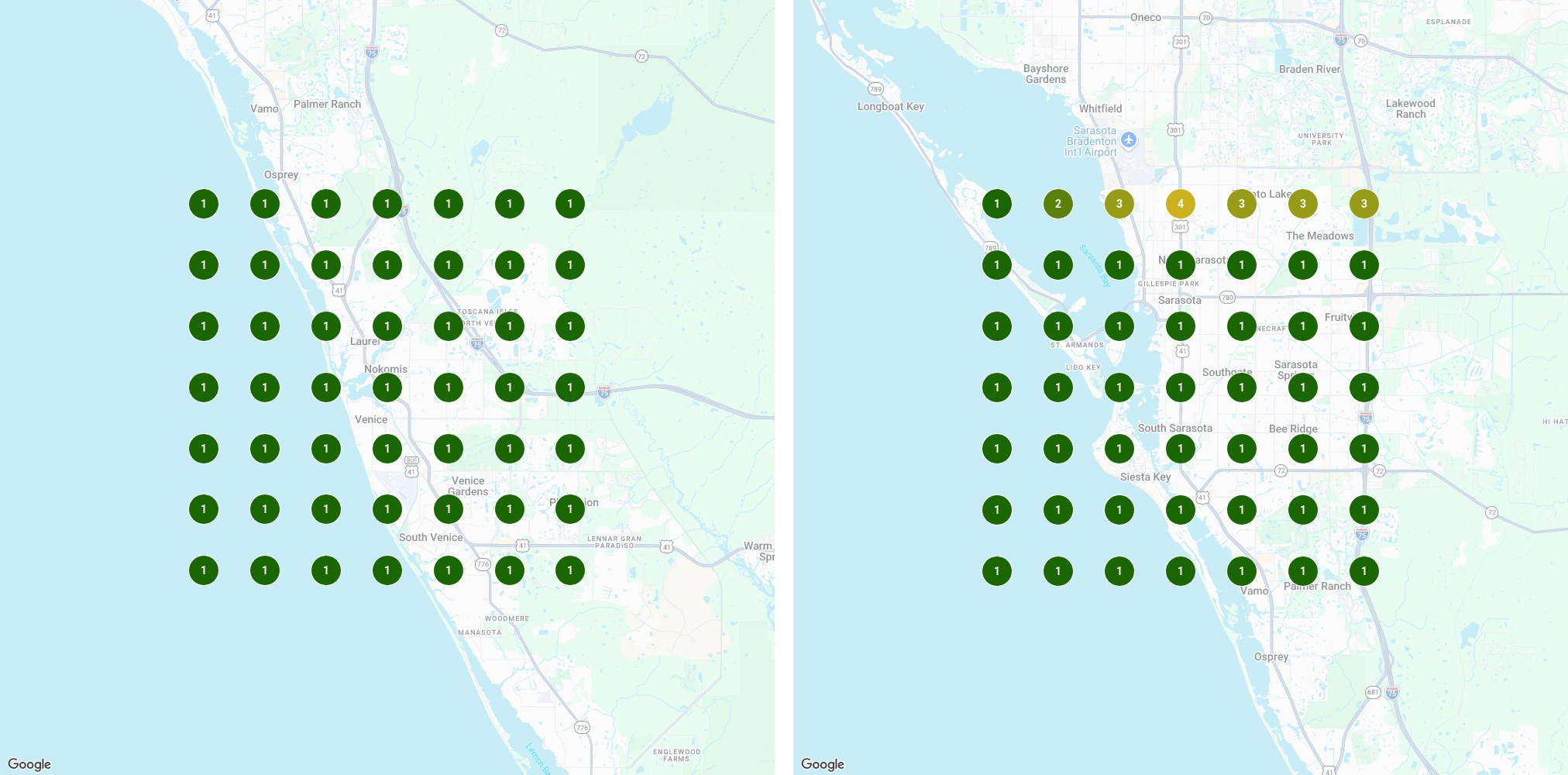

Two offices, each checked from 49 points around it, August 2026. Left: Venice Retina for “retina specialist,” first at every point. Right: Shane Retina’s South Sarasota office for “macular degeneration specialist,” in the top three at all but one point. Source: Local Falcon.
Checking the whole map also catches broken listings. If a location does not show up anywhere on the map, the cause is usually a problem with the listing itself, such as a lost verification or the wrong category, not the competition. Ranking work will not help until the listing is fixed.
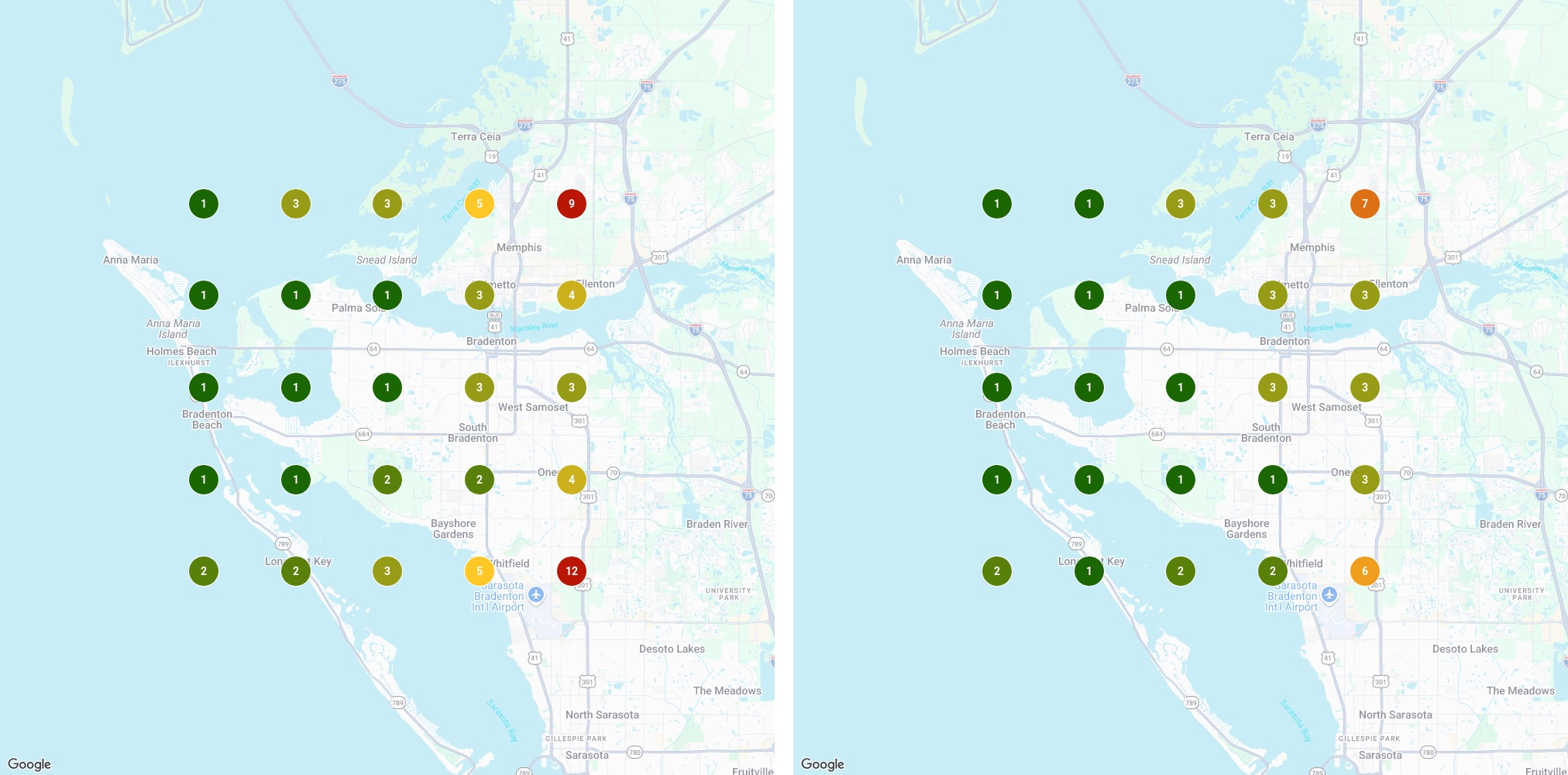
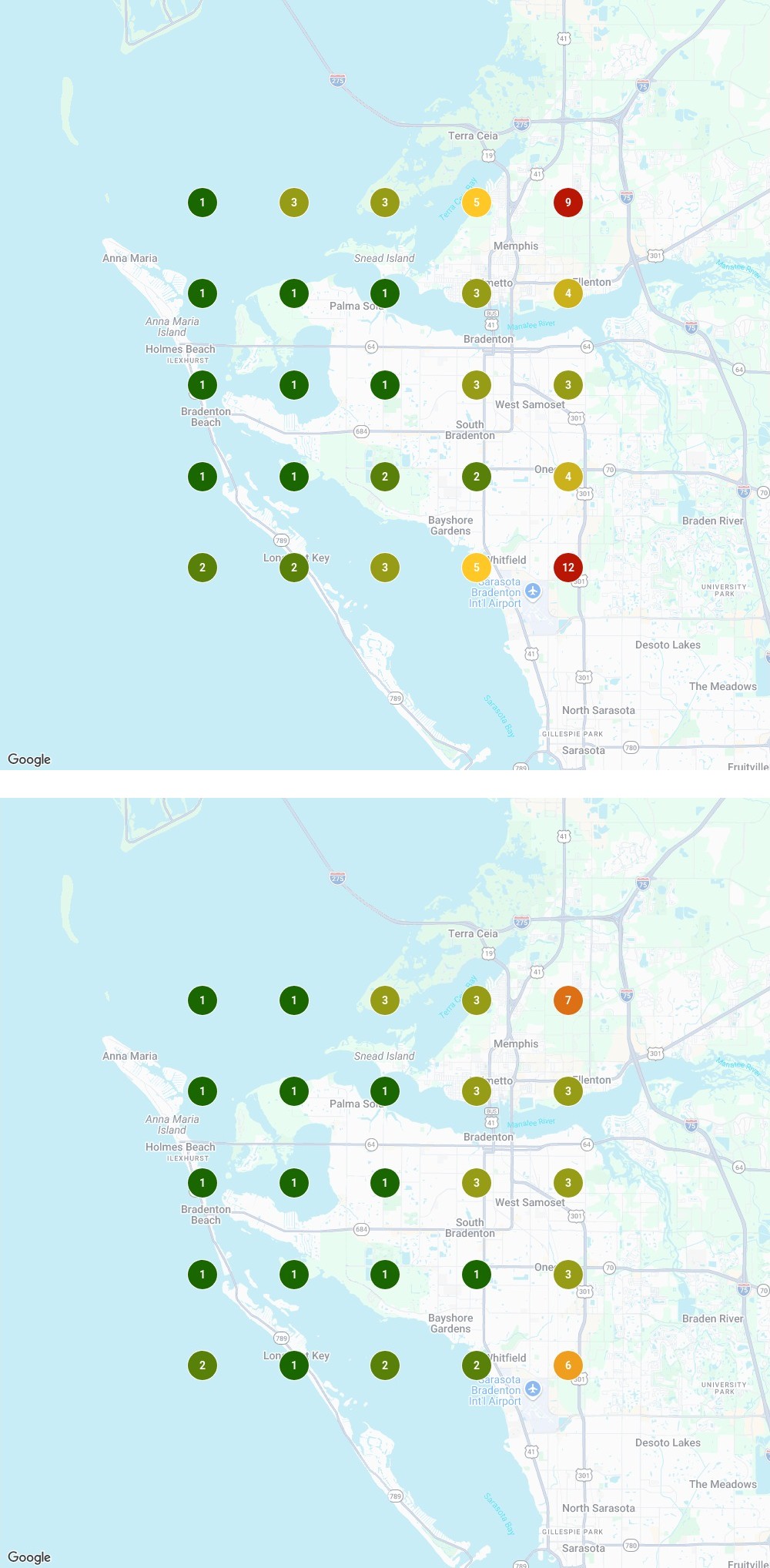
One office, two searches, the same day: Arsenault Dermatology’s West Bradenton office, June 2026. Left: “skin cancer screening,” in the top three at 19 of 25 points. Right: “pediatric dermatology,” in the top three at 23 of 25. Coverage differs by search as much as by place. Source: Local Falcon.
What Goes Wrong
Most local SEO problems are not about ranking. They are about something being broken, and nobody knowing.
Duplicate Listings
Two listings for the same business, splitting reviews and confusing Google about which is real. These accumulate over the years, often created by aggregators or by a staff member who set one up years ago.
Merged Listings
Google occasionally decides two of your locations are the same business and merges them, so two offices end up sharing one listing and one set of reviews. Untangling it means working the case through Google’s support process, and it takes persistence.
Unverified or Suspended Listings
A listing that has lost its verification quietly stops performing. So does one suspended for a guideline problem, sometimes one the business does not know it broke.
A Listing That Ranks Nowhere for Anything
When a location is invisible across every search and every month, the cause is almost never ranking. It is a listing problem: a verification issue, a category that does not exist for that search, a duplicate outranking it, or an address Google cannot place.
Stale Details
An old phone number, last year’s hours, a suite number that changed, a service you stopped offering, a provider who left.
Information You Did Not Write
Google adds details on its own, users suggest edits, and the questions section accumulates answers from strangers. Some of it is wrong, and a change you never made can sit on your listing for months. The only defense is monitoring: somebody checking the listing regularly so that changes get caught before they cost you customers.
The common thread is that none of these announce themselves. The business just quietly gets fewer calls. This is most of what ongoing local SEO actually is: somebody checking, every month, and catching things while they are small.
How You Know It Is Working
The clearest evidence of Google Maps SEO working is the map itself, checked the same way, month after month.
Because your ranking is different at every point around a location, the real measure is how much of the area you hold: the same points, the same searches, checked every month. When that grows, more of the people nearby who search are seeing you. The image below shows one office and one search, when tracking began and in August 2026.
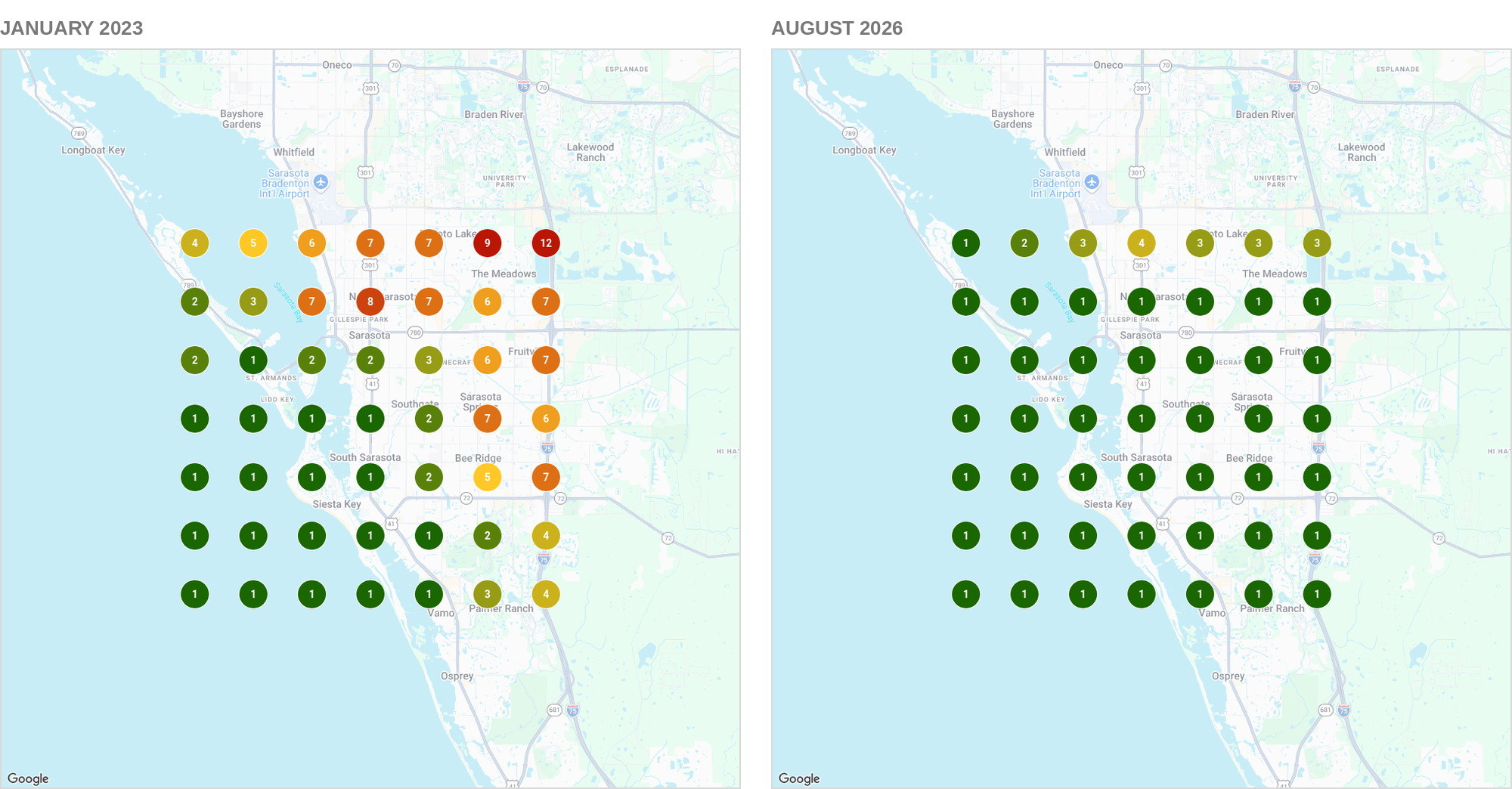

Shane Retina’s South Sarasota office, for “macular degeneration specialist,” January 2023 and August 2026. Each dot is a point I check around the office, and the number is where the practice ranked there. In the top three at about six in ten points at the start, and at all but one at the end. From the Shane and Venice Retina case study. Source: Local Falcon.
Google’s own listing numbers are the other half. For each listing you own, Google reports how many people saw it in search and on maps, how many called, and how many clicked through to the website. The line from those numbers to your front desk is short. I watch them for every listing.
I compare the same months a year apart, always. Most local businesses have a season. On Florida’s Gulf Coast the winter residents arrive in the fall and leave in the spring, and the phones move with them. Comparing this month to last month tells you about the calendar. Comparing this month to the same month last year tells you about the work.
Instead of a ranking report, you get a plain-language update every month. It tells you how things are going, what I worked on, and what I’m planning next. A single ranking number for a local search does not mean much, for the reason above.
“Now, we’re regularly hearing from clients who found us through Google searches and Google Maps. We’ve even had a handful of clients mention finding us through ChatGPT! This has been especially meaningful during a challenging time for the Maui wedding industry. While other local artists and teams have shared that business has been slower, we’ve continued to stay consistently busy. I truly believe our stronger online presence has played a big role in that.”
Nikki Quinn · Lead Stylist and Owner, Love and Beauty Maui
When Local SEO Is Not the Answer
Some businesses do not need local SEO.
Sometimes it is obvious. If nobody comes to you and you do not go to them, there is nothing for the map to show. A software company selling to customers across the country, a consultant who works entirely over video calls, an online store shipping from a warehouse nobody visits: for businesses like these, local search brings nobody, and the money belongs in ordinary search and content instead.
Sometimes it takes some thought. Local search matters less than you would expect in a few situations that look local from the outside:
When your customers are referred rather than choosing. Most radiology is physician-directed. The patient goes where the referral sends them and looks up the practice afterwards to confirm the address and form an impression. The listing still has to be right. It is doing validation, not discovery. Interventional radiology is the exception: patients research a procedure and choose where to have it, which is why Florida Radiology Consultants‘ procedure pages bring patients in from Google.
When the person choosing is not the person arriving. A compounding pharmacy like Medrock Pharmacy is chosen by the prescriber, and the patient follows.
When customers come from far away. If people travel hours to you for something specific, the map is a small part of your picture and your content is most of it. Optimal Health Institute of Ohio draws patients from across northeast Ohio, and its content does most of that work.
And sometimes it is not obvious at all. Then the right first step is a conversation about where your customers actually come from, which ones you want more of, and what you are trying to grow. The answer decides where the work should go.
Getting this wrong in either direction is expensive. Businesses that need local search and treat it as an afterthought lose the customers who were closest to buying. Businesses that do not need it can spend years optimizing for a map that was never going to bring them anyone.
Working out which one you are is the first conversation, not the fifth.
Local SEO for Medical Practices
Healthcare is where local search matters most, and where it is hardest. Local SEO for doctors and medical practices has rules of its own.
A patient searching for a specialist is usually searching close to a decision, often with some urgency, and almost always on a phone. The map is where that decision gets made. For many practices it is one of the largest sources of new patients who did not already know the practice existed.
What makes it harder than other industries:
There are listings for people as well as places. Every physician can have their own profile, and they can be created without the practice’s involvement, by data companies drawing on medical directories. They are frequently wrong.
The directory sites are formidable competitors. Health directories outrank individual practices for many searches by default. The map is one of the few places an independent practice competes on level terms.
Specialty language and patient language are different. Patients search for symptoms and plain descriptions. The listing and the pages behind it have to bridge both.
The competition is consolidating. Independent practices are increasingly competing with corporate groups that have marketing departments. Local search is one of the areas where care and attention still beat budget.
The practices I work with show what this looks like. Venice Retina comes up first on the map at every point checked around Venice for “retina specialist.” Search “black dermatologist tampa” and Skin Health Forever is the first map result and the first organic result. Arsenault Dermatology has a Google Business Profile and a location page for each of its seven offices.
The rest of the picture for medical practices, including the content, the provider pages, and how patients actually search, is on the Healthcare SEO page.
Related
SEO and content strategy
Search, local SEO, schema, and AI visibility.
Healthcare SEO
SEO for independent practices.
Schema and knowledge graphs
The code that tells machines who you are.
AI search optimization
Showing up in AI answers.
Local SEO in Denver
Local search for practices in the Denver area.
See my work
Case studies, and what happened after launch.
“Since we began working together, our new patient volume has doubled, and approximately half of our patients now come through online marketing. Josh has played a major role in that growth, helping us consistently outperform local competitors in online patient acquisition, including practices much larger than ours.
Josh also understands that a successful online marketing program requires coordination across multiple platforms. He works closely with our digital advertising team to ensure that our website, SEO, Google Business Profiles, and paid advertising efforts complement and reinforce one another. That integration has been enormously valuable to our growth.”
Dr. Thomas Shane · Ophthalmologist & Founder, Shane Retina
How the work happens
Start with what is actually true.
Whether you hire me as a local SEO consultant for one cleanup or for ongoing work, it starts with finding out what is actually true right now. I start with what exists: every listing under your name, including the ones you did not create, how your details are written across the web, and where you currently come up across the area you serve rather than at one convenient point.
That normally turns up something. A duplicate listing, a category that does not match what you do, an address written four ways, an office that is invisible for reasons nobody has looked into.
The broken things get fixed first, because they cost little to put right and they hold everything else back. Then the profiles get built out properly, then the pages behind them, then the listings elsewhere. Then it becomes a monthly rhythm: checking, correcting, adding, and watching the map.
None of this is fast, and all of it compounds.
Common questions
What people ask.
What is local SEO?
Local SEO is the work of making a business show up when somebody nearby searches for what it offers, most visibly in the map and the short list of businesses at the top of Google’s results. It covers three things: your Google Business Profile, your website, and everything written about your business elsewhere on the web, including directories and reviews. The goal is not to rank in general. It is to be one of the businesses shown to the people close enough to become customers, at the moment they are looking.
Why is local SEO important?
Local SEO matters because the people searching nearby are the closest to becoming customers. A search with a town or “near me” in it usually comes from someone deciding where to go, and Google answers it with a map and a short list of businesses. The businesses on that list get considered, and the rest mostly do not. Local SEO is how you get on that list and stay there, for the searches that matter to your business.
How is local SEO different from regular SEO?
Regular SEO ranks web pages, and local SEO ranks businesses. Local search uses a different set of signals: how close the business is to the person searching, how complete and accurate its Google Business Profile is, its reviews, and how consistently it appears across other websites. The two are related, because your ordinary search presence feeds how prominent your business looks, but a business can rank well in ordinary results and be invisible on the map, and the reverse happens too.
How does local SEO work?
Google chooses local results on three factors it names itself: relevance, distance, and prominence. Relevance is how well your business matches the search, and it comes mostly from your categories, your listed services, and what your website says. Distance is how far you are from the person searching, and you cannot change it. Prominence is how well known and well regarded your business is, and it comes from reviews, mentions on other websites, and your ordinary search standing. Local SEO is the work of making relevance and prominence as strong as they can be, and putting a real page and a real listing behind every place you serve.
What are local citations?
A local citation is any mention of your business name, address, and phone number on another website. Directories, professional associations, review sites, industry listings, and the data companies that feed them all count. Citations matter because consistent details across many sources give search engines confidence that your business is real and that its details are correct. Some are needed by every business, such as Google, Apple, Bing, Yelp, and Facebook. Others are specific to your industry, such as the medical directories for a practice or the wedding directories for a wedding vendor.
Does my Google Business Profile matter more than my website?
Your Google Business Profile is what most people see first, but it cannot rank properly without your website behind it. Google reads the website to decide whether the profile deserves to show for a search, so the two feed each other. The profile is where people read the hours, look at the photographs, scan the reviews, and call. The website is where they go when the listing has convinced them to look closer, and it is a large part of what decides whether the listing ranks at all.
How long does local SEO take?
Local SEO usually shows results faster than ordinary SEO. Fixing something broken can show within weeks, and building real standing across an area takes months. Holding that standing is ongoing, because map rankings are relative: if a competitor stops working on theirs, you gain, and if you stop, the reverse happens.
How much does local SEO cost?
The cost depends on how many locations you have, what shape they are in, and how competitive your area is, so I do not put a price on the site. Ongoing local SEO usually runs on a monthly retainer. Pricing comes after we have talked about your business and what you want to grow.
Does local SEO help me show up in AI search?
Yes. When an AI answer recommends a nearby business, it draws on the same material local SEO builds: an accurate Google Business Profile, consistent listings, real reviews, and a website that says clearly who you are and where. Searches with a place name or “near me” in them are also the ones that still mostly return a map rather than an AI answer, so local search is one of the more protected places to be found. The businesses that are easy to understand are the ones that get named. There is more on how AI search actually works on the AI search optimization page.
Can you do local SEO if I already have someone doing my website?
Yes. Much of local SEO happens outside the website, on your Google Business Profile and across the directories and listings that mention you. Where changes are needed on the site, such as a page for each location or the address marked up in code, I can either make them or hand your developer a specific list.
Do you do local SEO for businesses in Denver?
Yes. I am based in Denver, and local search here works the way it does everywhere: the map decides most of it, and the profile, the listings, the reviews, and the pages behind them decide the map. There is more on what I do for businesses here on the Denver page.
What if my listing has been suspended?
A suspended Google Business Profile can usually be recovered, and the first step is working out what triggered it. Often it is something innocent, such as an address change or an edit that looked like a guideline violation. Recovery means correcting the cause and working the case through Google’s process until it is actually resolved. I have done this for a client, and it took persistence rather than a trick.
Do you guarantee I will be in the top three?
No, and nobody can. Distance is one of the three factors Google uses and it cannot be changed, so no one can promise a position for every search in every part of your area. What I will tell you is where you stand now, what is realistic, and what it will take to get there.

Ready to get started?
If you want more of the people nearby to find you first, I can help.
Tell me about your business and where your customers come from, and we’ll both get a sense of whether we’re the right match.